
Who Needs ECT Treatment in Hyderabad? Benefits, Procedure & Recovery Explained | Bharosa Hospitals
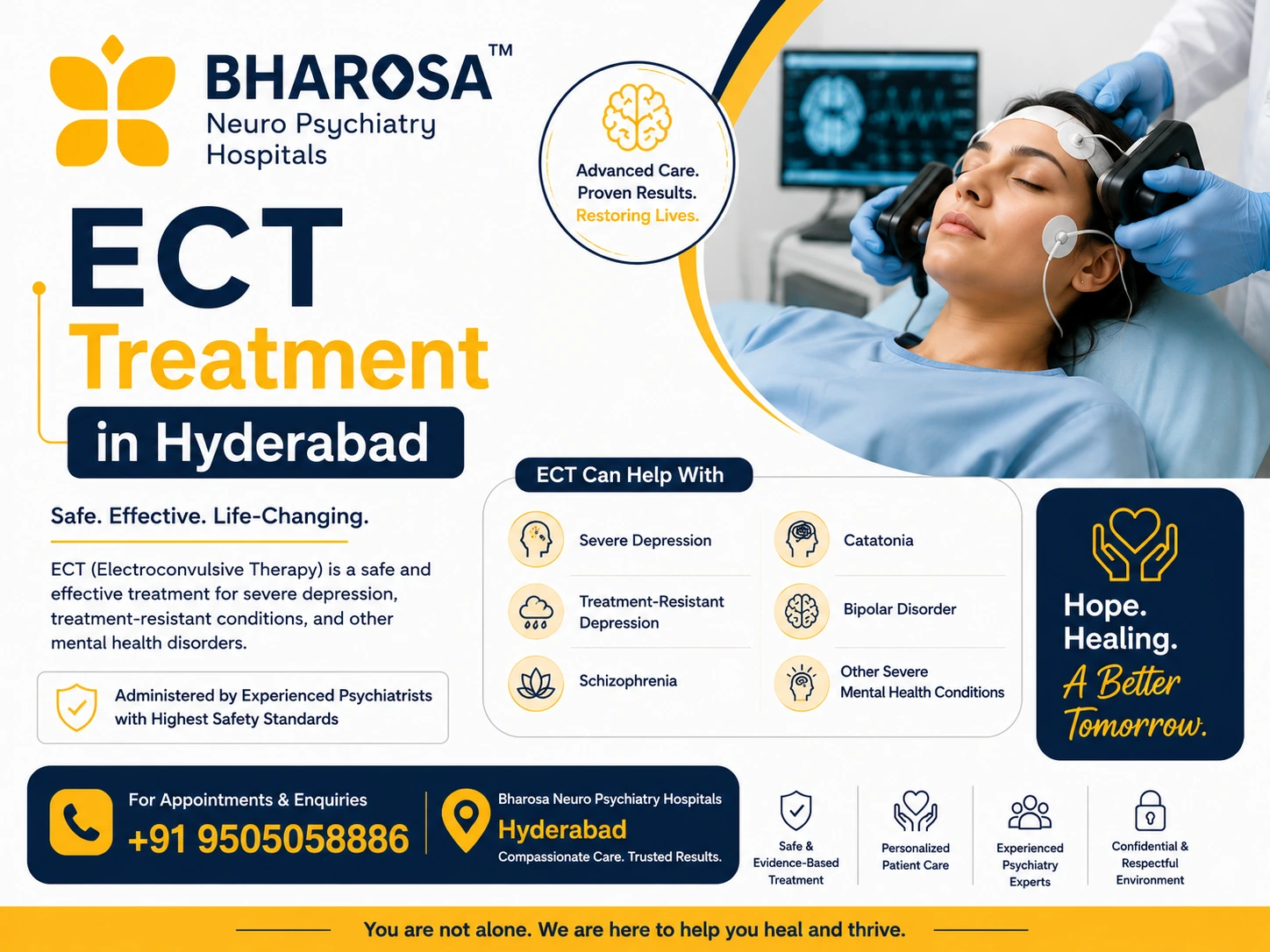
Of all the treatments in psychiatry, Electroconvulsive Therapy (ECT) is perhaps the most misunderstood — and the most underutilised as a result of that misunderstanding. Thanks largely to its portrayal in historical films and literature, ECT carries a stigma that has prevented countless patients from accessing a treatment that could dramatically change — and in some cases save — their lives. The reality of modern ECT Treatment in Hyderabad at Bharosa Neuro Psychiatry Hospital is entirely different from these outdated depictions: it is a safe, precisely administered, medically supervised procedure conducted under general anaesthesia that consistently produces some of the most dramatic and rapid improvements in severe psychiatric conditions available anywhere in clinical medicine.
This blog answers the three most important questions about ECT: Who genuinely needs it? What are its proven benefits? And what does the procedure and recovery process actually look like at Bharosa Hospitals?
Clinical Evidence: ECT produces antidepressant response rates of 70–90% in severe, treatment-resistant depression — the highest response rate of any treatment in psychiatry. For many patients, ECT is not the last resort but the fastest and most effective route to recovery. (American Psychiatric Association, 2023)
Who Needs ECT Treatment in Hyderabad? The Clinical Indications
Understanding the specific clinical situations where ECT Treatment in Hyderabad is indicated helps patients and families make informed decisions about this powerful treatment option. ECT is recommended by international psychiatric guidelines (American Psychiatric Association, Royal College of Psychiatrists, NIMHANS) for:
1. Severe, Treatment-Resistant Major Depressive Disorder
The most common and evidence-supported indication for ECT is major depressive disorder that has not responded adequately to two or more antidepressant medication trials at therapeutic doses — so-called treatment-resistant depression (TRD). Approximately 30–40% of patients with depression do not achieve remission with standard medication, and for this population, ECT is not a 'last resort' but rather the most effective treatment available.
Patients with treatment-resistant depression who choose ECT avoid the months or years of further medication trials, each with their own side effect profile and uncertain effectiveness, and instead access a treatment that produces response in the majority of cases within 3–4 weeks.
2. Depression with Imminent Suicidal Risk
When a patient is actively suicidal — with intent, plan, and means, or following a serious suicide attempt — the standard 4–12 week timeline required for antidepressant medication to take effect is clinically unacceptable. ECT produces significant antidepressant effect within 1–2 weeks, making it the treatment of choice when rapid response is medically urgent. ECT can literally be life-saving in acute suicidal crisis.
3. Psychotic Depression
Depression accompanied by psychotic features — hallucinations (hearing voices), delusions (fixed false beliefs), or severe cognitive disorganisation — is one of the most severe and dangerous psychiatric presentations. International guidelines recommend ECT as a first-line treatment for psychotic depression, producing superior outcomes to the combination of antidepressant plus antipsychotic medication alone.
4. Severe Bipolar Depression
The depressive phase of bipolar disorder can be profoundly severe, prolonged, and resistant to mood stabiliser-based pharmacological treatment. For severe bipolar depression — particularly when psychotic features are present, suicidal risk is high, or multiple medication trials have failed — ECT provides effective, rapid mood improvement without the risk of antidepressant-induced mood switching that makes pharmacological treatment of bipolar depression particularly complex.
5. Catatonia
Catatonia — a state of unresponsiveness, muscular rigidity, mutism, or extreme behavioural agitation that can occur in severe depression, bipolar disorder, schizophrenia, and medical conditions — is one of the most dramatic and rapidly effective ECT indications. ECT's effect in catatonia can be near-immediate, with some patients showing remarkable improvement after just one or two sessions. When benzodiazepine treatment for catatonia is ineffective or insufficient, ECT is the recommended next step.
6. Severe Manic Episodes Unresponsive to Medication
Acute mania that is not adequately controlled by mood stabilisers and antipsychotics — particularly when it poses serious safety risks to the patient or others — can be effectively treated with ECT. ECT's rapid mood-stabilising effect is valuable in severe mania where medication is taking too long or producing insufficient response.
7. Pregnancy — When Medication Safety Is a Concern
Depression during pregnancy can be severe and debilitating, yet antidepressant medications carry potential risks to the foetus that some patients and obstetricians wish to avoid. ECT has been used safely in pregnancy, with appropriate precautions, and may be recommended when the severity of maternal depression outweighs the managed risks of the procedure.
8. Medical Frailty — When Medication Side Effects Are Too Risky
Elderly patients and those with significant cardiovascular, hepatic, or renal disease may not be able to safely tolerate antidepressant medications at therapeutic doses. ECT — while requiring anaesthesia — may paradoxically be safer than medication in these populations, as its systemic side effects are more predictable and manageable than those of long-term pharmacotherapy.
The ECT Procedure at Bharosa: Step by Step
Understanding exactly what happens during ECT Treatment in Hyderabad at Bharosa removes fear and enables informed consent:
Pre-ECT Preparation
- Comprehensive pre-ECT workup: Full blood count, metabolic panel, ECG, chest X-ray, and detailed anaesthetic fitness assessment
- Medication review: Certain medications are adjusted or withheld before ECT as per anaesthetic protocol — our team manages this carefully
- Informed consent discussion: A thorough, jargon-free explanation of the procedure, expected benefits, risks, alternatives, and the course of treatment — with time for all questions to be answered
- Fasting: Patients fast for 6–8 hours before each ECT session to ensure anaesthetic safety
- Patient and family preparation: Clear written information provided, specific instructions for the day of treatment, and contact details for any pre-treatment questions
On the Day of ECT
- The patient arrives at Bharosa's ECT suite, which is equipped with full anaesthetic monitoring and emergency equipment
- An intravenous cannula is placed and monitoring equipment attached — ECG leads, pulse oximeter, blood pressure cuff, and EEG electrodes on the scalp
- Dr. Rajesh Kumar R (DNB Anaesthesia, IDCCM) — Bharosa's dedicated ECT anaesthetist — administers general anaesthesia: the patient loses consciousness within seconds
- A short-acting muscle relaxant is administered immediately after anaesthetic induction — all muscular activity is completely blocked, so no convulsive body movements occur
- ECT electrodes are positioned precisely on the scalp — right unilateral (RUL), bilateral, or bifrontal placement depending on clinical indication and response
- The ECT device delivers a brief, precisely calibrated electrical pulse — the brain experiences a controlled, therapeutic seizure lasting 20–50 seconds while the patient remains completely unconscious and motionless
- The total time from anaesthetic induction to awakening is approximately 15–20 minutes
Immediately After ECT
- The patient awakens in the recovery area under continuous nursing monitoring — typically within 5–15 minutes of the session ending
- Mild, temporary side effects — headache, muscle ache, or brief confusion — are managed with appropriate medications in recovery
- Most patients are alert, oriented, and able to eat and drink within 30–60 minutes of the session
- A responsible adult must accompany the patient home after each session — driving is not permitted on ECT treatment days
ECT Treatment Course and Frequency
A standard acute ECT course at Bharosa consists of 6–12 sessions delivered 2–3 times per week over 3–6 weeks. Response is assessed carefully after each session using validated rating scales, and the treating psychiatrist determines the total number of sessions based on clinical response, tolerability, and the nature of the condition being treated.
Some patients show dramatic improvement within 3–4 sessions; others require the full course. The decision to continue or conclude the ECT course is made collaboratively between the patient, family, and psychiatric team based on regular, objective assessment of response.
Recovery from ECT: What to Expect
Immediate Post-Session Recovery (Hours)
Most patients feel groggy, mildly confused, or headachy immediately after each ECT session — these effects are temporary, typically resolving within 1–4 hours. Some patients experience short-term memory difficulties for events immediately before and after each session. Adequate rest on the day of treatment is recommended.
During the Treatment Course (Weeks)
During the active ECT course, the most commonly reported side effect is short-term memory difficulty — particularly difficulty forming new memories (anterograde amnesia) and recalling events from around the time of treatment (retrograde amnesia for the recent past). These effects are temporary and related to the course of treatment. Most patients experience these as mild and manageable; for some they are more noticeable.
The psychiatric improvement during the course — lifting of depressive mood, reduction in suicidal thinking, return of motivation and energy — is typically experienced as far more significant and positive than the temporary memory side effects by the majority of patients.
After the ECT Course Is Complete (Months)
Post-course memory effects typically resolve fully within 2–6 weeks of completing the ECT course for the majority of patients. Cognitive function — including memory, concentration, and decision-making — typically improves markedly above pre-treatment baseline as the severe depression (which itself profoundly impairs cognition) resolves.
Long-term follow-up studies consistently show that completed ECT Treatment in Hyderabad courses do not cause lasting cognitive impairment, reduction in intelligence, or structural brain damage — evidence that should provide significant reassurance to patients and families considering this treatment.
Maintenance ECT: Protecting Long-Term Recovery
For patients who have achieved remission through ECT but have a history of frequent relapse — particularly those who have relapsed during medication maintenance in the past — maintenance ECT (typically monthly sessions) is an evidence-based strategy for preventing relapse and protecting long-term recovery. Maintenance ECT is offered at Bharosa for appropriate patients, allowing them to maintain the gains of the acute course over the long term.
ECT is not a treatment of the past — it is one of psychiatry's most powerful, most evidence-based, and most consistently effective interventions, with a safety profile that is well-characterised and a response rate that no antidepressant medication can match. For the patients who truly need it, ECT Treatment in Hyderabad at Bharosa Hospitals is not something to fear. It is a lifeline — a rapid, effective, medically safe path to recovery when other treatments have not provided the relief that every patient suffering from severe psychiatric illness deserves.
Call Now for an ECT Consultation: +91 9505058886
Frequently Asked Questions (FAQs)
Q: Is ECT Treatment in Hyderabad at Bharosa safe?
A: Yes. Modern ECT at Bharosa is performed under full general anaesthesia with complete muscle relaxation, continuous vital sign monitoring, and emergency equipment immediately available. The mortality rate of ECT is approximately 1 in 10,000 procedures — comparable to minor elective surgery. Comprehensive pre-ECT medical screening identifies and manages any individual risk factors before treatment begins.
Q: Will ECT permanently damage my memory or brain?
A: No. Decades of long-term follow-up research consistently demonstrate that ECT does not cause permanent brain damage, lasting cognitive impairment, or reduction in intelligence. Temporary memory effects during and immediately after the treatment course typically resolve fully within 2–6 weeks of completing ECT. Many patients report that their memory and thinking improve markedly above pre-treatment baseline as their severe depression resolves.
Q: How is modern ECT different from what I have seen in old films?
A: Modern ECT bears almost no resemblance to its historical or cinematic depictions. Today, ECT is administered under complete general anaesthesia (the patient is fully unconscious), with full muscle relaxation (no convulsive movements occur), using precisely calibrated, brief electrical pulses (not the crude instruments of the past), with continuous medical monitoring throughout, and conducted in a purpose-built clinical suite by specialist medical staff.
Q: How quickly does ECT produce results?
A: Most patients begin to notice meaningful improvement in mood, suicidal thinking, or psychotic symptoms within the first 3–6 sessions (1–2 weeks of treatment). Full response typically develops over the complete course of 6–12 sessions. ECT is one of the fastest-acting treatments in psychiatry — significantly faster than antidepressant medications.
Q: Can ECT be used alongside medication?
A: Yes. ECT is most often used alongside carefully managed psychiatric medications — antidepressants, mood stabilisers, or antipsychotics as appropriate to the diagnosis. Certain medications are adjusted before ECT sessions for safety reasons, as managed by our anaesthetic and psychiatric team. After the ECT course, medication is continued or optimised to protect against relapse.
Q: How do I arrange an ECT assessment at Bharosa Hospitals?
A: Call or WhatsApp +91 9505058886 at any time — including for urgent assessments when ECT is needed rapidly for a suicidal or acutely unwell patient. You can also visit our hospital at Plot No. 114, Mythripuram, Karmanghat, Opposite TKR College Comman, LB Nagar, Hyderabad – 500079. Our psychiatric team will conduct a thorough assessment and discuss ECT openly and honestly as one treatment option among several available at Bharosa.
Hospital Address & Contact
Bharosa Neuro Psychiatry Hospital & Rehabilitation Center
Plot No. 114, Mythripuram, Karmanghat, Opposite TKR College Comman (TKR Kamaan),Main Road, LB Nagar / Karmanghat, Hyderabad – 500079, Telangana, India
Phone / WhatsApp: +91 9505058886