
Repetitive Thoughts and Behaviors: When to Seek OCD Treatment in Hyderabad
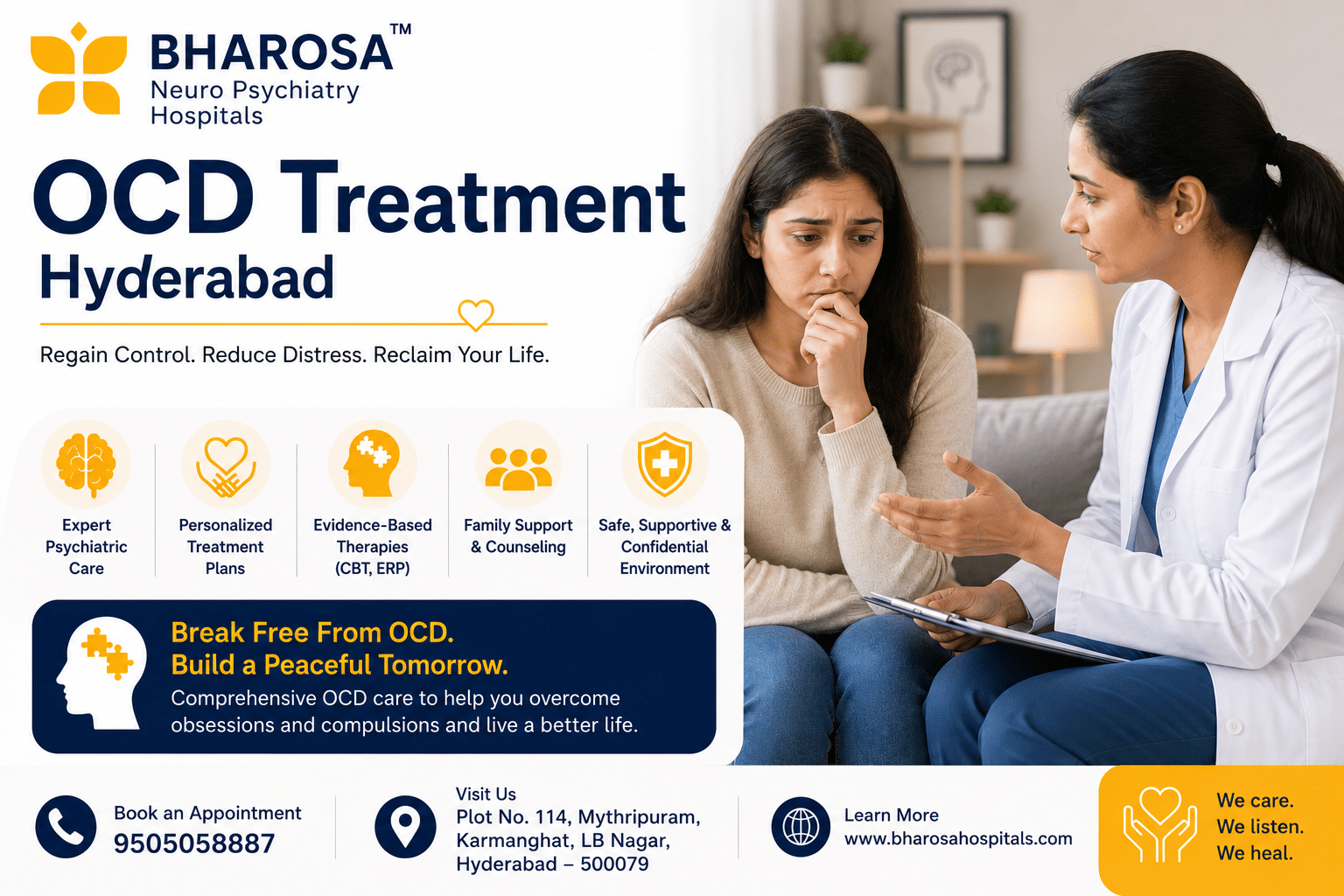
Repetitive thoughts are universal. Everyone has experienced a song stuck in their head, a worry that returns despite efforts to dismiss it, or a nagging sense that they may have left the door unlocked. These are normal experiences — and they pass. But for individuals living with Obsessive Compulsive Disorder, repetitive thoughts do not pass. They return with relentless, escalating urgency, demanding rituals, reassurance, or avoidance before they will relent — temporarily — only to return again. This cycle can consume hours of every day and fundamentally destroy quality of life. At Bharosa Neuro Psychiatry Hospital, we provide the most comprehensive OCD treatment in Hyderabad has available — including gold-standard Exposure and Response Prevention therapy, evidence-based medication management, and specialist care for all OCD subtypes. This blog will help you understand when repetitive thoughts and behaviours have crossed the clinical threshold that requires professional treatment.
Understanding OCD: The Obsession–Compulsion Engine
OCD operates through a specific, self-perpetuating mechanism: an intrusive, unwanted thought (obsession) generates acute distress, which drives a behavioural or mental response (compulsion) that provides temporary relief, which reinforces the obsession's authority, which generates the next intrusive thought. Without OCD treatment in Hyderabad, this engine runs continuously — and with time, it typically accelerates, involving more obsessions, more elaborate compulsions, and more of daily life consumed by the cycle.
When Repetitive Thoughts Become OCD
The clinical threshold for OCD — the point at which repetitive thoughts require professional OCD treatment — is defined by three criteria:
- The thoughts or behavioural patterns consume more than one hour per day
- They cause significant distress
- They meaningfully impair daily functioning — at work, in relationships, or in self-care
If all three criteria are met, OCD treatment in Hyderabad at Bharosa Hospitals is strongly indicated. But you do not need to wait until you are at crisis level — earlier intervention consistently produces better, faster outcomes.
The Most Common Repetitive Thought Patterns in OCD
One of the most important functions of OCD treatment Hyderabad assessment is helping patients recognise that their specific thoughts — however distressing or embarrassing — are recognised patterns of OCD, not unique evidence of personal danger or moral failing. Common OCD thought themes include:
Contamination Obsessions
Persistent, distressing thoughts about contamination — from germs, dirt, illness, chemicals, or bodily fluids — that drive compulsive washing, cleaning, or avoidance of touched surfaces. The compulsions provide temporary relief, but the anxiety returns — often requiring more elaborate or time-consuming rituals each time.
Harm Obsessions
Unwanted, intrusive thoughts about causing harm to oneself or loved ones — through action, negligence, or accident. These thoughts are not desires — they are precisely the opposite. They cause immense distress in a person who would never act on them, which is a defining feature of OCD rather than genuine intent. Many patients with harm obsessions delay treatment for years due to shame, not understanding that their thoughts are OCD.
Symmetry and Ordering Compulsions
An intense, anxiety-generating need for objects, actions, or arrangements to be 'just right' — perfectly symmetrical, in a specific order, or completed a precise number of times. The distress generated when things are 'not right' is genuine and overwhelming, and the relief provided by ordering and arranging is temporary, requiring repetition.
Religious and Moral Obsessions (Scrupulosity)
Persistent doubts about whether one has sinned, violated moral codes, or committed sacrilege — driving repetitive prayer, confession, mental reviewing, or avoidance of religious content. Scrupulosity is particularly common in religious communities and is frequently misidentified as excessive religious devotion rather than recognised as OCD.
Relationship OCD
Relentless doubt about the authenticity or quality of romantic relationships — 'Do I really love my partner?', 'Are they the right person?', 'Am I attracted to someone else?' — driving constant reassurance-seeking, mental reviewing, or avoidance of intimacy. Relationship OCD can destroy genuine relationships and is highly treatable with specialist OCD therapy.
Pure Obsessional OCD ('Pure O')
OCD without visible compulsions — where the compulsions are entirely mental (reviewing, praying, replaying, neutralising) rather than behavioural — is frequently unrecognised and untreated because it does not 'look like OCD'. Bharosa Hospitals' OCD treatment in Hyderabad specialists are specifically trained in identifying and treating Pure O using adapted ERP and cognitive therapy techniques.
When the Compulsions Are Taking Over Your Day
The decision to seek OCD treatment Hyderabad becomes urgent when compulsions are consuming 2 or more hours daily, when avoidance has significantly restricted your activities, when family members are being drawn into rituals or reassurance-giving, or when your quality of life has deteriorated substantially. At Bharosa Hospitals, our OCD specialists will conduct a comprehensive assessment using the Yale-Brown Obsessive Compulsive Scale (Y-BOCS) to quantify severity and design the most effective treatment plan.
Frequently Asked Questions
Q: How do I know if my checking, cleaning, or worrying is OCD or just being careful?
A: The key distinctions are: the time consumed (more than one hour per day), the level of distress caused, the difficulty stopping despite wanting to, and the impact on daily functioning. Careful people check once and feel reassured. OCD checking provides only temporary relief before the doubt returns. If you recognise this pattern, consult an OCD specialist.
Q: Is ERP therapy painful or frightening?
A: ERP involves facing feared thoughts or situations without performing compulsions — which initially increases anxiety. This anxiety is temporary, and it is precisely the therapeutic mechanism. Bharosa Hospitals' therapists design ERP programmes gradually and collaboratively, starting at a level of challenge that is difficult but manageable, and building progressively. Most patients describe the process as challenging but enormously liberating.
Q: How many ERP sessions will I need for OCD treatment at Bharosa Hospitals?
A: Most patients with OCD see significant improvement within 16 to 24 ERP sessions. Severe or complex OCD may require longer. Gains from ERP continue to build beyond the active treatment phase as the brain consolidates new response patterns and the patient applies skills in daily life.
Q: Can OCD worsen if untreated?
A: Yes. OCD typically worsens progressively without treatment — obsessions proliferate to new themes, compulsions become more elaborate and time-consuming, and avoidance expands to restrict more of daily life. Early OCD treatment Hyderabad intervention is consistently more effective and requires less intensive treatment than treating entrenched, long-standing OCD.
Q: Does Bharosa treat OCD that has not responded to previous therapy or medication?
A: Yes. Bharosa Hospitals has experience treating complex, treatment-resistant OCD using adapted ERP protocols, combination pharmacotherapy, and specialist cognitive approaches. If you have not responded adequately to previous treatment elsewhere, a fresh assessment at Bharosa Hospitals may identify approaches that have not yet been tried.
Bharosa Neuro Psychiatry Hospital & Rehabilitation Center
Plot No. 114, Mythripuram, Karmanghat, LB Nagar, Hyderabad – 500079
Opp. TKR College, Main Road, LB Nagar / Karmanghat, Hyderabad
+91 95050 58887 | www.bharosahospitals.com