
Understanding Mood Swings and Bipolar Disorder Symptoms
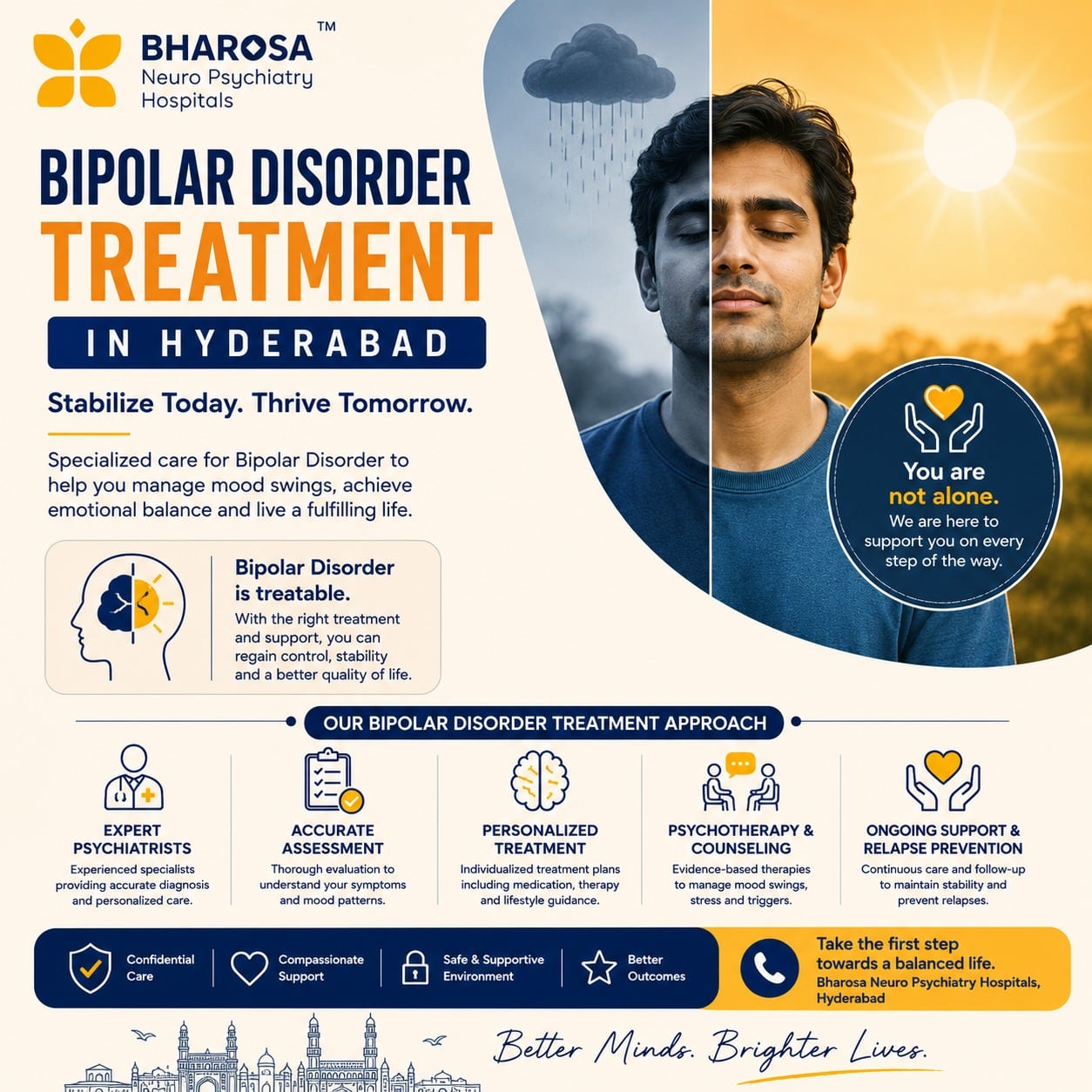
Everyone experiences mood variation. Life brings joy and disappointment, enthusiasm and fatigue, confidence and self-doubt. These fluctuations are part of the human experience — not a disorder. But bipolar disorder is something categorically different: a neurobiological condition characterised by distinct episodes of mania and depression that are disproportionate in intensity, prolonged in duration, and profoundly disruptive to every area of life.
Understanding the difference between ordinary mood swings and clinical bipolar disorder is essential — because misidentification in either direction carries serious consequences. Dismissing bipolar disorder as 'just mood swings' delays treatment and allows devastating episodes to accumulate. Diagnosing ordinary mood variation as bipolar disorder leads to unnecessary medication. The answer is accurate assessment by an experienced specialist — and access to expert Bipolar Disorder Treatment Hyderabad that is based on clinical precision, not approximation.
Normal Mood Swings vs Bipolar Disorder: The Key Differences
Four dimensions distinguish normal emotional variation from the mood episodes of bipolar disorder, and understanding them is the first step toward seeking the right Bipolar Disorder Treatment Hyderabad provides:
Duration
Normal mood variations last hours to a day or two. Bipolar mood episodes last days to weeks — a full manic episode must last at least 7 days to meet diagnostic criteria, and depressive episodes at least 2 weeks. The persistence of a mood state far beyond its situational context is one of the most telling indicators of a bipolar episode.
Intensity
Normal moods — even at their most elevated or most low — remain within a range that preserves the person's basic functioning. Bipolar episodes are characterised by intensities that overwhelm normal functioning: a manic person may go 5 days without sleep, spend their family's savings in a single day, or experience such racing thoughts that they cannot hold a coherent conversation. A bipolar depressive episode may produce such profound immobilisation that the person cannot leave their bed for weeks.
Trigger Proportionality
Normal mood variation is typically linked to life circumstances — good news lifts mood, bad news lowers it, and proportionately. Bipolar episodes frequently arise with minimal or no identifiable trigger, following their own internal neurobiological logic. A person with bipolar disorder may enter a manic episode during an objectively stable period of their life, or plunge into depression despite seemingly positive circumstances.
Functional Impact
Normal mood variation does not significantly impair daily functioning. Bipolar episodes, by definition, cause significant impairment — in work performance, financial management, relationships, parenting, and self-care. This functional dimension is central to the clinical diagnosis.
Recognising Mania: More Than Just a Good Mood
Mania is frequently misunderstood as simply feeling very happy. In reality, a manic episode is a neurological state characterised by a cluster of specific symptoms that are central to the diagnosis and management of Bipolar Disorder Treatment Hyderabad:
- Elevated, expansive, or irritable mood — often all three in alternation
- Dramatically reduced need for sleep — feeling fully rested after 2 to 3 hours
- Racing thoughts and pressured speech — talking rapidly and switching topics
- Inflated self-esteem or grandiosity — unrealistic beliefs about abilities or importance
- Increased goal-directed activity — starting multiple projects simultaneously
- Reckless, impulsive behaviour — excessive spending, risky sexual behaviour, unwise investments
- In severe cases: psychotic features including hallucinations and delusions
Recognising Bipolar Depression: Distinct from Unipolar Depression
The depressive phase of bipolar disorder is clinically distinct from ordinary depression in several important ways. Bipolar depression tends to feature more hypersomnia (sleeping excessively) than insomnia, more psychomotor retardation (slowing of movement and speech), more pronounced anhedonia, a greater risk of psychotic features, and a higher risk of suicidal ideation. Critically, prescribing standard antidepressants for bipolar depression without mood stabilisation can trigger a manic episode — making accurate diagnosis essential before any pharmacological treatment begins.
The Danger of Misdiagnosis
Research shows that the average time from first bipolar symptoms to correct diagnosis is 6 to 10 years — during which many patients are misdiagnosed with unipolar depression, ADHD, personality disorder, or anxiety disorder and receive treatments that are at best ineffective and at worst harmful. Expert Bipolar Disorder Treatment Hyderabad at Bharosa Hospitals begins with diagnostic precision — using structured clinical interviews, mood charting, family history, and longitudinal assessment — to ensure that every patient receives a diagnosis they can build their recovery upon.
Frequently Asked Questions
Q: How do I tell my family that I think I have bipolar disorder when they see it as just mood swings?
A: This is one of the most common challenges families face. Sharing concrete examples of how your mood episodes differ in duration, intensity, and impact from ordinary mood variation can help. Bringing a family member to a consultation at Bharosa Hospitals allows our psychiatrists to explain the clinical picture in terms that families can understand and accept.
Q: Can bipolar disorder begin in childhood or adolescence?
A: Yes. Bipolar disorder frequently has its first onset in late adolescence — typically between 15 and 25 years of age. Early-onset bipolar disorder can be particularly difficult to recognise as it often presents differently from adult bipolar, with more irritability, mixed states, and rapid cycling. Bharosa Hospitals' Child Psychiatry team has specific expertise in adolescent bipolar disorder.
Q: Is bipolar disorder genetic? Should my children be tested?
A: Bipolar disorder has a significant genetic component. First-degree relatives of a person with bipolar disorder have an elevated lifetime risk. However, genetic predisposition does not determine outcome — early recognition and good mental health support can significantly reduce the impact even for those with genetic vulnerability. Bharosa Hospitals can advise on monitoring and early intervention for at-risk family members.
Q: Can I live a normal life with bipolar disorder treatment?
A: Yes. With appropriate bipolar disorder treatment Hyderabad at Bharosa Hospitals — combining mood stabilisation, psychotherapy, lifestyle management, and family support — many patients achieve sustained remission and live full, functional, meaningful lives including careers, families, and personal fulfilment.
Q: What is the difference between Bipolar I and Bipolar II disorder?
A: Bipolar I involves full manic episodes — at least 7 days in duration, often requiring hospitalisation. Bipolar II involves hypomanic episodes — less severe than full mania, not requiring hospitalisation — alternating with major depressive episodes. Both require professional treatment, and the distinction significantly influences the medication approach.
Visit Bharosa Hospitals
Bharosa Neuro Psychiatry Hospital & Rehabilitation Center
Plot No. 114, Mythripuram, Karmanghat, LB Nagar, Hyderabad – 500079
Opp. TKR College, Main Road, LB Nagar / Karmanghat, Hyderabad
+91 95050 58887 | www.bharosahospitals.com