
Stress Management Hyderabad: Practical Strategies for Everyday Life | Bharosa Hospitals
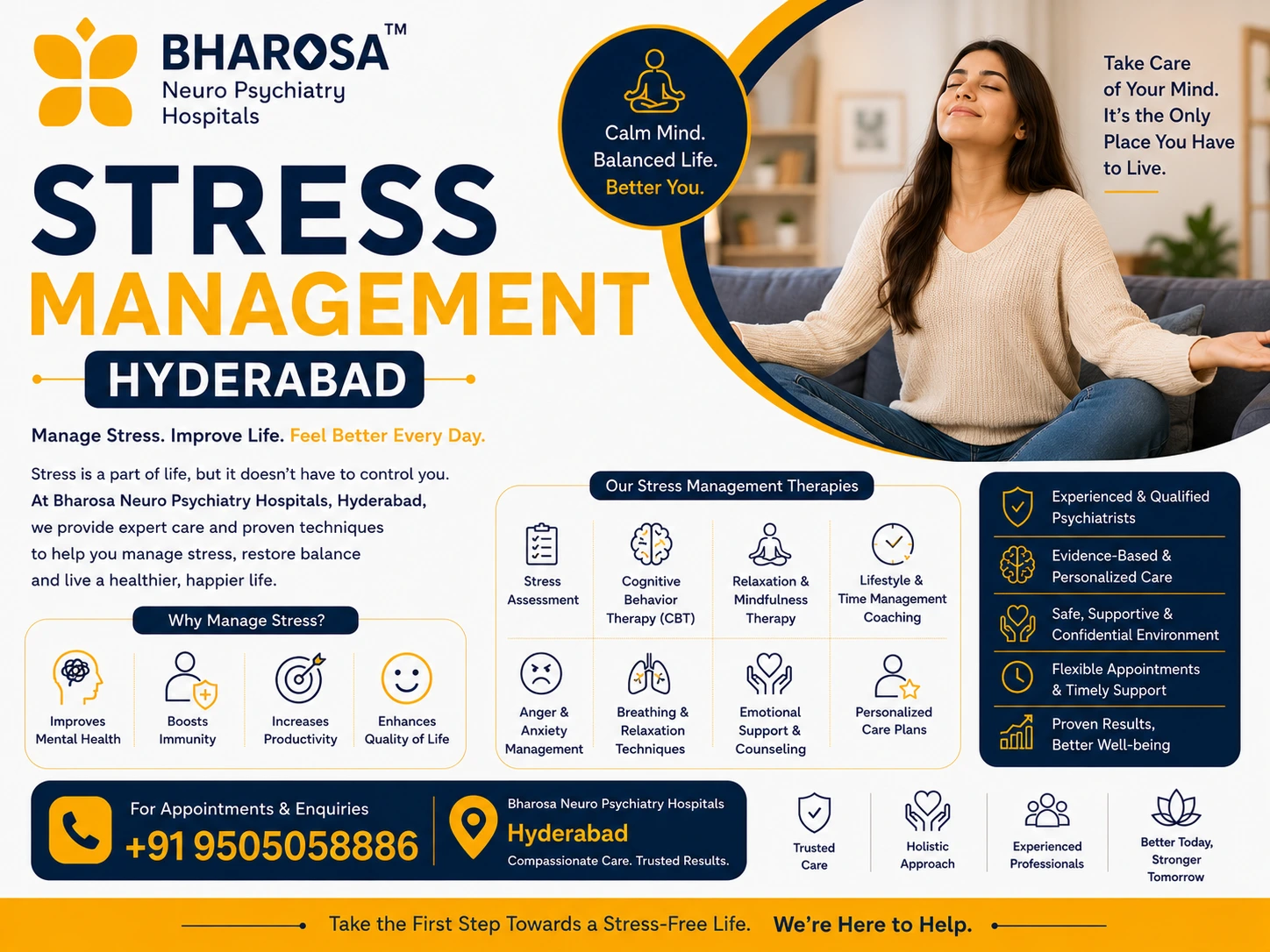
Hyderabad never slows down. Between the high-stakes IT projects, EAMCET preparation, family responsibilities, long commutes on the Outer Ring Road, and the relentless buzz of notifications demanding immediate attention, modern life in this city can feel like running a marathon that never ends. Stress is not simply an occasional inconvenience in Hyderabad — for many residents, it has become a chronic, daily companion that silently erodes health, happiness, and wellbeing. The good news is that effective Stress Management Hyderabad — combining professional expertise with practical daily strategies — can transform your relationship with stress from one of being overwhelmed to one of genuine resilience and control.
Bharosa Neuro Psychiatry Hospital at LB Nagar, Hyderabad, offers dedicated stress management assessment and therapy services — helping individuals and working professionals build the personalised, evidence-based stress management toolkit they need to not just survive, but genuinely thrive in one of India's most demanding urban environments.
Hyderabad Stress Reality: A 2023 survey ranked Hyderabad among the top five most stressed cities in India, with IT professionals, students preparing for competitive examinations, and working parents reporting the highest stress burden. Professional stress management support has never been more needed.
Understanding Your Stress: The First Step in Stress Management
Effective Stress Management Hyderabad begins with understanding your specific stress profile — the particular combination of stressors, internal responses, and coping patterns that characterises your experience. Not all stress is the same, and what works for one person may be ineffective or even counterproductive for another. The three key dimensions of your stress profile are:
- Your Stressors: The specific external demands, situations, or life circumstances generating stress — workplace deadlines, relationship conflict, financial pressure, health concerns, or academic demands. Some stressors can be changed; others must be managed differently.
- Your Stress Response Pattern: How your nervous system and mind respond to stressors — some people immediately enter fight-or-flight (anxiety, aggression, restlessness); others freeze (paralysis, avoidance, withdrawal); others fawn (people-pleasing, inability to set boundaries). Each pattern requires different management strategies.
- Your Current Coping Resources: What you already do to manage stress — and whether these strategies are genuinely helpful (exercise, social support, mindfulness) or temporarily relieving but ultimately harmful (alcohol, overworking, avoidance, rumination).
The Hyderabad Stress Landscape: What Makes This City Uniquely Demanding
Understanding the specific stress context of Hyderabad helps tailor stress management strategies to the realities of life in this city:
- IT Industry Pressure: The 'always-on' culture of Hyderabad's technology sector — international clients across time zones, agile sprints, performance reviews, and the constant threat of role obsolescence — creates a particularly intense and relentless form of occupational stress
- Academic Competition: The stakes attached to board examinations, JEE, NEET, and EAMCET results — and the enormous parental, social, and personal investment in outcomes — generate extreme examination-related stress in students and parents alike
- Traffic and Commuting: Hyderabad's traffic — while improving with infrastructure development — remains a significant daily stressor, with many residents spending 2–4 hours daily in transit
- Rapid Social Change: Hyderabad's rapid modernisation has brought generational, cultural, and social tensions — particularly around marriage, career choices, gender roles, and family structures — that generate unique psychosocial stress
- Cost of Living Pressure: Rising property prices, school fees, and the financial demands of maintaining a middle-class lifestyle in a rapidly developing city create persistent financial stress for many families
Practical Stress Management Strategies for Everyday Life in Hyderabad
Based on evidence-based Stress Management Hyderabad principles and adapted for the specific demands of life in this city, here are the most effective daily strategies:
Strategy 1: Structured Time Management — Reclaiming Control
A significant proportion of stress in professional and student contexts stems from the overwhelming feeling of having too much to do and too little time. Structured time management — using techniques such as the Eisenhower Matrix (sorting tasks by urgency and importance), time-blocking (dedicating specific calendar slots to specific tasks), and the Pomodoro Technique (25-minute focused work intervals followed by 5-minute breaks) — restores the sense of control that chronic overload destroys.
Critically, effective time management includes the deliberate scheduling of rest, recovery, and enjoyment — not just work tasks. The brain requires recovery time to maintain performance, and scheduling this time is not laziness but essential biological maintenance.
Strategy 2: Mindfulness and Present-Moment Awareness
The modern mind in Hyderabad is typically living simultaneously in three time zones — the past (ruminating about yesterday's performance review), the future (worrying about next quarter's targets), and the present (physically in a meeting but mentally somewhere else). This cognitive time-travelling is exhausting and stress-amplifying. Mindfulness practice — the deliberate cultivation of present-moment, non-judgmental awareness — is one of the most evidence-supported stress management techniques available.
Even five minutes of daily mindfulness practice — using the Bharosa-recommended STOP technique (Stop what you're doing, Take three deep breaths, Observe what you notice in body and mind, Proceed with awareness) — can begin to shift the chronic stress-amplifying patterns of the overloaded urban mind.
Strategy 3: Physical Activity — The Biological Stress Antidote
Exercise is the most powerful biological stress antidote available — reducing cortisol and adrenaline levels, stimulating endorphin and BDNF release, improving sleep quality, and producing measurable reductions in anxiety and depressive symptoms. The WHO recommends 150 minutes of moderate aerobic exercise weekly — which, broken into 30-minute sessions five days per week, is achievable even within Hyderabad's demanding schedules.
The critical point is regularity rather than intensity. A 30-minute brisk walk, yoga session, or swim five days per week delivers far greater stress management benefits than an intense two-hour weekend workout session. Bharosa's stress program includes personalised exercise prescriptions integrated into each patient's daily schedule.
Strategy 4: Sleep Hygiene — The Non-Negotiable Foundation
Chronic sleep deprivation and chronic stress exist in a vicious cycle — stress disrupts sleep, and sleep deprivation dramatically amplifies stress reactivity. Breaking this cycle through consistent sleep hygiene practices is foundational to all other stress management strategies. Key evidence-based sleep hygiene practices include: maintaining consistent sleep and wake times (even on weekends), eliminating screen exposure 60 minutes before bed, keeping the bedroom cool, dark, and quiet, avoiding caffeine after 2pm, and establishing a calming pre-bed routine.
Strategy 5: Social Connection — The Stress Buffer
Social support is one of the most powerful stress buffers identified in psychological research — quality relationships literally reduce the physiological stress response by activating the social engagement system and reducing amygdala activation. In Hyderabad's high-demand environment, relationships are often the first thing sacrificed to work and study demands. Protecting and investing in quality relationships is a non-negotiable component of effective stress management.
Strategy 6: Boundary Setting — The Professional Essential
Many Hyderabad professionals experience stress driven not by the work itself but by the inability to say 'no' — accepting additional responsibilities beyond their capacity, responding to WhatsApp messages at midnight, and allowing work demands to colonise personal and family time. Learning to set and communicate professional boundaries — through assertive communication, transparent workload conversations, and the deliberate creation of 'off-duty' time — is one of the highest-leverage stress management skills available.
Strategy 7: Progressive Muscle Relaxation (PMR)
PMR is a structured relaxation technique involving the systematic tensing and releasing of muscle groups throughout the body — producing a deep physiological relaxation response that directly counteracts the muscle tension and stress activation of chronic stress. Research demonstrates that regular PMR practice significantly reduces blood pressure, headaches, insomnia, and anxiety associated with chronic stress. Bharosa's team teaches PMR as a foundational component of our stress management program.
Strategy 8: Cognitive Reappraisal — Changing How You Think About Stress
Not all stress is harmful. Research by Stanford psychologist Kelly McGonigal demonstrates that the belief that stress is harmful — rather than manageable — is itself a significant predictor of stress-related health outcomes. Cognitive reappraisal — consciously re-evaluating a stressful situation to find alternative, less threatening interpretations — is a powerful psychological tool that changes the physiological stress response. Professional CBT at Bharosa teaches this skill systematically.
When DIY Stress Management Is Not Enough: Seeking Professional Support
Personal stress management strategies are powerful and essential — but there are situations where professional Stress Management Hyderabad support at Bharosa Hospitals becomes necessary:
- Stress that has persisted for more than 4–6 weeks despite self-management efforts
- Stress that is producing significant physical health consequences — hypertension, chronic pain, or frequent illness
- Stress that is manifesting as clinical anxiety, depression, or burnout requiring diagnosis and targeted treatment
- Stress involving substance use — alcohol or medication overuse as coping mechanisms
- Stress that is significantly impairing work performance, relationships, or daily functioning
Conclusion
Stress management is not about eliminating stress from your life — stress is an inevitable companion of an ambitious, engaged life. It is about developing the skills, strategies, and professional support to ensure that stress remains manageable and does not accumulate into a chronic health threat. Stress Management Hyderabad at Bharosa Hospitals combines practical daily strategies with expert professional support — giving you the complete toolkit to not just cope with stress, but build genuine, lasting resilience.
Call Now to Begin Your Stress Management Journey: +91 9505058886
Frequently Asked Questions (FAQs)
Q: How is professional stress management different from self-help strategies?
A: Self-help strategies — exercise, sleep hygiene, mindfulness — are valuable and important components of stress management. Professional stress management at Bharosa adds accurate stress assessment (identifying your specific stressor profile and stress response pattern), evidence-based CBT to address the cognitive amplifiers of stress (perfectionism, catastrophising), clinical-grade mindfulness training (MBSR), and the ability to identify and treat stress-related clinical conditions (anxiety, depression, burnout) that self-help alone cannot address.
Q: How quickly do stress management strategies produce results?
A: Simple techniques like diaphragmatic breathing, progressive muscle relaxation, and time management strategies can produce noticeable benefits within days to weeks of consistent practice. Larger, more systemic changes — building mindfulness capacity, restructuring cognitive stress amplifiers through CBT, lifestyle restructuring — typically produce significant results within 6–12 weeks of consistent engagement. Our team provides realistic timelines after the initial assessment.
Q: Can children and teenagers receive stress management support at Bharosa?
A: Yes. Academic stress, examination anxiety, peer pressure, and social media stress are significant mental health concerns for children and adolescents in Hyderabad. Bharosa's child and adolescent team provides age-appropriate stress management — including CBT for examination anxiety, mindfulness for teens, play-based stress processing for younger children, and parent coaching to support stress management at home.
Q: Does Bharosa offer corporate stress management programs?
A: Bharosa offers professional consultation, individual employee stress and burnout assessment, and referral pathways for corporate clients. Individual employees from any organisation can access our comprehensive stress management and burnout recovery services. Organisations interested in workplace mental health support are encouraged to contact us at 9505058886 to discuss available options.
Q: Is stress management covered by health insurance?
A: Coverage for stress management and mental health treatment varies by insurance provider and policy. We recommend checking with your specific insurance provider regarding coverage for psychiatric consultations and psychological therapy. Our team can provide the necessary documentation to support insurance claims where applicable.
Q: How do I book a Stress Management Hyderabad consultation at Bharosa?
A: Call +91 9505058886 at any time — our team is available 24 hours, 7 days a week. Walk-in assessments are also welcome at our hospital, Plot No. 114, Mythripuram, Karmanghat, Opposite TKR College Comman, LB Nagar, Hyderabad – 500079. Same-week appointments are typically available for stress management consultations.
Hospital Address & Contact
Bharosa Neuro Psychiatry Hospital & Rehabilitation Center
Plot No. 114, Mythripuram, Karmanghat, Opposite TKR College Comman (TKR Kamaan),Main Road, LB Nagar / Karmanghat, Hyderabad – 500079, Telangana, India
Phone: +91 9505058886