
How a Schizophrenia Hospital Hyderabad Supports Recovery and Stability
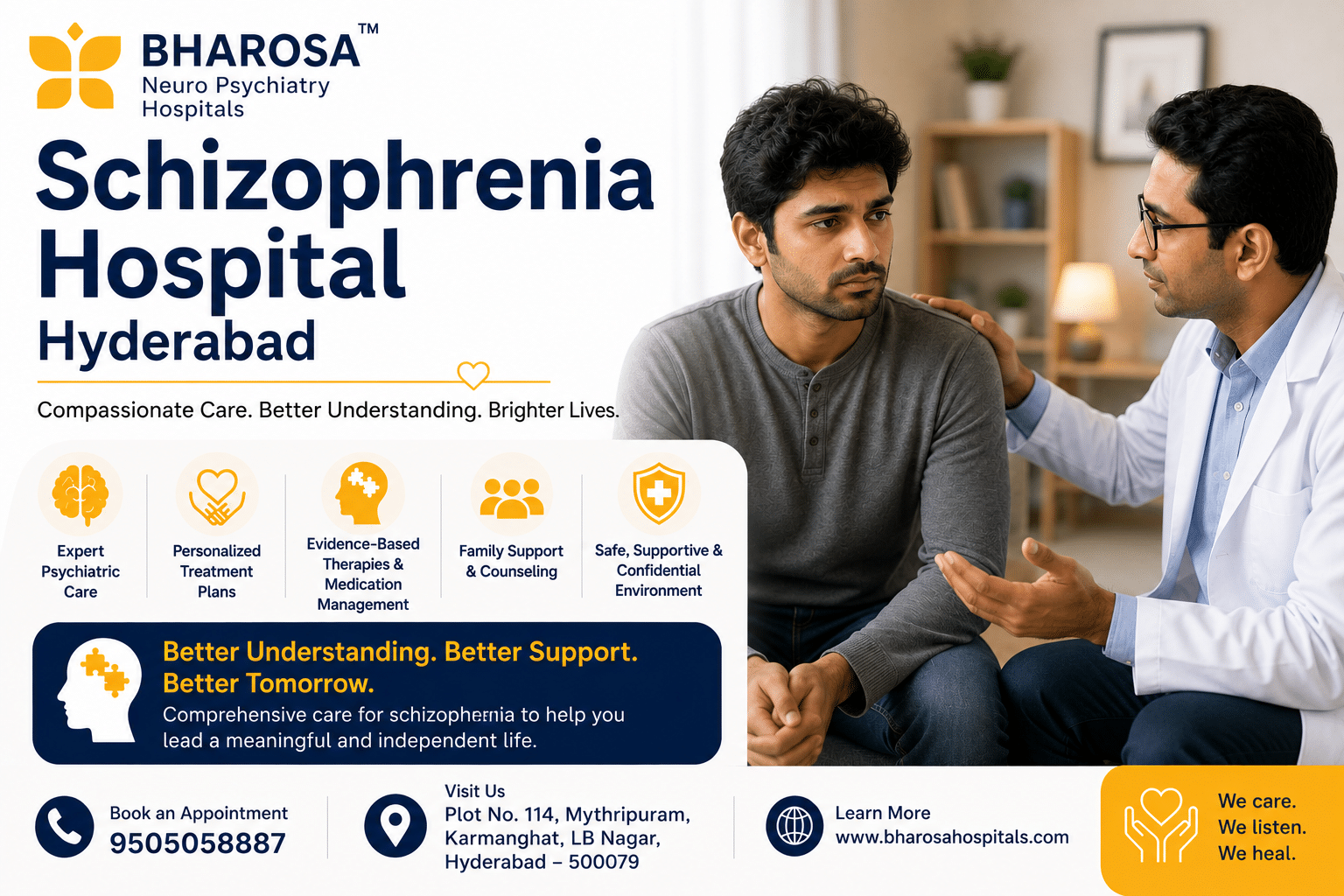
A diagnosis of schizophrenia — for the patient or for their family — can feel like the closing of a door. The images that popular culture has created around this condition are almost uniformly bleak and inaccurate. The clinical reality is far more hopeful: with the right support, from the right Schizophrenia hospital Hyderabad has available, many people with schizophrenia achieve remarkable stability, functional recovery, and quality of life.
Bharosa Neuro Psychiatry Hospital is Hyderabad's most experienced and comprehensively equipped Schizophrenia Hospital Hyderabad — providing every level of care from first-episode psychosis assessment to long-term maintenance treatment for chronic schizophrenia. This blog explains, in detail, how a specialised schizophrenia hospital supports the journey from crisis to stability.
Step 1: Accurate and Comprehensive Diagnosis
The foundation of effective schizophrenia care at our Schizophrenia Hospital Hyderabad is accurate diagnosis. Schizophrenia overlaps clinically with several other conditions — bipolar disorder with psychotic features, schizoaffective disorder, substance-induced psychosis, and severe depression with psychosis. Misdiagnosis leads to incorrect treatment, which can worsen outcomes. Our psychiatrists conduct thorough evaluations including detailed clinical history, structured diagnostic interviews, cognitive assessments, physical investigations, and, where relevant, neuroimaging — ensuring diagnostic precision before any treatment begins.
Step 2: Antipsychotic Medication — The Biological Foundation of Recovery
Antipsychotic medications are the cornerstone of schizophrenia treatment — without them, the positive symptoms of the illness (hallucinations, delusions, disorganised thinking) cannot be effectively controlled. Bharosa's psychiatrists select antipsychotic medication based on the individual patient's symptom profile, previous medication history, side-effect tolerance, and specific subtype of schizophrenia. First and second generation antipsychotics are available, along with long-acting injectable (LAI) antipsychotics for patients who struggle with daily oral medication adherence.
Step 3: Treating Negative Symptoms — The Hidden Challenge
While positive symptoms attract the most attention, it is the negative symptoms of schizophrenia — flat affect, social withdrawal, avolition, alogia, and cognitive slowing — that most significantly impair long-term functioning and quality of life. These symptoms are frequently under-treated at facilities that focus only on psychosis control. At Bharosa, the leading Schizophrenia Hospital Hyderabad, negative symptoms are addressed through a combination of carefully chosen antipsychotic agents, cognitive remediation therapy, social skills training, and structured occupational programming.
Step 4: Cognitive Remediation Therapy
Schizophrenia commonly affects cognitive functions including attention, working memory, processing speed, and executive function — and these cognitive impairments are among the strongest predictors of long-term functional outcome. Cognitive remediation therapy at Bharosa Hospitals uses structured, computerised, and therapist-guided exercises to systematically strengthen these cognitive domains, translating into improved ability to manage daily life, maintain employment, and sustain relationships.
Step 5: Family Psychoeducation — An Essential Pillar
Research consistently shows that family involvement dramatically improves outcomes in schizophrenia. Expressed emotion — patterns of criticism, hostility, or emotional over-involvement in the family environment — is one of the strongest predictors of relapse. Bharosa's Schizophrenia Hospital Hyderabad team delivers structured family psychoeducation covering the neuroscience of schizophrenia, medication and its importance, recognising early warning signs of relapse, communication strategies that reduce stress, and how to support recovery without fostering dependency.
Step 6: Social Skills Training
Schizophrenia frequently erodes the social skills that enable meaningful connection and community participation. Social skills training at Bharosa Hospitals uses modelling, role-playing, and structured feedback to help patients rebuild the interpersonal competencies needed to initiate and maintain conversations, manage conflicts, navigate social situations, and build supportive relationships — all of which are vital for sustained community integration.
Step 7: Vocational Rehabilitation and Life Skills
Recovery from schizophrenia is not simply the absence of psychotic symptoms — it is the restoration of a meaningful life. Bharosa Hospitals' rehabilitation programme includes vocational guidance, occupational therapy, life skills training, and structured community reintegration activities that help patients re-engage with education, employment, and community in ways that are realistic, supported, and sustainable.
Step 8: Long-Term Maintenance and Relapse Prevention
Schizophrenia is a long-term condition, and the work of a Schizophrenia Hospital Hyderabad does not end at discharge. Bharosa Hospitals provides structured long-term maintenance care including regular outpatient psychiatric reviews, early warning sign monitoring, family support, and rapid access to inpatient care if relapse occurs. This continuity of care is what separates genuine recovery support from episodic treatment.
Frequently Asked Questions
Q: Can someone with schizophrenia live a normal life?
A: Many people with schizophrenia, with appropriate treatment and support, live independently, maintain employment, have healthy relationships, and lead fulfilling lives — particularly when treatment begins early. Recovery looks different for each person, but meaningful improvement is achievable for the vast majority.
Q: What should I do if a family member is experiencing a first psychotic episode?
A: Contact Bharosa Hospitals immediately at +91 95050 58887. Early intervention during the first psychotic episode is the single most important factor in improving long-term outcome. Do not wait for symptoms to resolve on their own.
Q: How long does schizophrenia treatment take before improvement is seen?
A: Most patients begin showing meaningful response to antipsychotic medication within 2 to 6 weeks. Full stabilisation of symptoms typically requires 3 to 6 months. Long-term maintenance treatment continues beyond this to prevent relapse.
Q: Is schizophrenia caused by bad parenting or family dysfunction?
A: No. This harmful myth has no scientific support. Schizophrenia is a neurobiological condition with strong genetic underpinnings. While family environment can influence relapse risk, it does not cause the illness. Families of people with schizophrenia deserve support and education — not blame.
Q: Does Bharosa Hospitals provide inpatient care for acute psychotic episodes?
A: Yes. Bharosa Hospitals is fully equipped for inpatient psychiatric care during acute psychotic episodes, providing 24/7 medically supervised, safe, and structured care until stabilisation is achieved.
Bharosa Neuro Psychiatry Hospital & Rehabilitation Center
Plot No. 114, Mythripuram, Karmanghat, LB Nagar, Hyderabad – 500079
+91 95050 58887 | www.bharosahospitals.com