
OCD Treatment Hyderabad: Effective Therapies for Better Living | Bharosa Hospitals
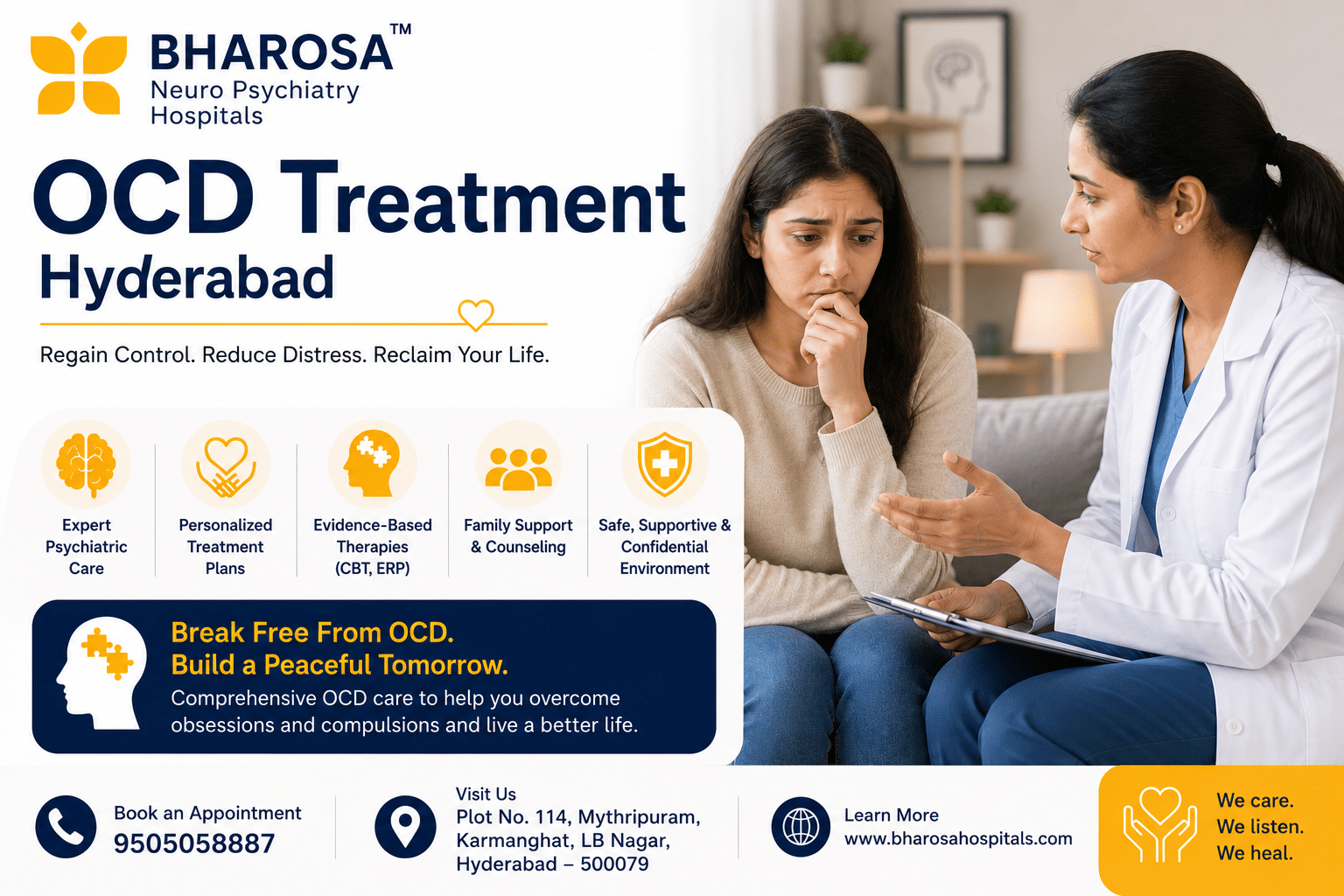
OCD can reduce a person's world to a series of rituals, avoidances, and compulsions that consume hours each day and leave no room for the relationships, work, creativity, and spontaneity that constitute a good life. The cruelty of OCD is that it holds the person hostage not through external force but through their own mind — generating intrusive thoughts that feel impossible to ignore and compelling rituals that provide only temporary, insufficient relief. The most important fact about OCD is also the most hopeful: it is one of the most treatable psychiatric conditions. Expert OCD Treatment Hyderabad at Bharosa Neuro Psychiatry Hospital consistently produces dramatic, measurable, lasting improvements in the lives of OCD patients — including those who have not responded to treatment elsewhere. This blog presents the most effective therapies available and explains how each one contributes to better living.
Therapy 1: Exposure and Response Prevention (ERP) — The Gold Standard
ERP is the most robustly evidence-based psychological treatment for OCD in the world, and the cornerstone of OCD Treatment Hyderabad at Bharosa Hospitals. ERP works by breaking the obsession–compulsion cycle at its most fundamental mechanism.
The therapy begins with a thorough assessment and the collaborative construction of a fear hierarchy — a personalised ranked list of the patient's OCD-feared situations, from least to most anxiety-provoking. Exposures — deliberately entering these feared situations — then proceed from the bottom of the hierarchy upward, with the patient resisting the compulsive response at each step.
The neurobiological mechanism of ERP is habituation: when the anxiety response to an exposure is met without the compulsion, it naturally peaks and then diminishes over repeated exposure — demonstrating to the brain that the feared consequence does not occur without the ritual. Over dozens of structured exposures, OCD Treatment Hyderabad through ERP systematically dismantles the authority that OCD has over the patient's behaviour. Multiple large clinical trials confirm ERP produces clinically significant improvement in 60 to 80% of OCD patients.
Therapy 2: Cognitive Therapy for OCD
Cognitive therapy addresses the belief systems that OCD exploits to maintain its grip. As part of OCD Treatment Hyderabad at Bharosa Hospitals, cognitive therapy identifies and challenges the specific OCD-maintaining beliefs:
- Thought-action fusion: 'Thinking something means I want to do it or that it will happen'
- Inflated responsibility: 'I am responsible for preventing harm to others and must take action to do so'
- Intolerance of uncertainty: 'I cannot function unless I know for certain that nothing bad will happen'
- Overestimation of threat: 'The danger of this situation is as high as my anxiety suggests'
- Perfectionism: 'Actions must be performed perfectly or something terrible will result'
By identifying, examining, and systematically challenging these beliefs, cognitive therapy changes the patient's relationship with their obsessive thoughts — from treating them as meaningful signals requiring action, to recognising them as the neurological noise that OCD generates. This cognitive shift, combined with ERP, is the most powerful approach to OCD Treatment Hyderabad available.
Therapy 3: Acceptance and Commitment Therapy (ACT) for OCD
ACT offers an approach to OCD Treatment Hyderabad that is particularly valuable for patients who struggle with the direct confrontation of ERP or who have significant difficulties with psychological flexibility. Rather than challenging the content of obsessive thoughts, ACT focuses on changing the person's relationship with those thoughts — cultivating an observer stance that allows thoughts to be present without being acted upon. Key ACT processes used in OCD treatment include:
- Defusion: learning to see thoughts as just thoughts — not facts, commands, or threats
- Acceptance: allowing distressing thoughts to be present without fighting or fleeing them
- Values clarification: identifying what truly matters to the person beyond OCD
- Committed action: taking steps toward valued living in the presence of OCD discomfort
Therapy 4: SSRI Medication — The Pharmacological Pillar
SSRIs — at doses typically higher than those used for depression — are the first-line pharmacological treatment for OCD, and an essential component of the most effective OCD Treatment Hyderabad approaches. At Bharosa Hospitals, our psychiatrists prescribe and monitor SSRI medication with specific attention to the dose ranges required for OCD effectiveness, the 12-week timeframe needed before full therapeutic effect is assessed, the management of side effects, and augmentation strategies for treatment-resistant OCD. Medication is always prescribed as part of an integrated treatment plan — working alongside ERP and cognitive therapy rather than replacing it.
Therapy 5: Family Therapy and Accommodation Reduction
One of the most frequently overlooked components of effective OCD Treatment Hyderabad is addressing family accommodation — the ways in which well-intentioned family members participate in or facilitate OCD rituals, provide reassurance, or modify family routines to accommodate OCD demands. While driven by compassion, accommodation actually maintains and worsens OCD by removing the patient's opportunity to experience that they can tolerate anxiety without performing rituals. Bharosa Hospitals' OCD treatment programme includes dedicated family therapy to educate relatives, guide them in gradually reducing accommodation, and equip them to be genuinely supportive rather than inadvertently enabling.
What Better Living Actually Looks Like After OCD Treatment
The ultimate measure of effective OCD Treatment Hyderabad at Bharosa Hospitals is not a clinical scale score — it is the return of a life. Patients who have completed treatment describe hours of rituals shrinking to minutes; the ability to travel, socialise, and work without OCD demanding its tribute; relationships freed from the burden of reassurance-seeking; and a self that is defined by values and choices rather than by the demands of an unwanted neurological condition. This is better living — and it is achievable.
Frequently Asked Questions
Q: How do I know if I have OCD or just regular anxiety?
A: OCD is distinguished from generalised anxiety by the specific obsession–compulsion cycle: unwanted intrusive thoughts generating distress that is relieved by compulsive rituals or avoidance, followed by the return of the obsession. Generalised anxiety involves pervasive worry without the specific ritual-based relief cycle. A specialist OCD assessment at Bharosa Hospitals will provide a definitive and clinically grounded answer.
Q: Is ERP painful? How does Bharosa Hospitals manage the anxiety during exposures?
A: ERP involves deliberately tolerating anxiety — which can be uncomfortable, particularly in the early stages. Bharosa Hospitals' therapists design ERP programmes collaboratively, starting at manageable levels of challenge and progressing gradually. The discomfort of exposure is time-limited and purposeful, and most patients describe the experience as challenging but ultimately profoundly liberating. Therapists provide consistent support, guidance, and encouragement throughout.
Q: Does OCD always require medication, or can therapy alone be sufficient?
A: For mild to moderate OCD, ERP alone can produce significant clinical improvement without medication. For moderate to severe OCD, combined ERP and SSRI medication consistently produces better and faster outcomes than either approach alone. Your psychiatrist at Bharosa Hospitals will assess the severity of your OCD and recommend the most appropriate treatment combination.
Q: Can OCD treatment at Bharosa Hospitals help with OCD that has been present for many years?
A: Yes. Long-standing OCD responds to ERP and combined treatment, though treatment may require more sessions and more time than recently onset OCD. Bharosa Hospitals has experience treating severe, complex, and long-standing OCD presentations, including those that have not responded adequately to treatment elsewhere.
Q: Does Bharosa Hospitals treat OCD in children and teenagers?
A: Yes. Bharosa Hospitals' Department of Child Psychiatry provides child-adapted ERP therapy, family-inclusive OCD treatment, and carefully managed medication for younger patients when indicated. Early treatment of childhood OCD prevents the condition from becoming more entrenched through the critical developmental years.
Visit Bharosa Hospitals
Bharosa Neuro Psychiatry Hospital & Rehabilitation Center
Plot No. 114, Mythripuram, Karmanghat, LB Nagar, Hyderabad – 500079
Opp. TKR College, Main Road, LB Nagar / Karmanghat, Hyderabad
+91 95050 58887 | www.bharosahospitals.com