
Living with OCD: Challenges, Treatment, and Recovery | Bharosa Hospitals
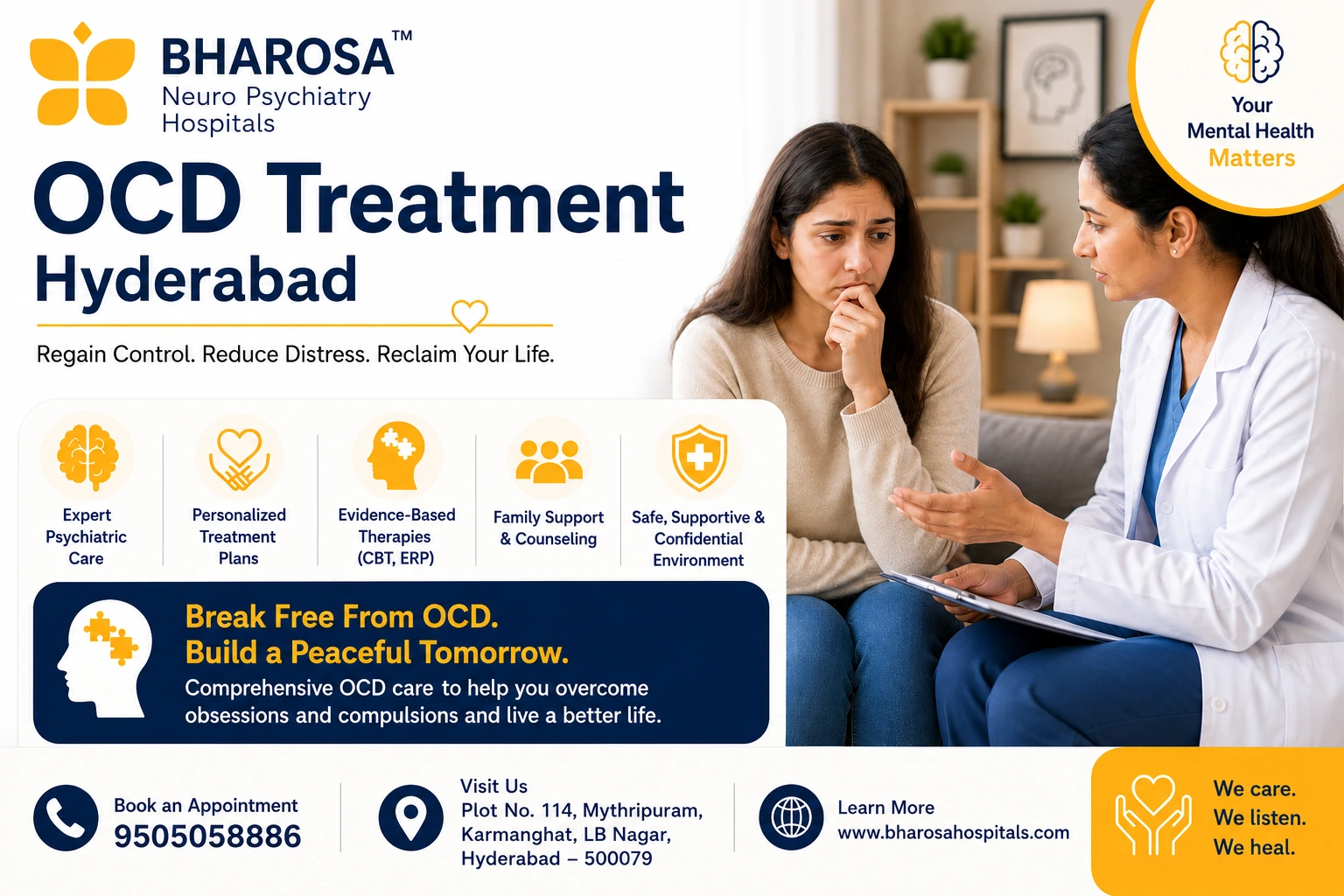
Obsessive-Compulsive Disorder (OCD) is far more complex, distressing, and disabling than the way it is often portrayed in popular culture. It is not a quirk of neatness or an affinity for organisation. OCD is a serious, chronic mental health condition involving intrusive, unwanted thoughts (obsessions) that generate intense anxiety, followed by repetitive behaviours or mental acts (compulsions) performed to temporarily reduce that anxiety. For millions of people across India, OCD consumes hours of every day, severely impairing work, relationships, and quality of life. Bharosa Hospitals provides evidence-based OCD Treatment Hyderabad that offers real, lasting relief.
Understanding the OCD Cycle
To understand why OCD is so difficult to live with, it helps to understand its core mechanism — the OCD cycle. An intrusive thought or image enters the mind (e.g., fear of contamination, fear of harming a loved one, fear of making a terrible mistake). The thought generates intense anxiety and distress. The person performs a compulsion — handwashing, checking, counting, praying, mental reviewing — to relieve the anxiety. Temporary relief is experienced. But the relief is short-lived, the obsessive thought returns stronger, and the cycle repeats with increasing intensity. Over time, compulsions grow more elaborate, consuming more time, and OCD gradually takes over the person's life.
Common Types of OCD
The OCD Treatment Hyderabad specialists at Bharosa Hospitals treat all presentations of OCD, including:
- Contamination OCD — fear of germs, illness, or dirt leading to excessive washing or avoidance
- Checking OCD — repeated checking of locks, appliances, or actions to prevent imagined harm
- Harm OCD — intrusive fears of unintentionally hurting oneself or others
- Purely Obsessional OCD (Pure O) — primarily mental obsessions without visible compulsions
- Religious or Scrupulosity OCD — excessive preoccupation with morality, sin, or religious correctness
- Symmetry and Order OCD — distress if objects are not arranged precisely or actions are not completed a certain way
- Relationship OCD — constant doubt and rumination about the quality or validity of one's relationships
Challenges of Living with OCD
Living with OCD means living in a perpetual state of anxiety and exhaustion. Simple daily tasks become fraught with uncertainty and fear. A person may spend 3 to 5 hours each day in rituals, arriving late to work, avoiding social situations, or being unable to complete meals or sleep without completing elaborate routines. Relationships suffer as family members are often pulled into OCD rituals themselves, accommodating compulsions in ways that inadvertently strengthen the disorder.
Shame and secrecy are significant barriers to seeking help. Many people with OCD believe their thoughts make them dangerous, sinful, or insane — which they do not. These thoughts are a symptom of OCD, not a reflection of character. Bharosa Hospitals' compassionate, non-judgmental approach helps patients bring their OCD into the open and begin the healing process.
Treatments That Work for OCD
Exposure and Response Prevention (ERP)
ERP is the gold-standard psychological treatment for OCD with the strongest evidence base. It works by deliberately exposing patients to their obsessional triggers in a gradual, structured way — while simultaneously preventing the compulsive response. Over time, the brain learns that the anticipated catastrophe does not occur, and anxiety naturally diminishes. ERP is challenging and requires courage, but it produces profound and lasting results. Bharosa's OCD Treatment Hyderabad specialists are highly trained in ERP and guide patients through the process with skill and compassion.
Cognitive Behavioural Therapy (CBT)
In addition to ERP, cognitive techniques help OCD patients challenge the appraisals they make of their obsessive thoughts — particularly the belief that having a thought is as bad as acting on it (thought-action fusion). CBT helps patients develop a healthier, detached relationship with their intrusive thoughts rather than engaging in exhausting mental battles against them.
Medication for OCD
SSRIs (particularly fluoxetine, sertraline, and fluvoxamine) are the first-line medications for OCD, typically prescribed at higher doses than those used for depression. They significantly reduce OCD symptom severity in many patients. Clomipramine, a tricyclic antidepressant, is also highly effective for treatment-resistant OCD. Bharosa Hospitals' psychiatrists integrate medication management seamlessly with therapy as part of a comprehensive OCD Treatment Hyderabad plan.
Mindfulness-Based Approaches
Mindfulness teaches OCD patients to observe their obsessive thoughts non-judgmentally — acknowledging their presence without treating them as directives requiring action or compulsive neutralisation. This fundamentally changes the person's relationship with their thoughts, reducing their power and emotional charge.
Recovery Is Possible
OCD recovery is not about eliminating all intrusive thoughts — that is neither possible nor the goal. Recovery means developing such a healthy, responsive relationship with those thoughts that they no longer dictate behaviour. Most people who complete evidence-based OCD treatment experience a dramatic reduction in symptom severity, reclaim hours of their day, and rebuild the life that OCD had been slowly taking away.
If OCD is controlling your life or the life of someone you love, effective help is available. Bharosa Hospitals offers comprehensive, evidence-based OCD Treatment Hyderabad delivered by specialists who understand the complexity and distress of this condition. You do not have to fight OCD alone. Call Bharosa Hospitals at +91 95050 58886 or visit bharosahospitals.com to take the first step toward freedom.
Frequently Asked Questions (FAQs)
Q: How do I know if I have OCD or just regular worrying?
A: OCD involves intrusive, repetitive thoughts (obsessions) that feel alien or ego-dystonic (not aligned with your values), paired with compulsive behaviours or mental rituals performed to reduce anxiety. Regular worry tends to be realistic and proportionate. If your thoughts and rituals are consuming significant time and causing significant distress, consult Bharosa Hospitals for a professional assessment.
Q: Is OCD curable?
A: OCD is a manageable, chronic condition. Most patients who complete ERP and CBT experience significant symptom reduction — often 50 to 70% — and are able to live full, functional lives. Some achieve very long periods of minimal or no OCD symptoms with continued practice of skills learned in therapy.
Q: How long does OCD treatment take at Bharosa Hospitals?
A: ERP therapy typically involves 12 to 20 sessions for mild to moderate OCD. Severe OCD may benefit from Bharosa's residential program, which allows intensive daily therapy within a structured, supportive environment over several weeks.
Q: Can OCD occur alongside other mental health conditions?
A: Yes. OCD frequently co-occurs with depression, anxiety disorders, ADHD, and tic disorders. Bharosa Hospitals' multidisciplinary team is experienced in treating complex, comorbid presentations comprehensively.
Q: Do I have to take medication for OCD?
A: Not necessarily. Mild to moderate OCD can often be treated effectively with therapy alone. For moderate to severe OCD, the combination of SSRI medication and ERP therapy typically produces the best outcomes. Your Bharosa psychiatrist will discuss options with you based on your specific presentation.
Q: Is OCD Treatment Hyderabad at Bharosa Hospitals available for children and adolescents?
A: Yes. OCD can affect children and teenagers, and Bharosa Hospitals' child psychiatry team provides age-appropriate ERP, CBT, and family-inclusive treatment for younger patients with OCD.
Bharosa Neuro Psychiatry Hospital & Rehabilitation Center
Plot No. 114, Mythripuram, Karmanghat, LB Nagar, Hyderabad – 500079
Opp. TKR College, Main Road, LB Nagar / Karmanghat, Hyderabad
+91 95050 58886 | www.bharosahospitals.com