
Ketamine Therapy in Hyderabad: A Breakthrough Treatment for Depression | Bharosa Hospitals
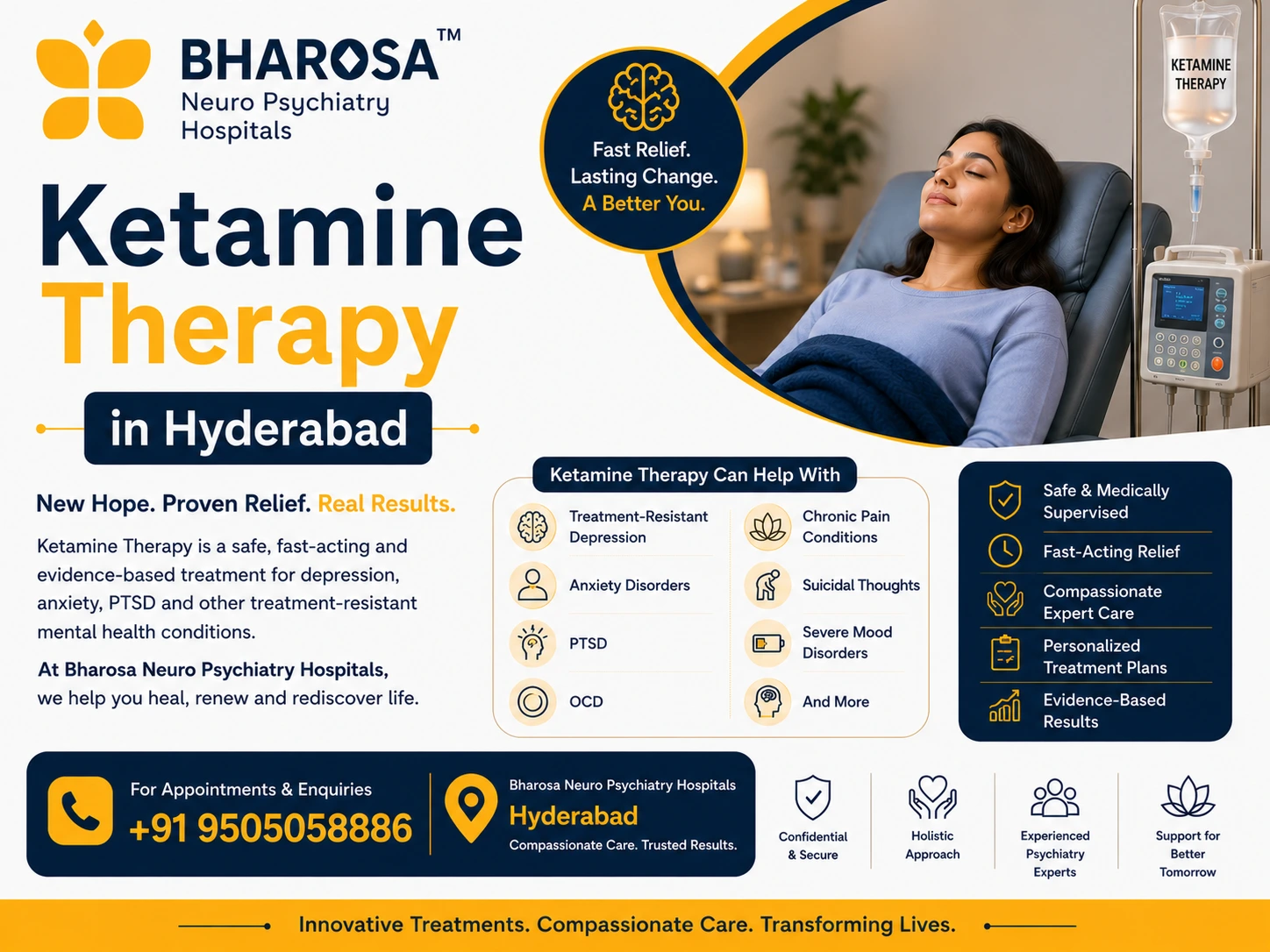
In the long history of psychiatric pharmacology — from the discovery of lithium in the 1940s to the introduction of SSRIs in the 1980s — few discoveries have generated as much scientific excitement as ketamine. For patients with treatment-resistant depression who have tried multiple medications and therapies without adequate relief, Ketamine Therapy in Hyderabad at Bharosa Neuro Psychiatry Hospital offers something that few other treatments can: the possibility of dramatic, rapid antidepressant effect — sometimes within hours rather than weeks.
Ketamine is not a new drug — it has been used safely as an anaesthetic and analgesic agent for over five decades. What is new is our scientific understanding of its profound and rapid antidepressant properties, particularly through its action on the glutamate neurotransmitter system — the brain's primary excitatory signalling pathway. This discovery has opened an entirely new chapter in the treatment of depression, suicidal ideation, and related psychiatric conditions.
Medical Breakthrough: A single sub-anaesthetic dose of intravenous ketamine can produce significant antidepressant effects within 2–4 hours — faster than any other antidepressant treatment currently available. (Source: National Institute of Mental Health, USA)
The Science of Ketamine: How It Works Differently from All Other Antidepressants
To understand why Ketamine Therapy in Hyderabad represents such a significant breakthrough, it is important to understand how ketamine works differently from every other antidepressant in current use.
Conventional Antidepressants: The Monoamine Approach
All conventional antidepressants — SSRIs, SNRIs, TCAs, MAOIs — work primarily on the monoamine neurotransmitter systems: serotonin, norepinephrine, and dopamine. They are effective for many patients but have critical limitations: they require 4–12 weeks to produce therapeutic effect, they fail to produce adequate response in 30–40% of patients (treatment-resistant depression), and they do not work rapidly enough for patients in acute suicidal crisis.
Ketamine: The Glutamate Revolution
Ketamine works through an entirely different mechanism — blocking NMDA (N-methyl-D-aspartate) receptors in the glutamate system, which is the brain's primary excitatory neurotransmitter system and accounts for approximately 80% of all neural communication. This NMDA blockade produces a cascade of downstream neurobiological effects that collectively explain ketamine's unique antidepressant properties:
- Rapid synaptogenesis: Ketamine triggers an immediate burst of AMPA receptor activation and subsequent BDNF release, leading to rapid formation of new synaptic connections in the prefrontal cortex — directly reversing the synapse loss that is a core biological feature of chronic depression
- mTOR pathway activation: Ketamine activates the mTOR signalling pathway, which regulates protein synthesis and neuronal growth — producing rapid structural changes in depressed neural circuits
- Glutamate surge and homeostatic reset: The NMDA blockade produces a brief glutamate surge followed by a homeostatic reset of glutamate signalling, normalising the hyperactive stress circuits that maintain depression
- Rapid anti-suicidal effect: Ketamine produces unique, rapid reduction of suicidal ideation independent of its antidepressant effect — a potentially life-saving property that no conventional antidepressant possesses
The result of these mechanisms is antidepressant effect that can begin within 2–4 hours of a single infusion — a timeframe that is utterly unprecedented in the history of antidepressant pharmacology.
Types of Ketamine Treatment Available
At Bharosa's Ketamine Therapy in Hyderabad program, patients receive ketamine treatment under expert psychiatric and medical supervision. Available modalities include:
1. Intravenous (IV) Ketamine Infusion — The Gold Standard
IV ketamine infusion delivers a sub-anaesthetic dose of racemic ketamine (typically 0.5 mg/kg) directly into the bloodstream over 40 minutes. IV administration provides the most precise dosing control, the most rapid onset, the highest bioavailability (100%), and the most extensive research evidence base. Patients receive IV infusions in a comfortable, monitored clinical setting, remaining conscious throughout (though most experience a dissociative state during the infusion that is typically mild and temporary).
A standard acute course consists of 6 infusions delivered over 2–3 weeks (2–3 per week). Response is assessed after each infusion, and the course is adjusted based on clinical response.
2. Esketamine (Spravato) — FDA-Approved Intranasal Formulation
Esketamine (the S-enantiomer of ketamine, marketed as Spravato) is an FDA-approved intranasal formulation specifically developed for treatment-resistant depression and for major depressive disorder with acute suicidal ideation or behaviour. Esketamine is self-administered intranasally in a clinical setting under monitoring, making it more accessible than IV infusion for ongoing maintenance treatment.
Esketamine is administered twice weekly for 4 weeks (induction phase), then weekly for 4 weeks, then weekly or biweekly for maintenance — always in conjunction with a standard antidepressant.
Who Is Ketamine Therapy in Hyderabad Right For?
Bharosa's Ketamine Therapy in Hyderabad is indicated for carefully selected patients with:
- Treatment-Resistant Depression (TRD): Patients who have not responded adequately to two or more adequate antidepressant trials — the population for whom ketamine produces the most evidence-based benefit
- Acute Suicidal Ideation: Patients with active, severe suicidal thoughts where rapid reduction of suicidal ideation is medically urgent — ketamine's unique rapid anti-suicidal effect can be life-saving in this context
- Major Depressive Disorder with Inadequate Response: Patients with moderate-to-severe MDD who have achieved only partial response to standard antidepressant treatment and require augmentation
- Bipolar Depression: Under careful psychiatric supervision, ketamine can be used for the depressive phase of bipolar disorder in patients who have not responded to mood stabiliser-based approaches
- PTSD with Depressive Features: Emerging evidence supports ketamine's effectiveness in PTSD, particularly when combined with psychotherapy
- Patients Requiring Rapid Response: Situations where the standard 4–12-week antidepressant timeline is clinically insufficient — such as before an important life event or in the context of acute functional collapse
The Ketamine Treatment Experience at Bharosa: What to Expect
Step 1: Comprehensive Pre-Treatment Assessment
Every patient undergoes a thorough pre-ketamine assessment by our psychiatrists — reviewing diagnosis and treatment history, medical history, cardiovascular health, substance use history (particularly history of dissociative drug misuse), current medications, and psychological readiness for the ketamine experience. This assessment determines candidacy, identifies contraindications, and informs the personalised treatment protocol.
Step 2: Preparation and Set
Before the first infusion, patients receive detailed information about what to expect during the ketamine experience — particularly the dissociative or perceptual changes that may occur during the infusion. Preparation reduces anxiety and allows patients to approach the experience with openness and equanimity rather than fear. The therapeutic mindset ('set') and treatment environment ('setting') are known to influence treatment outcomes.
Step 3: The Infusion Session
Patients recline comfortably in a dedicated treatment room with gentle lighting, soft music, and monitoring equipment. An intravenous line is placed and vital signs (blood pressure, heart rate, oxygen saturation) are monitored continuously throughout. The ketamine infusion is administered over 40 minutes at sub-anaesthetic doses — patients remain conscious throughout, often entering a calm, introspective state.
During the infusion, some patients experience mild perceptual changes — colours may appear more vivid, music may feel more enveloping, and thoughts may have a dreamy, free-floating quality. These effects resolve completely within 15–20 minutes of the infusion ending. Patients are observed in our recovery area until fully oriented before being discharged.
Step 4: Integration and Psychotherapy
The post-infusion period represents a window of enhanced neuroplasticity — when the brain's newly strengthened synaptic connections are most responsive to psychological learning and therapeutic change. At Bharosa, ketamine infusions are integrated with psychotherapy sessions (CBT, psychodynamic therapy, or EMDR as appropriate) to maximise and consolidate the therapeutic gains of each infusion. This integration is a critical component of optimised ketamine treatment.
Safety, Monitoring, and Contraindications
Patient safety is the absolute priority in Bharosa's Ketamine Therapy in Hyderabad program. Comprehensive safety protocols include:
- Continuous vital sign monitoring throughout every infusion session
- Medical emergency equipment immediately available in the treatment room
- Post-infusion recovery observation period until full orientation is confirmed
- Patients advised not to drive for 24 hours after infusion — transportation is arranged
- Regular psychiatric assessment of response, side effects, and ongoing indication
Contraindications
- Uncontrolled hypertension or cardiovascular disease
- Personal or family history of schizophrenia or psychotic disorder
- Active substance use disorder involving ketamine, PCP, or dissociative agents
- Severe hepatic impairment
- Pregnancy (relative contraindication — risk-benefit discussion required)
- Clinical Note: Ketamine treatment at Bharosa is exclusively administered under strict medical supervision for legitimate psychiatric therapeutic purposes — in full compliance with Indian medical and pharmaceutical regulations. Ketamine at Bharosa is never used recreationally or outside of strictly defined clinical protocols.
Ketamine and the Future of Psychiatry
The discovery of ketamine's rapid antidepressant properties has catalysed a broader scientific revolution in psychiatry — the glutamate hypothesis of depression — which is now producing a new generation of rapid-acting antidepressants targeting glutamate, GABA, and other non-monoamine systems. Drugs including SAGE-217 (brexanolone), rapastinel, and others are in clinical development, informed directly by the insights generated by ketamine research.
For patients suffering today, however, ketamine does not represent a future possibility — it represents an available, evidence-based treatment that can provide hope when all other options have been exhausted. At Bharosa Hospitals, we are committed to bringing the most advanced, evidence-based psychiatric treatments to patients in Hyderabad — and ketamine therapy is one of the most significant of these advances.
For patients who have lived with treatment-resistant depression — trying medication after medication, therapy after therapy, without finding adequate relief — Ketamine Therapy in Hyderabad at Bharosa Hospitals represents genuine hope. The science is clear, the evidence is compelling, and the outcomes for carefully selected patients can be transformative. If standard treatments have not given you the relief you deserve, it may be time to explore this breakthrough therapy. Call our team today — we are ready to assess whether ketamine therapy is the right next step for you.
Call Now for a Ketamine Therapy Consultation: +91 9505058886
Frequently Asked Questions (FAQs)
Q: Is Ketamine Therapy in Hyderabad at Bharosa safe?
A: Yes. Ketamine therapy at Bharosa is administered exclusively under strict medical supervision with continuous vital sign monitoring, emergency equipment on standby, and comprehensive pre-treatment medical assessment. Ketamine has been used safely in clinical medicine for over 50 years. Its psychiatric use at sub-anaesthetic doses under controlled conditions carries a well-characterised, manageable safety profile. All patients undergo thorough medical screening before treatment begins.
Q: How quickly does ketamine therapy work for depression?
A: This is ketamine's most remarkable and clinically significant attribute — antidepressant effects can begin within 2–4 hours of the first infusion, with many patients experiencing noticeable mood improvement within 24 hours. This is dramatically faster than conventional antidepressants which require 4–12 weeks. For patients with severe, active suicidal ideation, this rapid response can be genuinely life-saving.
Q: How long do the antidepressant effects of ketamine last?
A: The antidepressant effects of a single ketamine infusion typically last 1–2 weeks in treatment-resistant patients. A full course of 6 infusions over 2–3 weeks produces effects that can last several months. Maintenance infusions (monthly or as needed) and combination with antidepressant medications and psychotherapy help sustain the therapeutic benefit long-term.
Q: Is ketamine addictive? Will I become dependent on it?
A: Ketamine does have abuse potential at recreational (high) doses and with frequent unsupervised use. This is why Bharosa's ketamine therapy program uses strictly controlled, sub-anaesthetic therapeutic doses under close medical supervision with careful patient selection, regular monitoring, and clear treatment protocols. Ketamine use disorder does not occur with properly supervised clinical therapeutic use. Patients with a history of substance use disorders are assessed particularly carefully before ketamine is considered.
Q: Can ketamine therapy be combined with my current antidepressant medications?
A: Yes, in most cases. Esketamine (Spravato) is specifically designed to be used in conjunction with a standard antidepressant. IV ketamine infusions can also generally be combined with ongoing antidepressant medications. However, certain combinations require careful management — our psychiatrists conduct a thorough medication review before beginning treatment to ensure safety and optimise the combined therapeutic approach.
Q: How do I know if I am a good candidate for Ketamine Therapy in Hyderabad at Bharosa?
A: The ideal candidate is a patient with a well-established diagnosis of major depressive disorder or bipolar depression who has not responded adequately to two or more antidepressant medications — treatment-resistant depression. Patients with active suicidal ideation requiring rapid response are also strong candidates. Call us at +91 9505058886 to arrange a comprehensive assessment. Our psychiatrists will review your full history and honestly advise whether ketamine therapy is appropriate for your specific situation.
Hospital Address & Contact
Bharosa Neuro Psychiatry Hospital & Rehabilitation Center
Plot No. 114, Mythripuram, Karmanghat, Opposite TKR College Comman (TKR Kamaan),Main Road, LB Nagar / Karmanghat, Hyderabad – 500079, Telangana, India
Phone : +91 9505058886