
ECT Treatment in Hyderabad: Everything You Need to Know About Electroconvulsive Therapy | Bharosa Hospital
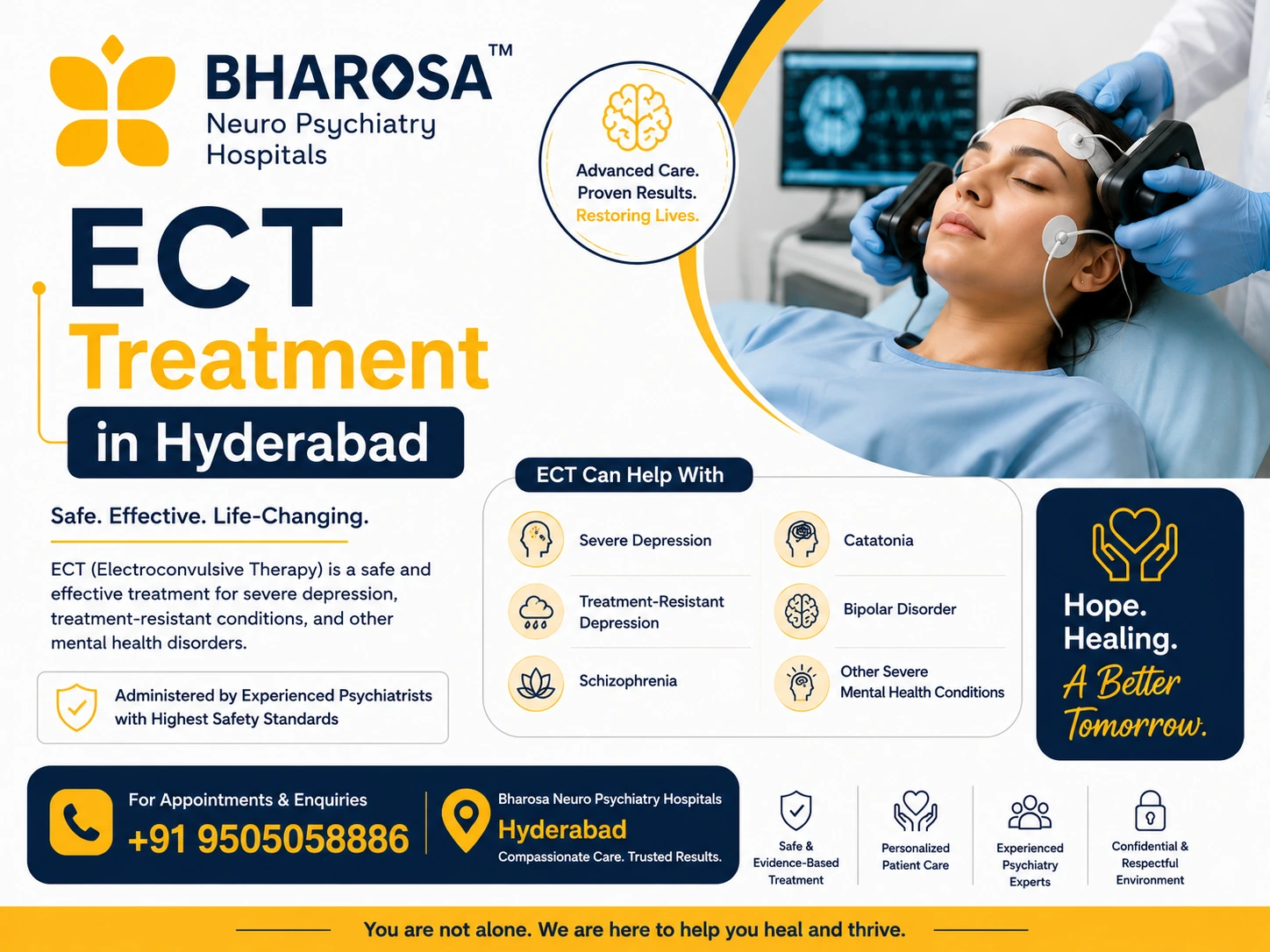
When someone hears the words "Electroconvulsive Therapy," their mind may immediately jump to outdated Hollywood depictions — restraints, screaming, and punishment. This could not be further from the reality of modern ECT. Today, Electroconvulsive Therapy is one of the safest, most precisely administered, and most dramatically effective treatments in all of psychiatry. For patients suffering from severe, treatment-resistant depression, acute mania, catatonia, or psychosis who have not responded to medications and therapy, ECT Treatment in Hyderabad at Bharosa Neuro Psychiatry Hospital can be genuinely life-saving.
Bharosa Hospitals, located in LB Nagar, Hyderabad, offers expert, medically supervised ECT administered under general anaesthesia by qualified specialists. This blog answers every question you might have about ECT — what it is, how it works, who it is for, what to expect, and why it deserves a place in modern psychiatric care.
Medical Fact: ECT has response rates of 70–90% in severe, treatment-resistant depression — significantly higher than any antidepressant medication currently available. (Source: American Psychiatric Association)
What Is ECT? The Science Behind the Treatment
Electroconvulsive Therapy (ECT Treatment in Hyderabad) is a medical procedure in which a brief, precisely controlled electrical stimulus is applied to the scalp through carefully positioned electrodes, inducing a controlled generalised seizure in the brain under complete general anaesthesia and full muscle relaxation.
The therapeutic benefit of ECT does not come from the electricity itself but from the controlled seizure activity in the brain, which triggers a cascade of profound neurobiological changes:
- Neurotransmitter normalisation: ECT rapidly normalises dysregulated serotonin, dopamine, norepinephrine, and GABA systems — the same neurotransmitters targeted by antidepressant medications, but with far greater speed and potency
- Neuroplasticity stimulation: ECT dramatically increases neuroplasticity markers including BDNF (Brain-Derived Neurotrophic Factor), promoting new neural connections and brain circuit reorganisation
- Neuroendocrine changes: ECT normalises the dysregulated HPA (hypothalamic-pituitary-adrenal) axis stress response system that is overactive in severe depression
- Anti-inflammatory effects: ECT reduces neuroinflammatory markers that are elevated in treatment-resistant psychiatric conditions
- Neurogenesis: ECT stimulates new neuron growth in the hippocampus — the brain region most affected by chronic depression
These neurobiological changes explain why ECT works rapidly — often producing significant improvement within the first 2–3 sessions — and why it is effective when medications and therapy have failed.
Conditions Treated with ECT Treatment in Hyderabad at Bharosa
Bharosa's ECT Treatment in Hyderabad is indicated for the following conditions, as per international psychiatric guidelines (APA, Royal College of Psychiatrists, NIMHANS):
1. Severe Major Depressive Disorder (MDD)
ECT is the gold-standard treatment for severe depression — particularly when there is imminent suicide risk requiring rapid response, when the patient has not responded to two or more adequate antidepressant trials (treatment-resistant depression), when depression is accompanied by psychotic features (delusions or hallucinations), or when severe depression prevents adequate nutrition, hydration, or self-care.
2. Bipolar Depression and Acute Mania
ECT is highly effective for both the depressive and manic poles of bipolar disorder. For patients with severe bipolar depression unresponsive to mood stabilisers and antidepressants, and for patients with acute mania that is not responding to medication or poses serious safety risks, ECT provides rapid, powerful mood stabilisation.
3. Catatonia
Catatonia — a state of unresponsiveness, rigidity, and mutism that can occur in severe depression, bipolar disorder, schizophrenia, and medical conditions — is one of the most rapidly effective applications of ECT. Response to ECT in catatonia is often dramatic, with patients showing significant improvement within one to two treatments.
4. Treatment-Resistant Schizophrenia and Schizoaffective Disorder
For patients with chronic schizophrenia or schizoaffective disorder who have not adequately responded to antipsychotic medication — including clozapine — ECT used in combination with antipsychotic therapy can produce significant additional symptom reduction.
5. Psychotic Depression
Depression accompanied by psychotic features (delusions or hallucinations) is one of the most severe and dangerous psychiatric presentations, with very high suicide risk. ECT is considered a first-line treatment recommendation for psychotic depression by international guidelines, producing superior outcomes to medication alone.
The Modern ECT Procedure: Step by Step at Bharosa Hospitals
Understanding what actually happens during ECT Treatment in Hyderabad at Bharosa removes fear and replaces it with informed confidence:
Before the Procedure
- Pre-ECT medical workup: Complete blood count, metabolic panel, ECG, chest X-ray, and anaesthetic assessment to ensure medical fitness
- Informed consent: A thorough discussion of benefits, risks, alternatives, and expected outcomes — patients and families are fully informed before treatment begins
- Nil by mouth: Patients fast for 6–8 hours before ECT to ensure anaesthetic safety
- Pre-ECT medications: Certain medications are adjusted or withheld before ECT as per anaesthetic protocol
During the Procedure
- Intravenous line placement and monitoring electrodes (ECG, EEG, pulse oximetry) are attached
- General anaesthesia is administered by Dr. Rajesh Kumar R (DNB Anaesthesia, IDCCM) — the patient is completely unconscious within seconds
- A short-acting muscle relaxant is administered to prevent any muscular convulsive movements — the patient lies completely still throughout
- The ECT device delivers a brief, precisely calibrated electrical pulse through electrodes positioned on the scalp (bilateral, right unilateral, or bifrontal placement depending on clinical indication)
- A brief, controlled seizure occurs in the brain — typically lasting 20–50 seconds — while the patient remains completely anaesthetised and motionless
- The entire procedure, from anaesthetic induction to awakening, takes approximately 15–20 minutes
After the Procedure
- Patients awaken in the recovery area under nursing observation as the anaesthetic wears off — typically within 5–15 minutes
- Mild, temporary side effects such as headache, muscle aches, and short-term confusion may occur immediately after the procedure and are managed with appropriate medications
- Patients rest comfortably before returning to the ward — most patients are alert and able to eat and drink within an hour
- A treatment course typically consists of 6–12 sessions delivered 2–3 times per week over 3–6 weeks
Safety, Risks, and Side Effects of ECT
Modern ECT Treatment in Hyderabad at Bharosa is among the safest medical procedures performed under general anaesthesia — safer, in fact, than many routine surgical procedures. The mortality rate associated with ECT is approximately 1 in 10,000 procedures — comparable to minor elective surgery under anaesthesia.
Common, Temporary Side Effects
- Post-procedure headache or muscle ache — managed with simple analgesics
- Temporary confusion or disorientation immediately after the procedure — typically resolves within 30–60 minutes
- Short-term memory difficulties during the treatment course — the most common concern, addressed below
Memory and ECT: The Critical Question
The most frequently asked question about ECT concerns memory. ECT can cause temporary difficulties with memory during the treatment course — most commonly affecting the ability to retain new information (anterograde memory) and recall memories from around the time of treatment (retrograde memory for the period immediately surrounding ECT sessions).
These memory effects are almost always temporary, resolving fully within weeks to months after the treatment course ends. Long-term, independent assessments consistently show that ECT does not cause lasting damage to intelligence, long-term memory, or cognitive function. Many patients report that their memory and thinking actually improve significantly after ECT, as the debilitating effects of severe depression on cognition are reversed.
Important: The cognitive effects of untreated severe depression — profound difficulties in concentration, memory, and decision-making — are typically far more impairing than any temporary memory effects of ECT. Successful ECT treatment consistently improves overall cognitive performance.
Maintenance ECT: Protecting Long-Term Recovery
After a successful course of acute ECT, some patients benefit from maintenance ECT — periodic ECT sessions (typically monthly) to prevent relapse of severe or treatment-resistant conditions. Maintenance ECT is a well-established, safe strategy for patients whose conditions have consistently relapsed despite multiple medication trials, providing ongoing neurobiological stabilisation.
ECT is not the treatment of last resort — it is the treatment of best resort for specific, severe psychiatric presentations. Decades of research, clinical evidence, and thousands of patient outcomes support ECT Treatment in Hyderabad as one of psychiatry's most powerful and humane tools. At Bharosa Hospitals, ECT is administered with the highest standards of medical safety, anaesthetic expertise, and compassionate patient care. If you or a loved one has not responded to standard treatment, ECT may be the breakthrough you have been waiting for.
Frequently Asked Questions (FAQs)
Q: Is ECT Treatment in Hyderabad at Bharosa performed under anaesthesia?
A: Yes, absolutely. Every ECT session at Bharosa is performed under complete general anaesthesia administered by Dr. Rajesh Kumar R (DNB Anaesthesia, IDCCM). The patient is fully unconscious throughout the procedure and experiences no pain or discomfort. This is fundamentally different from historical ECT depictions — modern ECT bears no resemblance to how it has been portrayed in older films.
Q: Will ECT cause permanent memory loss or brain damage?
A: No. Extensive long-term research consistently shows that ECT does not cause permanent brain damage or lasting memory impairment. Temporary memory difficulties during the treatment course are common, particularly for memories around the time of treatment, but these resolve fully within weeks to months after the treatment course. Intelligence, long-term memory, and cognitive function are not permanently affected. Most patients experience cognitive improvement as their depression resolves.
Q: How many ECT sessions are typically needed?
A: A standard acute ECT course consists of 6–12 sessions, delivered 2–3 times per week over 3–6 weeks. The number of sessions required varies by individual response, condition severity, and clinical judgment. Some patients show dramatic improvement within 3–4 sessions; others require the full course. Our psychiatrists monitor response after each session and adjust the treatment plan accordingly.
Q: Who is a suitable candidate for ECT at Bharosa Hospitals?
A: ECT is indicated for patients with severe, treatment-resistant major depression (including psychotic depression), acute mania, catatonia, schizoaffective disorder unresponsive to medication, and situations where rapid psychiatric improvement is medically urgent — such as severe suicidal risk, inability to eat or drink, or medical compromise due to psychiatric illness.
Q: Can ECT be used alongside medications?
A: Yes. ECT is most often used alongside carefully managed psychiatric medications. During and after the ECT course, our psychiatrists optimise the medication regimen to complement the therapeutic effects of ECT and protect against relapse once the treatment course is complete.
Q: How do I arrange an ECT assessment at Bharosa Hospitals?
A: Call or WhatsApp +91 9505058886 at any time to discuss whether ECT may be appropriate. Our team will arrange a comprehensive psychiatric assessment including review of previous treatment history, current diagnosis, and medical fitness for anaesthesia — and will discuss all options transparently before any decision is made. Informed consent from the patient and family is always obtained.
Hospital Address & Contact
Bharosa Neuro Psychiatry Hospital & Rehabilitation Center
Plot No. 114, Mythripuram, Karmanghat, Opposite TKR College Comman (TKR Kamaan),Main Road, LB Nagar / Karmanghat, Hyderabad – 500079, Telangana, India
Phone : +91 9505058886
BLOG 2 OF 3