
How Depression Affects Your Mind and Body and Ways to Recover | Bharosa Hospitals
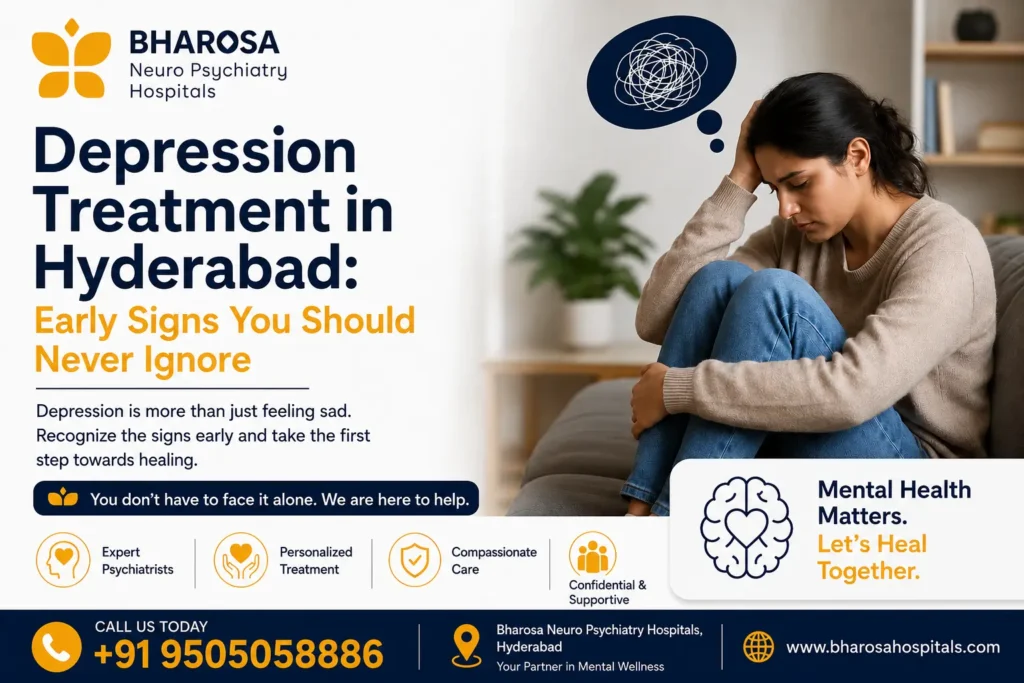
Ask most people what depression feels like, and they will describe sadness — a persistent, heavy, inexplicable low mood that colours everything grey. And while that is part of the truth, it is only a fraction of it. Depression is a whole-body condition — a complex neurological and physiological state that reshapes the way the brain processes information, the way the body functions, and the way a person experiences every dimension of their daily life. Understanding the full scope of what depression does to the mind and body is essential — both for people experiencing it and for those who love them — and it is the foundation of effective Depression Treatment in Hyderabad at Bharosa Neuro Psychiatry Hospital.
1. How Depression Affects the Brain
Depression is not simply a matter of thinking negatively. It involves measurable neurological changes — alterations in brain structure, chemistry, and function that are observable on neuroimaging and detectable through biochemical analysis.
Neurotransmitter Dysregulation
Depression is associated with dysregulation of multiple neurotransmitter systems — most prominently serotonin, norepinephrine, and dopamine. Reduced availability of serotonin is linked to persistent low mood, pessimistic thinking, and impaired emotional regulation. Dopamine deficiency underlies anhedonia — the inability to feel pleasure — which is one of the most diagnostically significant and debilitating features of major depressive disorder.
Structural Brain Changes
Research has demonstrated that prolonged depression is associated with reduced volume in the hippocampus — the brain region central to memory formation and emotional regulation — as well as decreased activity in the prefrontal cortex, which governs rational decision-making, problem-solving, and impulse control. These changes are not permanent with appropriate treatment — studies show that successful antidepressant therapy and psychotherapy can reverse hippocampal volume loss and restore prefrontal function.
The Cognitive Dimension
Depression profoundly impairs cognition. Working memory — the ability to hold and manipulate information in the moment — is significantly reduced. Concentration, attention, and processing speed all deteriorate. Decision-making becomes paralysing. Thinking becomes filtered through a pervasive negative cognitive bias — what cognitive therapists call the 'cognitive triad' of negative views of oneself, the world, and the future.
Depression does not only affect how you feel. It changes how you think, how your body functions, and how you perceive every experience — including the possibility of recovery itself.
2. How Depression Affects the Body
Depression's physical manifestations are real, medically significant, and frequently the first symptoms that prompt patients to seek help — often from non-psychiatric physicians who may not immediately recognise the underlying depressive disorder.
Sleep Disruption
Sleep disturbance is one of the most universal features of depression. Some patients experience hypersomnia — sleeping excessively, yet never feeling rested. More commonly, patients experience insomnia — particularly early morning awakening, where they wake hours before they need to and lie in the darkness overwhelmed by rumination and dread. The relationship is bidirectional: depression disrupts sleep, and disrupted sleep deepens depression.
Appetite and Weight Changes
Depression disrupts appetite regulation, most commonly producing a significant decrease in appetite and unintentional weight loss — with some patients losing 5–10% of body weight during a depressive episode. Less commonly, depression triggers emotional eating and weight gain. Both presentations reflect dysregulation of the hypothalamus and its interactions with stress hormones.
Physical Pain and Fatigue
Depression dramatically amplifies the perception of physical pain. Chronic headaches, unexplained muscle aches, back pain, and gastrointestinal symptoms are all common somatic presentations of depression — frequently misdiagnosed as purely physical conditions until the underlying mood disorder is identified. Profound fatigue — a heaviness that makes even basic daily tasks feel monumentally effortful — is reported by the majority of people with major depressive disorder.
Cardiovascular and Immune Impact
Chronic depression is associated with elevated inflammatory markers, dysregulation of the hypothalamic-pituitary-adrenal (HPA) axis, and increased cortisol levels — all of which contribute to significantly elevated risks of cardiovascular disease, metabolic syndrome, and reduced immune function. This is why early, effective Depression Treatment in Hyderabad is not only a matter of psychological wellbeing — it is a matter of physical health and longevity.
Psychomotor Changes
Depression can produce observable changes in physical movement and speech — either slowing them significantly (psychomotor retardation, visible as slowed movement, quiet and monotonous speech, and delayed responses) or, in agitated depression, producing restlessness, inability to sit still, and repetitive purposeless movement.
3. The Social and Relational Impact of Depression
Beyond the individual's internal experience, depression erodes the social fabric of a person's life. Withdrawal from social activities, reduced communication with family and friends, irritability that creates conflict in close relationships, and the shame and self-blame that depression generates all contribute to increasing isolation — which in turn deepens the depression, creating a self-reinforcing downward spiral.
This social dimension is why family involvement in depression treatment is so clinically important — and why Bharosa Hospitals integrates family therapy and family psychoeducation into its depression treatment programme as a standard component.
4. Effective Ways to Recover from Depression
Recovery from depression is not only possible — it is the statistically most likely outcome with appropriate treatment. The Depression Treatment in Hyderabad programme at Bharosa Hospitals is built on a multi-component model that addresses every dimension of depression described above:
Pharmacotherapy: Correcting Brain Chemistry
Antidepressant medications — SSRIs, SNRIs, TCAs, and MAOIs — target the neurotransmitter dysregulation that underlies depression. The choice of agent, dose, and duration is individualised based on the patient's specific symptom profile, medical history, prior treatment response, and tolerability preferences. Bharosa's psychiatrists take a precision pharmacology approach — not a one-size-fits-all prescription — and monitor medication response closely throughout treatment.
Cognitive Behavioural Therapy: Rewiring the Mind
CBT is the gold-standard psychological treatment for depression, targeting the distorted cognitions — the automatic negative thoughts and core beliefs — that maintain and intensify depressive episodes. Through structured, evidence-based techniques, CBT helps patients identify thought patterns such as catastrophising, black-and-white thinking, and personalisation, and systematically replace them with more balanced, reality-based perspectives. The research evidence for CBT in depression is among the most robust in all of clinical psychology.
Interpersonal Therapy (IPT): Healing Relationships
IPT focuses specifically on the interpersonal dimensions of depression — grief, role transitions, relationship conflicts, and social isolation. By directly addressing these relationship factors, IPT both reduces depressive symptoms and rebuilds the social connections that sustain long-term recovery.
Mindfulness-Based Cognitive Therapy (MBCT)
MBCT is specifically designed to prevent relapse in recurrent depression — one of the most clinically significant challenges in long-term depression management. By teaching patients to observe their thoughts and feelings without reactivity, MBCT breaks the automatic rumination cycles that typically trigger new depressive episodes.
ECT for Treatment-Resistant Depression
For patients who do not respond to two or more adequate antidepressant trials — a condition known as treatment-resistant depression — Electroconvulsive Therapy (ECT) is one of the most effective interventions in all of psychiatry, with response rates exceeding 70%. At Bharosa Hospitals, ECT is administered under general anaesthesia by Dr. Rajesh Kumar (DNB Anaesthesia, IDCCM Critical Care), using modern modified techniques that are safe, well-tolerated, and dramatically different from outdated depictions in popular culture.
Lifestyle and Physical Wellness
Regular aerobic exercise has been shown in controlled trials to have antidepressant effects comparable to medication for mild-to-moderate depression. Structured sleep hygiene, nutritional optimisation, and reduction of alcohol and substance use are all evidence-based components of comprehensive depression recovery. Bharosa's residential programme incorporates all of these as clinical components — not optional extras.
5. When to Seek Professional Help
If you or a loved one has been experiencing persistent low mood, loss of interest, sleep or appetite changes, fatigue, or thoughts of self-harm for more than two weeks, it is time to seek professional evaluation. Early Depression Treatment in Hyderabad consistently produces faster and more complete recovery than waiting until symptoms become severe. Please do not allow stigma, uncertainty, or the false hope that it will 'pass on its own' to delay care.
Frequently Asked Questions
Q1. How do I know if what I am feeling is depression or just stress?
Stress is typically tied to specific external circumstances and resolves when the circumstances change. Depression is persistent, pervasive, and often disconnected from external events. Symptoms lasting more than two weeks — including loss of interest, sleep disruption, unexplained physical symptoms, and fatigue — warrant a psychiatric evaluation. If in doubt, please call Bharosa Hospitals for a confidential assessment.
Q2. Can depression cause physical pain?
Yes. Physical pain — chronic headaches, back pain, muscle aches, and gastrointestinal symptoms — is a very common somatic manifestation of depression. These physical symptoms are neurologically real and frequently improve significantly with effective antidepressant treatment and psychotherapy.
Q3. Do I have to take medication to recover from depression?
Not always. Mild-to-moderate depression often responds well to psychotherapy alone, particularly CBT. Moderate-to-severe depression typically requires a combination of medication and therapy for the best outcomes. The Bharosa psychiatry team makes this recommendation based on a thorough individual assessment.
Q4. How long does it take to recover from depression?
An acute depressive episode typically responds to treatment within 6–12 weeks. Maintenance therapy to prevent relapse is usually recommended for at least 6–24 months depending on the patient's history. Recurrent depression may require longer-term maintenance treatment. Many patients experience significant improvement within the first 4–6 weeks.
Q5. Is it safe to exercise when I am depressed?
Yes — regular aerobic exercise is one of the most evidence-based non-pharmacological interventions for depression. Even gentle daily exercise such as walking has demonstrable mood-lifting effects. Bharosa's residential programme incorporates structured physical activity as a clinical component of treatment for exactly this reason.
Hospital Address & Contact
Bharosa Neuro Psychiatry Hospital & Rehabilitation Center
Plot No. 114, Mythripuram, Karmanghat, Opposite TKR College Common (TKR Kamaan), Main Road, LB Nagar / Karmanghat, Hyderabad – 500079, Telangana
+91 95050 58886 (Available 24/7)