
Dementia Care in Hyderabad: What Families Need to Know
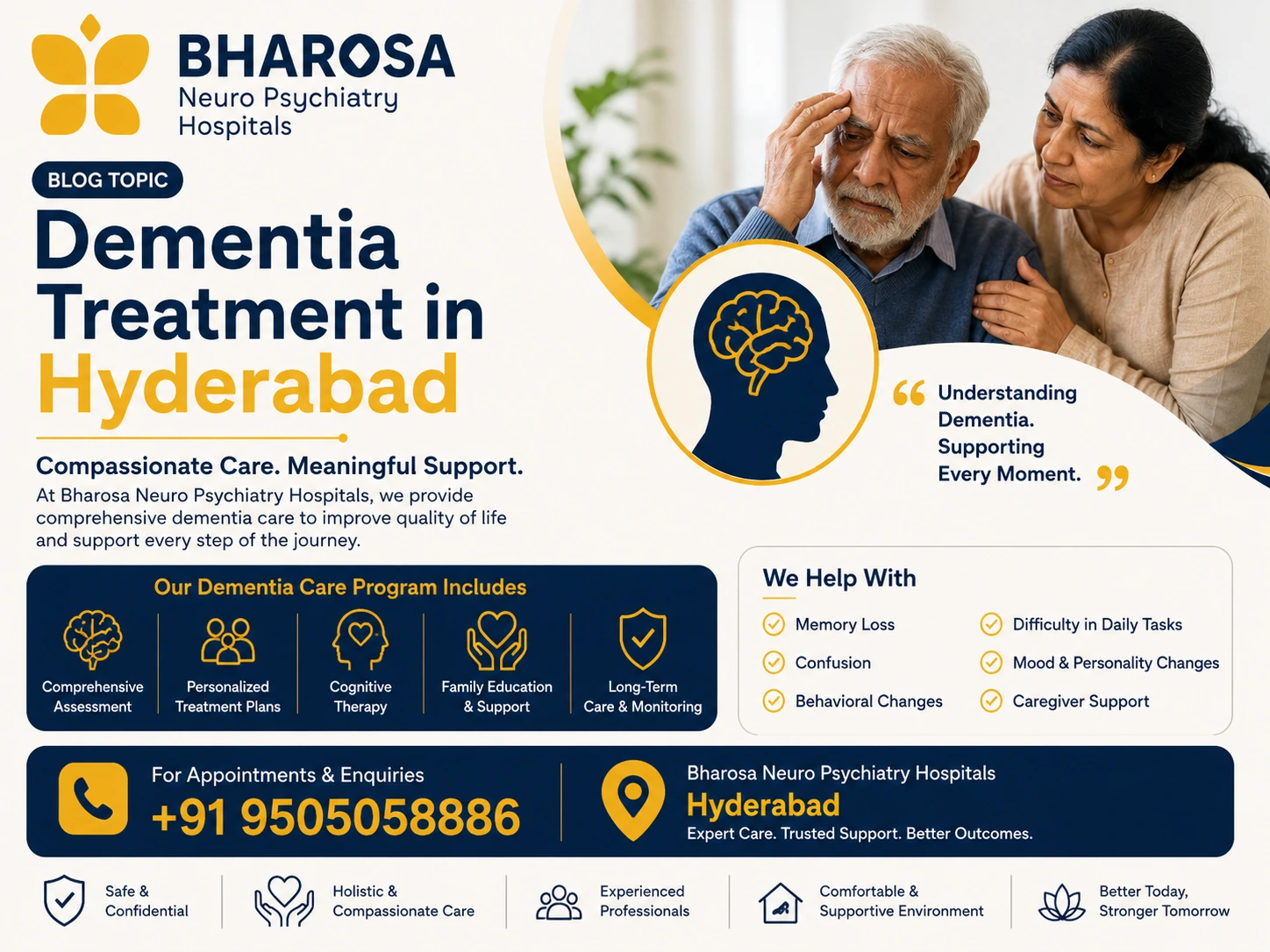
When a family member begins to forget — at first small things, then important things, then their own loved ones' faces — the experience is heart-breaking in a way that is difficult to describe. Dementia is not simply memory loss; it is the gradual erosion of identity, independence, and connection. Yet families navigating this journey need not do so without expert guidance and support. Accessing specialist Dementia Treatment in Hyderabad at Bharosa Neuro Psychiatry Hospital can make a profound difference — not only to the patient's quality of life but to the wellbeing of every family member walking this journey alongside them.
This blog is written for families — not just as an information guide, but as a compassionate companion document that addresses the questions, fears, and practical challenges that arise when a loved one is diagnosed with dementia. From understanding the condition to navigating treatment options, managing behavioural symptoms, and caring for yourself as a caregiver, this guide covers what families in Hyderabad need to know.
Understanding Dementia: What It Is and What It Is Not
What Dementia Is
Dementia is an umbrella term for a group of neurological syndromes characterised by progressive decline in cognitive function — memory, language, problem-solving, attention, and the ability to perform daily activities — severe enough to interfere with everyday life. It is caused by physical damage to brain cells, affecting how they communicate with each other.
Dementia is not a normal part of aging. While the risk of dementia increases significantly with age, it is a disease — not an inevitable consequence of growing old. This distinction is critically important because it means that expert Dementia Treatment in Hyderabad can make a significant difference — slowing progression, managing symptoms, preserving quality of life, and supporting families — rather than simply waiting for the condition to worsen.
What Dementia Is Not
- Dementia is NOT a normal part of aging — it is a disease that requires medical care
- Dementia is NOT simply forgetfulness — it is a progressive, multidimensional cognitive impairment
- Dementia is NOT a psychiatric disorder — though psychiatric symptoms (depression, psychosis, agitation) frequently accompany it
- Dementia is NOT untreatable — while no cure currently exists, evidence-based treatments can significantly slow progression and improve quality of life
- Dementia is NOT just the patient's problem — it affects the entire family and requires a family-centred care approach
Types of Dementia: What Families Need to Know
Understanding which type of dementia your family member has is important because different types have different trajectories, different symptom profiles, and different treatment considerations. At Bharosa's Dementia Treatment in Hyderabad program, our geriatric psychiatrists diagnose and manage all types:
Alzheimer's Disease (60–80% of dementia cases)
The most common form, characterised by gradual, progressive memory loss beginning with recent memories. Named after Dr. Alois Alzheimer who first described it in 1906, Alzheimer's involves the accumulation of amyloid plaques and tau tangles in the brain, causing widespread neuronal death. Early-stage Alzheimer's involves forgetting recent events and conversations; middle-stage involves confusion, disorientation, and behavioural changes; late-stage involves profound memory loss, inability to communicate, and full dependence on care.
Vascular Dementia (Second Most Common)
Caused by reduced or blocked blood flow to the brain — often following a stroke or series of mini-strokes (TIAs). Unlike Alzheimer's, vascular dementia often has a 'stepwise' progression — periods of relative stability punctuated by sudden worsening following vascular events. Cardiovascular risk factor management (blood pressure, diabetes, cholesterol) is a critical component of vascular dementia treatment.
Lewy Body Dementia
Characterised by the accumulation of Lewy bodies (abnormal protein deposits) in brain cells. Distinctive features include visual hallucinations (often vivid and detailed), fluctuating alertness and attention (the person may seem 'switched on' one hour and profoundly confused the next), and Parkinsonian movement symptoms. Lewy body dementia requires particular care with medications as patients are highly sensitive to certain drugs.
Frontotemporal Dementia (FTD)
Affects the frontal and temporal lobes of the brain — the areas governing personality, behaviour, language, and emotion. FTD typically affects younger patients (50s–60s) and often presents primarily as personality and behavioural changes rather than memory loss — making it particularly distressing for families who observe a loved one becoming seemingly unrecognisable in their character and conduct.
Mixed Dementia
Many patients, particularly those over 80, have a combination of two or more types of dementia — most commonly Alzheimer's disease and vascular dementia. Mixed dementia is increasingly recognised as the most common dementia presentation in very elderly patients.
The 10 Early Warning Signs Every Family Should Know
Early detection is one of the most powerful tools in Dementia Treatment in Hyderabad. The earlier diagnosis is made, the more treatment options are available and the more time families have to plan. Watch for these early warning signs:
- Memory loss that disrupts daily life — particularly forgetting recently learned information, asking the same questions repeatedly
- Difficulty planning, following instructions, or solving familiar problems — such as following a recipe or managing monthly bills
- Confusion about time and place — losing track of dates, seasons, or getting lost in familiar neighbourhoods
- New visual difficulties — trouble reading, judging distances, or determining colour contrast
- Problems finding words in conversation — stopping mid-sentence, substituting wrong words, calling things by wrong names
- Misplacing things and inability to retrace steps — placing objects in unusual locations and accusing others of theft
- Poor or decreased judgment — making unusual decisions, giving money to strangers, neglecting personal hygiene
- Withdrawal from social activities, hobbies, and work — losing interest in previously enjoyed pursuits
- Changes in mood and personality — increased confusion, suspicion, depression, fearfulness, or anxiety
- Difficulty completing familiar daily tasks — driving to a known location, operating household appliances
What Families Can Expect from Dementia Treatment in Hyderabad at Bharosa
1. Comprehensive Geriatric Psychiatric Assessment
Diagnosis begins with a thorough, expert evaluation. Our geriatric psychiatrists use standardised cognitive assessment tools including the MMSE (Mini-Mental State Examination) and MoCA (Montreal Cognitive Assessment), alongside detailed medical history, neurological examination, collateral history from family members, blood tests to exclude reversible causes of cognitive decline (thyroid disease, vitamin B12 deficiency, infections), and neuroimaging (CT/MRI) when indicated.
This comprehensive diagnostic process differentiates dementia from normal aging, depression-related cognitive impairment (pseudodementia), delirium, and other reversible causes of cognitive decline — ensuring accurate diagnosis and appropriate treatment.
2. Pharmacological Management
While no medication currently reverses dementia, pharmacological treatment at Bharosa's Dementia Treatment in Hyderabad program focuses on:
- Cholinesterase inhibitors (donepezil, rivastigmine, galantamine) — proven to slow cognitive decline in Alzheimer's disease by enhancing neurotransmitter function
- Memantine — for moderate-to-severe Alzheimer's, providing additional cognitive protection
- Management of behavioural and psychological symptoms of dementia (BPSD) — including agitation, aggression, depression, anxiety, psychosis, and sleep disturbance — which are often more distressing for families than the cognitive symptoms
- Cardiovascular risk factor management in vascular dementia — blood pressure control, antiplatelet therapy, and diabetes management to prevent further vascular events
3. Cognitive Stimulation Therapy (CST)
CST is one of the few non-pharmacological interventions with strong evidence for improving cognition and quality of life in mild to moderate dementia. At Bharosa, structured CST sessions use mentally stimulating activities — word games, music, discussion, reminiscence, creative activities, and practical exercises — to engage and stimulate remaining cognitive function, maintain social connection, and improve mood.
Research shows that regular cognitive stimulation can produce cognitive improvements comparable to cholinesterase inhibitor medications in mild to moderate dementia — making it a vitally important component of comprehensive dementia care.
4. Behavioural and Psychological Symptom Management
BPSD — the behavioural and psychological symptoms of dementia — are among the most challenging and distressing aspects of the condition for families. These include agitation, aggression, wandering, sundowning (increased confusion in the late afternoon and evening), sexual disinhibition, repetitive behaviours, psychosis (hallucinations and delusions), depression, and sleep-wake cycle disruption.
Bharosa's multidisciplinary team uses a systematic approach to BPSD management — first identifying and addressing environmental and interpersonal triggers before considering pharmacological intervention, and using non-pharmacological strategies including structured daily routines, sensory therapies, music therapy, validation therapy, and environmental modification as first-line responses.
5. Caregiver Education and Psychological Support
Family caregivers of dementia patients are among the most stressed and burned-out population in all of health care. The physical, emotional, financial, and social demands of dementia caregiving are immense — and caregiver burnout is recognised as a serious health risk in its own right.
Bharosa's dementia care program includes structured caregiver education sessions covering communication strategies for different dementia stages, management of difficult behaviours, safety adaptations for the home environment, legal and financial planning guidance, and recognising and managing caregiver stress. Individual counselling and psychological support for family caregivers is an integral component of our program.
6. Residential and Respite Care
For patients who require more intensive supervision than can be provided at home — particularly those with severe behavioural symptoms, significant wandering risk, or whose family caregivers require a period of rest — Bharosa's residential facility provides safe, structured, expert dementia care in a calm and compassionate environment.
Communicating with a Family Member with Dementia: Practical Guidance
One of the most immediate challenges families face is communication. As language and comprehension abilities change with dementia progression, the familiar ways of communicating become ineffective. Bharosa's care team provides families with practical communication strategies:
- Use simple, short sentences with one idea at a time
- Approach from the front, at eye level, and use the person's name
- Allow extra processing time — do not rush or finish sentences for them
- Use gentle touch and nonverbal reassurance when words are failing
- Enter their reality rather than correcting delusions or misidentifications
- Focus on emotions and feelings rather than facts when reality orientation is not possible
Planning for the Future: What Families Need to Consider Early
Early dementia diagnosis — while the patient still has meaningful capacity — is the optimal time for important future planning. Families should discuss and document legal arrangements (power of attorney, advance medical directives), financial planning, care preferences and wishes, driving safety, and living arrangements. Bharosa's team can guide families through these conversations and connect them with appropriate legal and social support services in Hyderabad.
Conclusion
Dementia is one of life's most challenging journeys — for the person experiencing it and for every family member walking alongside them. But it is a journey that no family in Hyderabad needs to walk alone. Expert Dementia Treatment in Hyderabad at Bharosa Neuro Psychiatry Hospital offers not just medical management, but genuine partnership — providing the clinical expertise, emotional support, practical guidance, and compassionate care that families need at every stage. Reach out to us today and let us walk this journey with you.
Call Now: +91 9505058886
Frequently Asked Questions (FAQs)
Q: How is dementia diagnosed at Bharosa Hospitals?
A: Bharosa's geriatric psychiatrists conduct a comprehensive diagnostic evaluation including standardised cognitive assessments (MMSE, MoCA), detailed medical and family history, neurological examination, collateral history from family, blood investigations to exclude reversible causes, and neuroimaging (CT/MRI) when indicated. This thorough process ensures accurate diagnosis and differentiation from normal aging and other reversible conditions.
Q: Can dementia be cured with treatment?
A: Currently, no medication reverses or cures dementia. However, evidence-based treatments at Bharosa — including cholinesterase inhibitors, memantine, cognitive stimulation therapy, and comprehensive behavioural symptom management — can significantly slow cognitive decline, manage distressing symptoms, and meaningfully improve quality of life for both patients and families.
Q: At what stage of dementia should we seek specialist help?
A: Ideally at the very first signs of cognitive change — before a crisis occurs. Early diagnosis maximises the benefit of available treatments, allows important legal and financial planning while the patient retains capacity, and gives families more time to access support and adjust. If you have noticed any of the 10 warning signs listed in this blog, contact Bharosa immediately for an assessment.
Q: How does Bharosa support family caregivers of dementia patients?
A: Caregiver support is a core component of Bharosa's dementia care program. We provide structured psychoeducation, communication skills training, behavioural management strategies, home safety guidance, caregiver counselling, legal and financial planning guidance, and respite care options — recognising that caregiver wellbeing is inseparable from patient wellbeing.
Q: Does Bharosa provide residential dementia care?
A: Yes. For patients who require more intensive supervision than can be safely provided at home — particularly those with severe behavioural symptoms, significant wandering risk, or complex medical management needs — Bharosa's residential facility provides expert, compassionate dementia care in a safe and structured environment with 24/7 supervision.
Q: How do I book a dementia assessment at Bharosa Hospitals?
A: Call or WhatsApp +91 9505058886 at any time — our team is available 24 hours a day, 7 days a week. You can also visit our hospital at Plot No. 114, Mythripuram, Karmanghat, Opposite TKR College Comman, LB Nagar, Hyderabad – 500079. Our geriatric psychiatry team will arrange a thorough assessment at the earliest available appointment.
Hospital Address & Contact
Bharosa Neuro Psychiatry Hospital & Rehabilitation Center
Plot No. 114, Mythripuram, Karmanghat, Opposite TKR College Comman (TKR Kamaan),Main Road, LB Nagar / Karmanghat, Hyderabad – 500079, Telangana, India
Phone : +91 9505058886