The Complete Recovery Journey at a De-Addiction Centre in Hyderabad
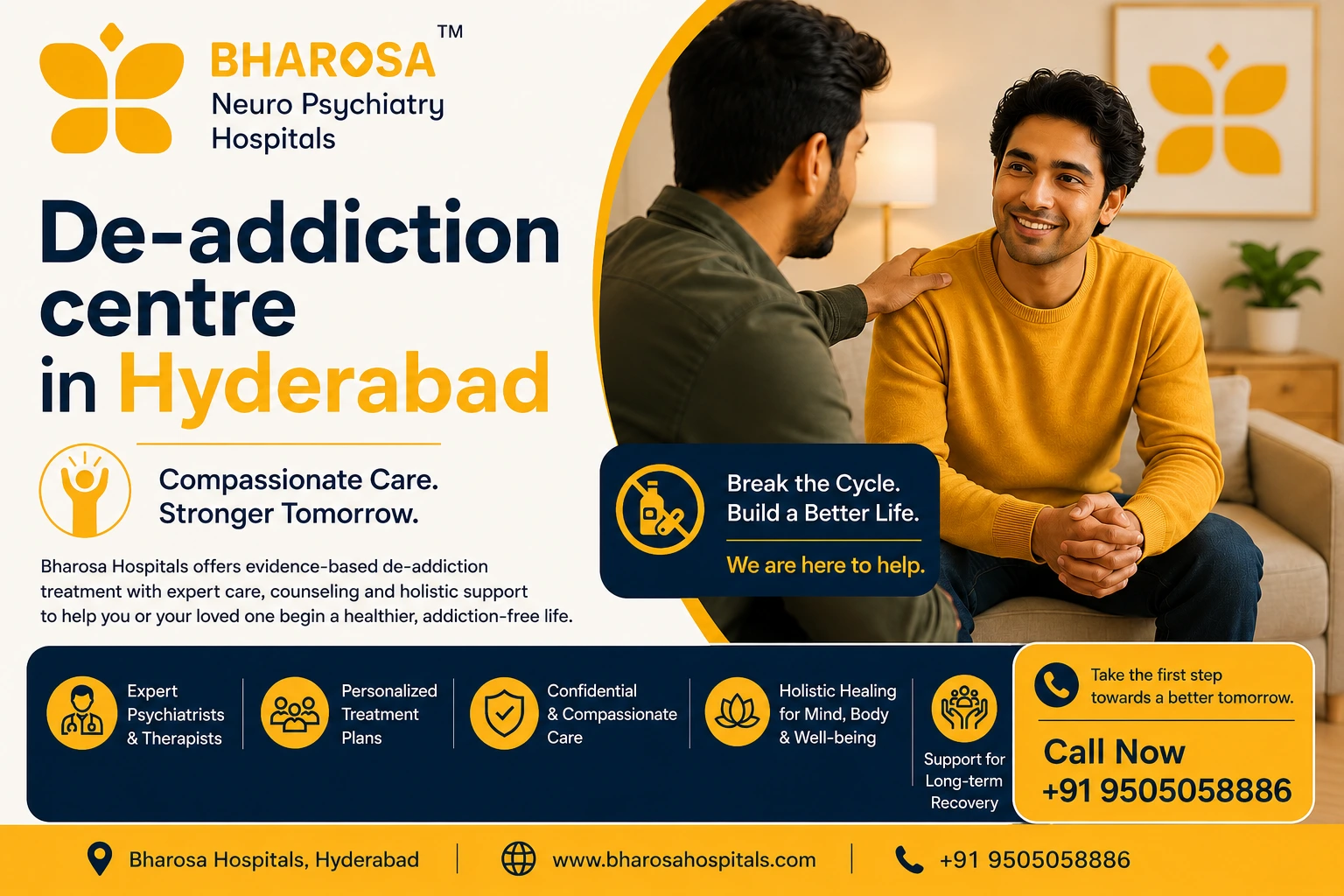
Recovery from addiction is not an event — it is a journey. It is a deeply personal, often non-linear process of biological healing, psychological transformation, social reconstruction, and spiritual renewal. For families watching a loved one struggle with alcohol or drug dependence, the question is rarely whether they want their loved one to recover. The question is: what does real recovery look like, how does it happen, and who can we trust to guide us through it? At Bharosa Neuro Psychiatry Hospital — the most comprehensive De Addiction Centre in Hyderabad — we believe that every family deserves to understand exactly what this journey entails, from the first phone call to the final step of long-term aftercare. This blog is that guide.
1. Understanding Addiction as a Brain Disease
Before the journey can begin, it is essential to understand what it is we are treating. Addiction — whether to alcohol, opioids, cannabis, cocaine, or behavioural compulsions — is not a moral failure, a lack of willpower, or a choice the person could simply reverse if they cared enough. It is a neurological condition characterised by fundamental changes in the brain's reward, motivation, memory, and decision-making systems.
When a person repeatedly uses a substance, the brain's dopamine system undergoes progressive adaptation. The substance hijacks the natural reward pathway, creating powerful compulsive urges and gradually suppressing the prefrontal cortex — the part of the brain responsible for rational decision-making and impulse control. The person does not choose to lose control; their neurology has been altered to make control increasingly difficult.
This neurological reality has two critical clinical implications: first, that willpower alone is insufficient for sustained recovery; and second, that professional, medically supervised treatment — spanning sufficient time for genuine brain recovery — is not a luxury but a necessity. It is the reason the De Addiction Centre in Hyderabad at Bharosa Hospitals developed its scientifically grounded 100-Days Treatment Program.
The brain's reward and decision-making circuits require 12–16 weeks of sustained abstinence and guided rehabilitation before meaningful neuroplastic recovery begins. This is the neuroscience behind Bharosa's 100-Days Program.
2. Step 1: The First Contact — Breaking Through Fear and Stigma
For most families, the first step is also the hardest: making the call. Shame, fear of judgement, uncertainty about what to expect, and concern about confidentiality all create barriers that delay life-saving intervention. At Bharosa Hospitals, we have designed every aspect of our first-contact experience to remove these barriers.
When you call +91 95050 58886 — available 24 hours a day, seven days a week — you will speak with a compassionate, trained staff member who will listen without judgement, answer your questions honestly, and guide you gently through the process of arranging an assessment. All enquiries are handled with absolute confidentiality. You do not need to have all the answers; you simply need to make the call.
Families can also visit the De Addiction Centre in Hyderabad at Bharosa directly, or book an appointment online at www.bharosahospitals.com. No referral is required.
3. Step 2: The Psychiatric Assessment — Understanding the Full Picture
Upon arrival, each patient undergoes a comprehensive psychiatric assessment conducted by a senior MD psychiatrist. This evaluation is the foundation of everything that follows — and it is significantly more thorough than a standard hospital intake.
The assessment covers: the history and pattern of substance use; the type, quantity, and duration of addiction; previous treatment attempts and their outcomes; the presence of any co-occurring mental health conditions (dual diagnosis) such as depression, anxiety, PTSD, or bipolar disorder; the patient's physical health status; family dynamics and social circumstances; and the patient's own goals and concerns about treatment.
The result is not just a diagnosis but a formulation — a clinically rich understanding of the person, not just the addiction — which informs a genuinely individualised treatment plan.
4. Step 3: Medical Detoxification — The Gateway to Recovery
What Detox Involves
Medical detoxification is the safe, clinically supervised process of clearing the substance from the patient's body while managing withdrawal symptoms with precision and compassion. At Bharosa's De Addiction Centre in Hyderabad, detox is conducted under 24-hour nursing supervision with daily review by a senior psychiatrist. Withdrawal — the physical and psychological response to the cessation of a substance the body has become dependent upon — ranges from mild to life-threatening depending on the substance and severity of use.
Why Medical Supervision is Non-Negotiable
Alcohol withdrawal is potentially fatal — with risks including seizures and delirium tremens (DTs) that require immediate medical management. Opioid withdrawal, while rarely fatal in otherwise healthy individuals, is intensely uncomfortable without pharmacological support. Attempting detox at home without medical supervision is dangerous, ineffective, and dramatically increases the risk of relapse during the acute withdrawal period.
At Bharosa, pharmacological protocols — including benzodiazepines for alcohol withdrawal, buprenorphine for opioid withdrawal, anti-craving medications, nutritional supplementation (particularly B-vitamin therapy for alcohol dependence), and symptomatic relief agents — ensure that each patient navigates detox safely and as comfortably as possible.
The Duration and Experience of Detox
Acute detoxification typically takes 5 to 14 days, depending on the substance, duration of use, and the patient's physical health. The team maintains continuous monitoring throughout, adjusting protocols in real time based on the patient's response. Families receive regular updates, and the patient is oriented at every stage — detox at Bharosa is never an isolating experience.
5. Step 4: Psychiatric Stabilisation — Addressing the Mind
As the body stabilises physically, the psychiatric team turns its focus to the mind. A significant proportion of people with addiction — estimates suggest up to 50–70% — have at least one co-occurring mental health condition. Depression, anxiety, trauma, PTSD, and bipolar disorder are particularly common. These conditions frequently drove or sustained the addiction — and if left untreated, they become the primary trigger for relapse after discharge.
During the stabilisation phase at Bharosa, the psychiatric team diagnoses and begins treating any co-occurring mental health conditions simultaneously with the addiction. Medications are introduced or adjusted as needed. The patient begins attending initial therapeutic sessions, begins re-establishing healthy sleep and daily routines, and starts to engage with the structure of the residential programme.
6. Step 5: Intensive Rehabilitation — The Heart of the Journey
This is the longest and most transformative phase of the recovery journey — and it is what distinguishes Bharosa as the leading De Addiction Centre in Hyderabad from facilities that offer only detox or short-term residential stays. The intensive rehabilitation phase typically spans Weeks 3 through 12 of the 100-Days Program, and it involves:
Individual Therapy
Each patient receives regular individual therapy sessions with a qualified clinical psychologist or psychiatrist. The therapeutic modality is matched to the patient's profile: CBT for cognitive restructuring and relapse prevention; DBT for emotional regulation and distress tolerance; ACT for acceptance of difficult emotions and commitment to recovery values; EMDR for trauma processing where addiction has roots in unresolved traumatic experiences.
Group Therapy
Daily group therapy sessions provide a peer support environment of enormous value — reducing the shame and isolation that sustain addiction, building communication and interpersonal skills, and providing the lived experience of others in recovery as a source of hope and practical wisdom. At Bharosa, groups are facilitated by experienced clinical staff and are structured around specific therapeutic themes.
Family Therapy
Addiction is a family disease — it disrupts relationships, creates enabling dynamics, generates patterns of conflict and avoidance, and traumatises family members in ways that require their own healing. Bharosa's family therapy programme involves regular sessions with the patient and their family members, focusing on communication, boundary setting, rebuilding trust, and preparing the family to support recovery without inadvertently enabling relapse.
Expressive and Holistic Therapies
Art Therapy, Music Therapy, Yoga, and structured recreational activities complement the clinical programme — supporting emotional expression, stress regulation, physical wellbeing, and the rediscovery of pleasure in sober experience. These are not extras — they are clinically integrated components of a whole-person rehabilitation approach.
Life Skills and Vocational Rehabilitation
Addiction often erodes fundamental life skills — financial management, time organisation, interpersonal communication, occupational functioning. The rehabilitation programme at Bharosa addresses these directly, preparing patients not just for sobriety but for a functional, meaningful life after discharge.
7. Step 6: Relapse Prevention Planning — Building the Safety Net
Approximately two-thirds of the way through the programme, the clinical team begins working intensively with the patient on relapse prevention — arguably the most critical component of long-term recovery success.
This involves: identifying the patient's personal high-risk situations and triggers; developing concrete, practiced coping strategies for each; building a sober social support network; creating an emergency response plan for moments of intense craving; addressing any unresolved conflicts in key relationships; and planning the reintegration into work, education, or daily responsibilities in a staged, supported way.
Relapse is not failure — it is often part of the recovery journey. The goal of relapse prevention planning is not to guarantee that the patient never experiences a craving, but to ensure that when they do, they have the tools, support, and plan to navigate it without returning to use.
8. Step 7: Discharge and Aftercare — The Journey Continues
Discharge from the De Addiction Centre in Hyderabad at Bharosa Hospitals is not the end of the recovery journey — it is the beginning of the next phase. Every patient leaves with a comprehensive written aftercare plan that includes:
- Scheduled follow-up psychiatric consultations with the treating psychiatrist
- Continued outpatient therapy (individual and/or group) at specified intervals
- Maintenance medication plan with clear instructions and monitoring schedules
- Peer support group participation — connecting with others in recovery for ongoing community
- Crisis intervention contacts and protocols for moments of acute craving or relapse risk
- Family support guidelines — helping the family understand their role in sustained recovery
- Lifestyle recommendations — sleep, nutrition, exercise, social re-engagement
The Bharosa clinical team maintains contact with patients and families during the post-discharge period, adjusting the aftercare plan as the patient's life evolves. Recovery is a dynamic process, and support must be equally dynamic.
9. What Successful Recovery Looks Like
Recovery is different for every person — but it consistently involves a return to functioning in the areas that matter most: relationships, work or purpose, physical health, and self-respect. Many of Bharosa's patients describe their post-treatment lives not merely as 'sober' but as fundamentally transformed — with clarity, emotional depth, and a sense of agency they had not experienced for years.
Patient testimonials from Bharosa consistently highlight the structured environment, the genuine care of the clinical team, the effectiveness of the counselling, and the lasting changes achieved. From individuals who had struggled with alcohol dependence for two decades to young people whose lives had been derailed by drug use — the journey through Bharosa's 100-Days Program has proven, time and again, to be a genuine turning point.
10. When to Seek Help — There Is No Threshold That Must Be Met
One of the most harmful myths in addiction is that the person must 'hit rock bottom' before seeking help. There is no required level of suffering that qualifies a person for treatment at the De Addiction Centre in Hyderabad at Bharosa Hospitals. Early intervention — before careers are destroyed, before relationships are severed, before health is irreparably damaged — produces faster and more complete recovery. If you are concerned about yourself or a loved one, the time to seek help is now.
Frequently Asked Questions
Q1. How do I know if my loved one's drinking or drug use has crossed into addiction?
Key indicators include inability to control or stop use despite wanting to, withdrawal symptoms when not using, prioritising substance use over family, work or health, using more than intended, and continuing use despite clear negative consequences. If you are asking the question, the answer is almost certainly 'yes' — and a professional assessment at Bharosa will confirm and clarify.
Q2. What is the difference between detox and rehabilitation?
Detox is the medical process of safely clearing the substance from the body and managing withdrawal — it typically takes 5–14 days. Rehabilitation is the longer process of psychological, behavioural, and social recovery that follows detox. Both are essential; detox alone without rehabilitation produces very high rates of relapse.
Q3. Is the 100-Days Program residential?
Yes. The 100-Days Program at Bharosa is a fully residential programme — patients live on campus in a clean, structured, medically supervised environment throughout the 100 days. This residential component is critical because it removes patients from their usual triggers and provides continuous therapeutic engagement.
Q4. Can patients use their mobile phones during the 100-Days Program?
Mobile phone access is structured within the programme guidelines, with provisions for regular family contact. For patients with mobile addiction as part of their presentation, access is managed as part of the therapeutic plan. Specific guidelines are provided at the time of admission.
Q5. What types of addiction does Bharosa Hospitals treat?
Bharosa treats all substance addictions including alcohol, opioids, heroin, cannabis, cocaine, and tobacco — as well as behavioural addictions including mobile addiction, gaming addiction, gambling and betting addiction, shopping addiction, and pornography addiction.
Q6. What is the cost of the de-addiction programme at Bharosa?
Programme costs vary based on the type of care, duration, and individual requirements. Contact +91 95050 58886 or visit www.bharosahospitals.com for current pricing information. Bharosa is committed to making world-class care accessible and discusses payment options with every family.
Bharosa Neuro Psychiatry Hospital & Rehabilitation Center
Plot No. 114, Mythripuram, Karmanghat, LB Nagar, Hyderabad – 500079
Opp. TKR College, Main Road, LB Nagar / Karmanghat, Hyderabad
+91 95050 58886