
Child Psychiatrist Hyderabad: When Should Your Child See a Specialist? | Bharosa Hospitals
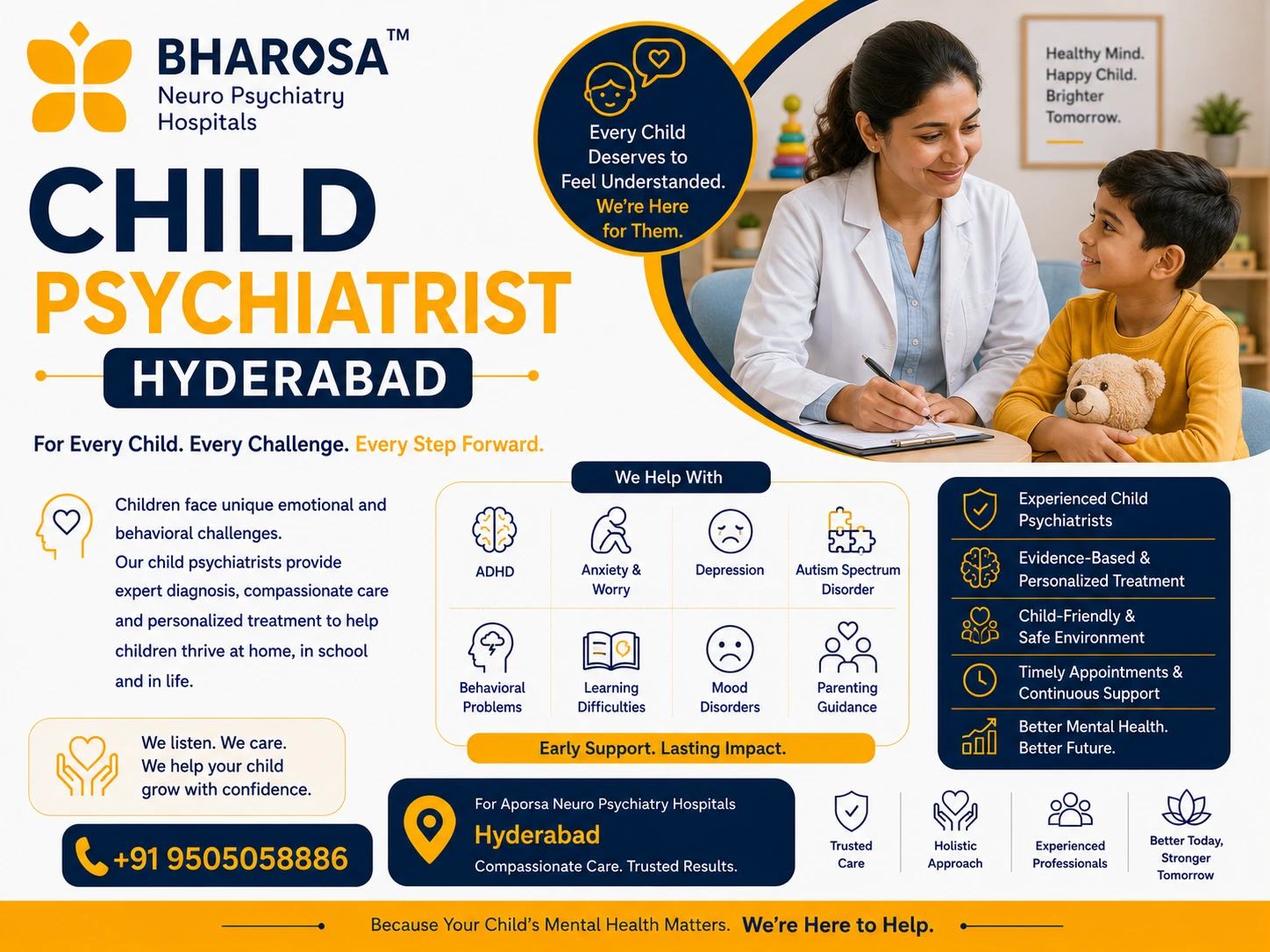
Every parent instinctively knows when something is 'not quite right' with their child — a persistent sadness that does not lift, an anxiety so intense it prevents school attendance, behaviours that seem beyond the child's control, or a developmental trajectory that worries even the most patient, attentive parent. Yet many parents hesitate to seek professional help — uncertain whether their concerns are serious, worried about stigma, or simply unsure where to turn. This guide answers the single most important question: when should your child see a Child Psychiatrist Hyderabad?
Bharosa Neuro Psychiatry Hospital at LB Nagar, Hyderabad, has a dedicated Child and Adolescent Psychiatry Department offering specialised assessment and treatment for children from early childhood through late adolescence. Our team brings clinical expertise and genuine warmth to the youngest and most vulnerable patients — and the families who love them.
Child Mental Health Fact: The WHO reports that 50% of all adult mental health conditions have their first onset before the age of 14. Early intervention with a Child Psychiatrist can prevent childhood difficulties from becoming lifelong conditions.
What Does a Child Psychiatrist Do?
A Child Psychiatrist Hyderabad is a medical doctor with specialist postgraduate training in both psychiatry and child/adolescent development — uniquely equipped to diagnose and treat mental, emotional, developmental, and behavioural disorders in children from infancy through 18 years of age.
Unlike a general paediatrician, who manages physical health, or a school counsellor, who provides emotional support, a child psychiatrist can diagnose psychiatric conditions, prescribe and monitor medication when indicated, formulate comprehensive biopsychosocial treatment plans, and coordinate care across families, schools, and other health professionals.
At Bharosa, child psychiatric assessments are conducted with particular sensitivity to the child's developmental stage, family context, cultural background, and the systemic factors — school environment, family dynamics, peer relationships — that profoundly influence childhood mental health.
10 Key Signs Your Child Should See a Child Psychiatrist Hyderabad
Knowing when to consult a Child Psychiatrist Hyderabad rather than waiting and hoping symptoms resolve on their own is one of the most important decisions a parent can make. Seek specialist assessment if your child shows:
1. Persistent Emotional Difficulties (Mood and Anxiety)
Sadness, crying, or emotional withdrawal persisting for more than 2 weeks; intense, uncontrollable worry about school, family, health, or friendships; persistent fear of separation from parents beyond the developmentally expected age; or frequent, intense mood swings that significantly disrupt family life and daily functioning.
2. School Refusal or Severe Academic Decline
Repeated, distressed refusal to attend school — particularly when accompanied by somatic complaints (stomach aches, headaches that resolve once allowed to stay home) — is a significant warning sign. Similarly, a sudden, unexplained drop in academic performance from a child's established baseline warrants psychiatric assessment to exclude depression, anxiety, ADHD, learning disabilities, or social difficulties as contributing factors.
3. Significant Behavioural Changes
Sudden, dramatic changes in behaviour — increased aggression, defiance, destructiveness, or social withdrawal — that represent a clear departure from the child's previous personality and persist for more than 2 weeks. It is important to distinguish normal developmental changes (the challenging behaviours of toddlerhood and adolescence) from clinically significant, persistent, and impairing behavioural changes.
4. Attention, Hyperactivity, and Impulsivity Concerns (ADHD)
If teachers and parents are both noting significant difficulties with attention, impulse control, and hyperactivity that impair learning and social functioning across multiple settings (not just at school or just at home), a professional assessment for ADHD is warranted. Early, accurate diagnosis and treatment transforms outcomes for children with ADHD.
5. Developmental Concerns — Language, Social Skills, or Play
Delays in reaching developmental milestones — particularly in language development, social interaction, eye contact, imaginative play, and flexible thinking — may indicate autism spectrum disorder or other neurodevelopmental conditions requiring specialist assessment. Early identification and intervention produces dramatically better developmental outcomes.
6. Self-Harm or Suicidal Expression
Any expression of self-harm, suicidal thinking, or wishes to die in a child or adolescent requires immediate psychiatric assessment — regardless of whether the parent believes these statements are 'attention-seeking' or 'not serious.' Children and adolescents express suicidal thoughts differently from adults and these expressions should never be dismissed without professional evaluation.
7. Disordered Eating
Significant restriction of food intake, food fear, excessive concern about weight and body shape, or binge-purge behaviours in children or adolescents require specialist assessment. Eating disorders in young people are medical emergencies when severe, and early intervention dramatically improves prognosis.
8. Sleep Disorders and Nightmares
Persistent, severe sleep difficulties — recurring nightmares, sleep paralysis, night terrors, or chronic insomnia — that significantly disrupt the child's daily functioning, mood, and academic performance warrant assessment, as sleep disorders in children are frequently linked to anxiety, trauma, or mood disorders.
9. Social Withdrawal and Peer Relationship Difficulties
A child who has progressively withdrawn from friendships, is being bullied or is bullying others, or who has never developed age-appropriate peer relationships may benefit from psychiatric assessment to explore anxiety, autism spectrum traits, depression, or social skills deficits that specialist intervention can address.
10. Exposure to Trauma or Significant Stressors
Children who have experienced parental separation or divorce, domestic violence, abuse, bereavement, serious illness, or other significant trauma should be assessed by a child psychiatrist for trauma-related responses — even if they appear to be 'coping fine on the surface.' Children often internalise trauma rather than expressing it overtly, and early assessment prevents long-term psychological impact.
What to Expect at Your Child's First Psychiatric Assessment
The prospect of bringing your child to a Child Psychiatrist Hyderabad for the first time can feel daunting. At Bharosa, we work to make this experience as comfortable and reassuring as possible for both the child and parents. A typical first assessment includes:
- Parent Interview: A detailed discussion with parents covering the child's developmental history, current concerns, school performance, family history, and any previous assessments or treatments
- Child Assessment: An age-appropriate individual meeting with the child — using play, drawing, storytelling, or direct conversation depending on the child's age and presentation — to understand their perspective, emotional world, and current difficulties
- Behavioural Observation: Our psychiatrists observe the child's behaviour, interaction style, attention, and emotional regulation throughout the session
- Psychometric Assessment: Standardised rating scales and, where indicated, formal psychological testing to support accurate diagnosis
- Feedback and Treatment Planning: A compassionate, jargon-free discussion of findings, diagnosis (or the need for further assessment), and recommended treatment options — always involving parents as full partners in the process
Child Mental Health Treatment Approaches at Bharosa
- Child-adapted Cognitive Behavioural Therapy (CBT) — for anxiety, depression, and OCD in children and adolescents
- Play Therapy — using structured therapeutic play to help younger children process emotions and experiences
- Art Therapy — creative expression as a therapeutic and diagnostic medium for children who struggle to verbalise feelings
- Parent Training Programs — equipping parents with evidence-based behaviour management and emotional support strategies
- School Liaison — working with teachers and school counsellors to ensure consistent support across settings
- Medication Management — careful, conservative prescribing when medication is indicated, with thorough parental education and consent
- Family Therapy — addressing the family-systemic dimensions of childhood mental health
- Social Skills Training — structured group-based learning for children with social communication difficulties
Your instinct as a parent is one of the most reliable indicators that something needs professional attention. If you have been wondering whether your child should see a Child Psychiatrist Hyderabad — the answer is almost always: it is better to seek an assessment and be reassured than to wait and allow difficulties to deepen. At Bharosa Hospitals, our child and adolescent psychiatric team is ready to provide the expert, compassionate assessment your child deserves.
Call Now to Book a Child Psychiatric Assessment: +91 9505058886
Frequently Asked Questions (FAQs)
Q: From what age can a child see a Child Psychiatrist Hyderabad at Bharosa?
A: Bharosa's Child and Adolescent Psychiatry Department sees patients from toddler age through 18 years. For the youngest children (under 3 years), assessments focus primarily on developmental concerns — language, social development, and early signs of autism spectrum disorder. Age-appropriate assessment methods are used for every developmental stage.
Q: Will my child be given medication at their first appointment?
A: No. Medication is never prescribed at a first appointment without thorough assessment, diagnosis, and detailed discussion with parents. At Bharosa, medication is used conservatively, always as part of a comprehensive treatment plan, and only after all non-pharmacological options have been considered. Parental informed consent is always obtained before any medication is prescribed.
Q: Should I tell my child we are going to see a psychiatrist?
A: Yes — and honestly, at an age-appropriate level. Explaining the visit as 'talking to a doctor who helps people understand their feelings and thoughts' removes the mystery and reduces anxiety about the appointment. Avoid describing it as going because they are 'bad' or 'crazy' — frame it as getting help for difficult feelings. Our team can advise parents specifically on how to prepare their child for the assessment.
Q: Can ADHD be managed without medication in children?
A: Yes, for mild to moderate ADHD, particularly in younger children. Behavioural parent training, classroom accommodations, social skills training, and CBT-based approaches are effective first-line interventions. For moderate-to-severe ADHD significantly impairing academic and social functioning, medication combined with behavioural intervention produces the best outcomes. Our child psychiatrists discuss all options thoroughly with families.
Q: How long does childhood mental health treatment typically take at Bharosa?
A: Treatment duration varies by condition and individual. Brief, focused interventions (parent training, CBT for specific phobias) may involve 6–12 sessions. Ongoing management of conditions like ADHD, autism, and depression may continue for years with regular review. Our team provides realistic timeline expectations and reviews progress regularly to ensure treatment remains appropriately tailored.
Q: How do I make an appointment with the Child Psychiatrist Hyderabad at Bharosa?
A: Call or WhatsApp +91 9505058886 at any time. You can also visit our hospital at Plot No. 114, Mythripuram, Karmanghat, Opposite TKR College Comman, LB Nagar, Hyderabad – 500079. Our team will arrange an assessment appointment for your child with our Child and Adolescent Psychiatry team as quickly as possible.
Hospital Address & Contact
Bharosa Neuro Psychiatry Hospital & Rehabilitation Center
Plot No. 114, Mythripuram, Karmanghat, Opposite TKR College Comman (TKR Kamaan),Main Road, LB Nagar / Karmanghat, Hyderabad – 500079, Telangana, India
Phone: +91 9505058886