
Bipolar Disorder Treatment Hyderabad: A Complete Recovery Guide
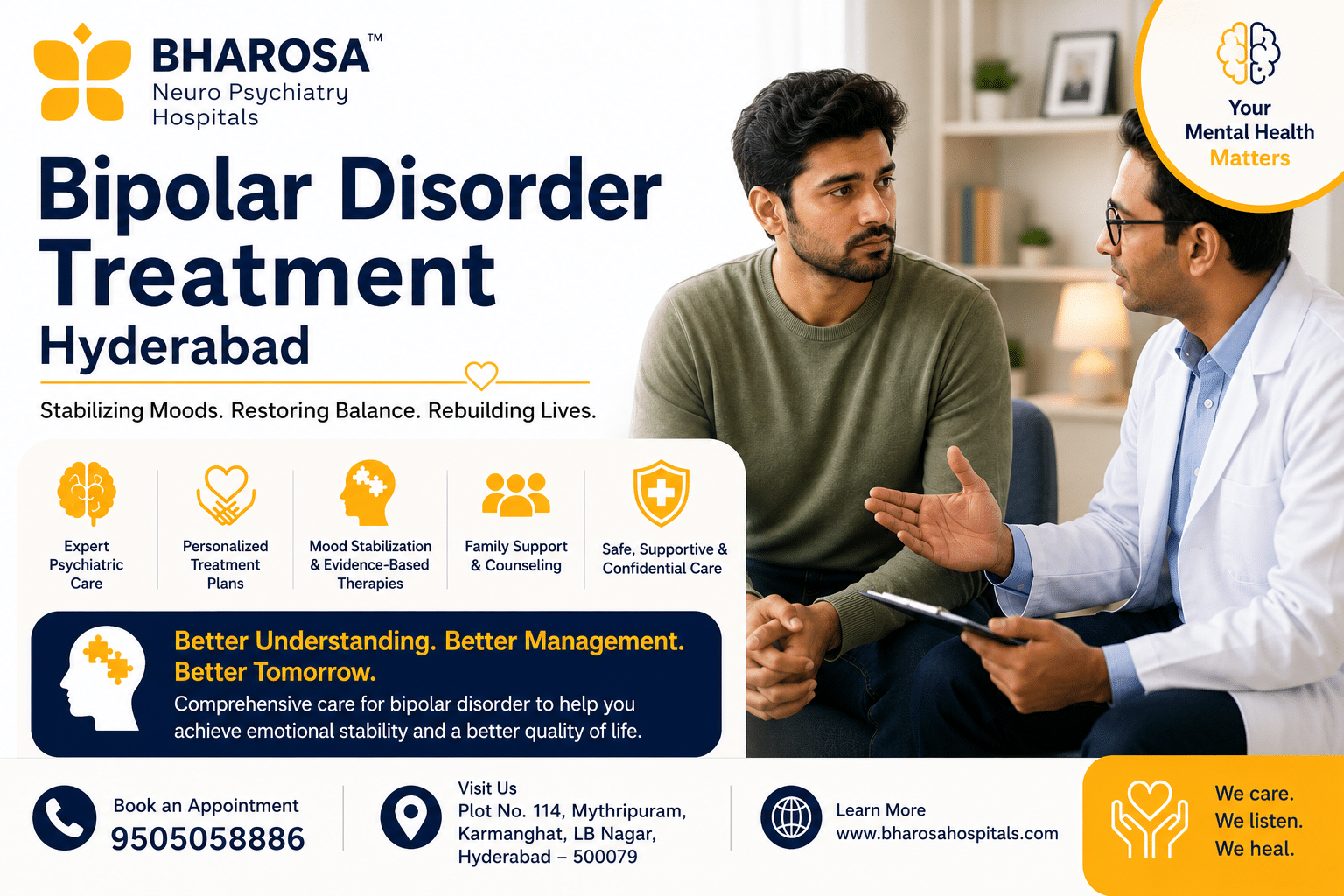
Bipolar disorder is a serious, complex, and lifelong neurological condition — but it is also one of the most manageable psychiatric conditions when treated with the precision, consistency, and comprehensive support that effective care requires. The challenge is not the treatability of bipolar disorder — it is ensuring that treatment is thorough enough, sustained enough, and personalised enough to produce genuine, lasting stability. This complete recovery guide to Bipolar Disorder Treatment Hyderabad at Bharosa Neuro Psychiatry Hospital covers every dimension of the treatment and recovery process — from accurate diagnosis through pharmacological management, psychotherapy, family support, lifestyle management, and long-term maintenance — so that patients and families have the complete clinical picture they need to engage confidently with treatment.
Step 1: Accurate Diagnosis — The Foundation of Effective Treatment
The most important first step in Bipolar Disorder Treatment Hyderabad is diagnosis that is accurate — not approximate. Bipolar disorder is frequently misdiagnosed as unipolar depression (missing the hypomanic or manic episodes), ADHD (given the impulsivity and distractibility overlap), or borderline personality disorder (given the emotional dysregulation overlap). Each misdiagnosis leads to a treatment approach that is at best ineffective and at worst harmful — antidepressants prescribed for unipolar depression can trigger mania in a bipolar patient.
At Bharosa Hospitals, diagnostic assessment for bipolar disorder includes a detailed longitudinal mood history, structured mood charting where indicated, family history evaluation, physical investigations to rule out medical causes, and standardised diagnostic instruments. The precision of this diagnostic process is the foundation on which all subsequent treatment decisions are built.
Step 2: Mood Stabilisation — The Pharmacological Core
Pharmacological mood stabilisation is the biological core of Bipolar Disorder Treatment Hyderabad. Bharosa Hospitals' psychiatrists use the most evidence-based agents available:
Lithium: The Gold Standard
Lithium has the most robust evidence base of any mood stabiliser — with clinical data spanning over 60 years demonstrating effectiveness in preventing both manic and depressive episodes, and unique antisuicidal properties not shared by other mood stabilisers. At Bharosa Hospitals, lithium is initiated carefully, with baseline and ongoing blood level monitoring and renal and thyroid function testing to ensure safety and optimal efficacy.
Valproate: For Mania and Mixed States
Sodium valproate is particularly effective for rapid cycling bipolar disorder and mixed states — presentations where lithium alone may be insufficient. Regular liver function and blood count monitoring is conducted throughout valproate treatment.
Lamotrigine: For Bipolar Depression
Lamotrigine is the most effective mood stabiliser for preventing the depressive episodes of bipolar disorder — often the most disabling phase. Its titration must be careful and gradual to minimise the risk of serious skin reactions, and Bharosa's psychiatrists manage this process with the vigilance it requires.
Atypical Antipsychotics: For Acute Episodes and Maintenance
Several atypical antipsychotics have established efficacy for acute mania, bipolar depression, and long-term maintenance. Bharosa's psychiatrists select from this range based on the patient's specific subtype, symptom pattern, comorbidities, and individual tolerability.
Step 3: Psychotherapy — Building the Psychological Stability Foundation
Medication stabilises the neurobiological substrate of bipolar disorder. Psychotherapy builds the psychological and behavioural structures that protect against relapse and enable full functional recovery. Bipolar Disorder Treatment Hyderabad at Bharosa Hospitals integrates three specific, evidence-based psychotherapies for bipolar disorder:
Psychoeducation: Understanding as Treatment
Structured psychoeducation — helping patients and families understand the neuroscience of bipolar disorder, the rationale for medication, the personal early warning signs of mood episodes, and the lifestyle factors that influence mood stability — is one of the most robustly evidence-based interventions in bipolar disorder. Patients who are well-educated about their condition make better treatment decisions and achieve longer periods of stability.
IPSRT: Interpersonal and Social Rhythm Therapy
- IPSRT directly addresses two of the most powerful triggers for bipolar episodes — interpersonal stressors and disruption to daily social rhythms. By stabilising daily routines (sleep-wake cycle, meal times, activity levels, social engagement), IPSRT provides a neurobiological mood regulation tool that complements pharmacological treatment.
CBT for Bipolar Disorder: Addressing the Cognitive Dimensions
CBT for bipolar disorder targets the cognitive patterns specific to each phase — the grandiosity and impulsivity that escalate mania, and the hopelessness and negative self-evaluation that deepen depression. Patients also learn to identify their personal prodromal signs and initiate a pre-agreed clinical response before full episodes develop.
Step 4: Family Therapy — Protecting the Relational Environment
Family expressed emotion — the level of criticism, hostility, or emotional overprotection in the family environment — is one of the most strongly evidenced predictors of bipolar relapse. Family therapy at Bharosa Hospitals as part of Bipolar Disorder Treatment Hyderabad reduces expressed emotion, educates families about the condition and its management, improves communication and boundary-setting, and equips family members to participate actively and constructively in early warning sign monitoring.
Step 5: Lifestyle Management — The Daily Protective Factors
Lifestyle factors have a direct neurobiological impact on mood stability in bipolar disorder, and their management is a formal component of Bipolar Disorder Treatment Hyderabad at Bharosa Hospitals:
- Sleep consistency — irregular sleep is one of the most potent mania triggers; maintaining strict sleep-wake times is clinically protective
- Alcohol and substance avoidance — substances destabilise mood and interfere with medication efficacy
- Stress management — chronic stress raises cortisol, which disrupts mood regulation
- Physical exercise — regular moderate exercise stabilises mood and improves medication tolerability
- Caffeine moderation — high caffeine intake can worsen sleep quality and contribute to mood instability
Step 6: Long-Term Maintenance — The Commitment That Protects the Future
Long-term recovery from bipolar disorder is sustained through maintenance treatment — medication continued beyond the resolution of acute episodes, regular psychiatric reviews, ongoing psychotherapy or booster sessions, and continued lifestyle management. Bipolar Disorder Treatment Hyderabad at Bharosa Hospitals includes a structured long-term maintenance programme with flexible follow-up scheduling, rapid access for early warning signs, and open-door access to the clinical team at any point in the ongoing recovery journey.
Frequently Asked Questions
Q: How long does bipolar disorder treatment take before I feel stable?
A: Initial mood stabilisation following an acute episode typically occurs within 4 to 8 weeks of appropriate pharmacological treatment. Full functional stability — with reliable protection against future episodes — develops over 3 to 6 months of consistent medication and psychotherapy. Long-term maintenance continues beyond this to sustain stability.
Q: Can women with bipolar disorder safely have children?
A: Yes, with careful perinatal psychiatric planning. Pregnancy and the postpartum period require specific adjustments to the medication regimen and close monitoring, as hormonal changes significantly affect mood stability. Bharosa Hospitals provides specialist perinatal psychiatric care for women with bipolar disorder planning pregnancy or in the postpartum period.
Q: What should I do if I notice early warning signs of a manic episode in a family member?
A: Contact Bharosa Hospitals immediately at +91 95050 58887. Early intervention at the prodromal stage — before a full manic episode has developed — is significantly more effective than crisis management after escalation. Our team can assess urgency and advise on immediate steps within the same contact.
Q: Is it safe to stop bipolar disorder medication if I feel completely well?
A: No. Feeling well on medication is evidence that the treatment is working — not that it is no longer needed. Stopping mood stabilisers abruptly is one of the most common triggers of acute manic relapse in bipolar disorder. Any change to medication must be made collaboratively with your treating psychiatrist at Bharosa Hospitals, never unilaterally.
Q: Does Bharosa Hospitals provide bipolar disorder treatment for adolescents?
A: Yes. Bipolar disorder frequently first emerges in adolescence. Bharosa Hospitals' Department of Child and Adolescent Psychiatry provides developmentally appropriate bipolar disorder assessment and treatment for young patients, using age-appropriate medication protocols and family-centred psychotherapy.