
How RTMS Treatment in Hyderabad Helps Treatment-Resistant Depression | Bharosa Hospitals
For many people living with depression or anxiety, standard treatment, antidepressant medication combined with therapy, brings real relief. But for a meaningful percentage of patients, symptoms persist even after trying multiple medications at the right dose for the right length of time. This is known as treatment-resistant depression, and it can leave patients and families feeling like they have run out of options. This is where
RTMS Treatment in Hyderabad: A Non-Invasive Solution for Depression and Anxiety has become an increasingly important part of modern psychiatric care, offering renewed hope without the need for surgery, anaesthesia, or systemic medication.
What Is rTMS?
Repetitive Transcranial Magnetic Stimulation, or rTMS, is a non-invasive, FDA-approved treatment that uses focused magnetic pulses to stimulate specific regions of the brain associated with mood regulation, particularly the left dorsolateral prefrontal cortex, an area that tends to be underactive in people with depression.
Unlike ECT, rTMS does not require anaesthesia, does not induce a seizure, and does not cause memory loss. Patients remain fully awake and alert throughout the session, can drive themselves home afterward, and can typically resume daily activities immediately.
How RTMS Treatment in Hyderabad Works
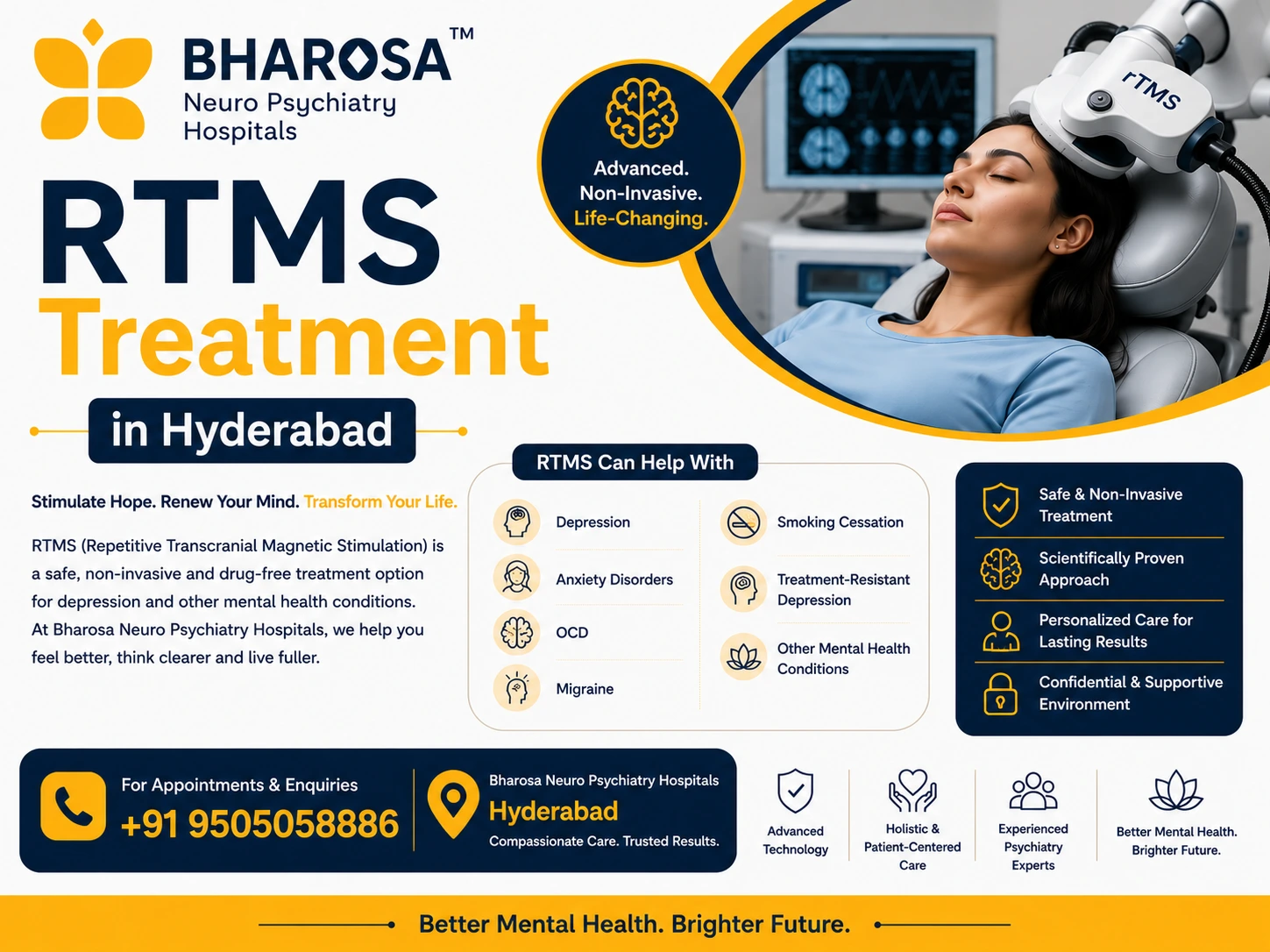
During a session, the patient sits comfortably in a chair while a magnetic coil is placed gently against the scalp, over the targeted area of the brain. The device delivers repeated magnetic pulses in a specific pattern, similar in strength to an MRI machine, which pass painlessly through the skull and stimulate underactive neural circuits.
- Each session typically lasts between 20 and 40 minutes.
- A full course usually involves daily sessions, five days a week, for about 4 to 6 weeks.
- Most patients feel a tapping sensation on the scalp during the pulses, which becomes more tolerable after the first couple of sessions.
- There is no downtime — patients can return to work, driving, or normal routines right after each session.
Who Benefits Most from rTMS?
rTMS is especially valuable for patients who fall into one or more of these categories:
- Those diagnosed with treatment-resistant depression, meaning depression that has not responded adequately to at least two different antidepressant trials.
- Patients who experience intolerable side effects from antidepressant medications, such as weight gain, sexual dysfunction, or sedation.
- Individuals who prefer to avoid systemic medication altogether, including some pregnant or breastfeeding women, after discussion with their psychiatrist.
- People struggling with co-occurring anxiety symptoms alongside depression, since rTMS protocols can be adjusted to target anxiety-related brain circuits as well.
- Patients seeking an alternative to ECT because of milder illness severity or a preference to avoid anaesthesia.
rTMS vs Medication vs ECT: Where It Fits
It helps to understand where rTMS sits on the spectrum of psychiatric treatment. Medication and psychotherapy remain the first-line approach for most patients with depression and anxiety. When these do not produce sufficient improvement, rTMS offers a non-invasive next step before considering more intensive interventions.
ECT, by comparison, is generally reserved for more severe, urgent, or psychotic depression, where a faster and more powerful response is needed, and it requires anaesthesia. rTMS, in contrast, is better suited to patients who are medically stable but have not responded well enough to medication, and who want a treatment with a strong safety profile and no effect on memory or daily functioning.
Safety and Side Effects
rTMS has one of the strongest safety profiles among modern psychiatric interventions. The most common side effects are mild scalp discomfort or a temporary headache during or shortly after a session, both of which usually improve within the first week of treatment. Serious side effects, such as seizures, are extremely rare and are further minimised through careful patient screening beforehand, including a review of any personal or family history of seizure disorders.
Because there is no anaesthesia and no systemic medication involved, rTMS avoids many of the side effects associated with antidepressants and does not carry the memory-related risks sometimes seen with ECT.
The Bharosa Hospitals Approach to rTMS
At Bharosa Neuro Psychiatry Hospital, rTMS is offered as part of a comprehensive, psychiatrist-led treatment plan rather than a standalone gadget-based fix. Every patient undergoes a detailed clinical evaluation to confirm that rTMS is the right fit, followed by individualised mapping of the stimulation site to maximise effectiveness.
Sessions are conducted under the supervision of trained psychiatric staff, with progress reviewed regularly using standardised mood and anxiety assessments. rTMS is combined with ongoing psychotherapy, lifestyle counselling, and family support where appropriate, in keeping with the hospital's holistic, structured approach to recovery from mood and anxiety disorders.
What Results Can You Expect?
Improvement with rTMS tends to be gradual rather than immediate. Many patients begin noticing subtle changes in mood, motivation, and sleep by the second or third week of treatment, with more substantial improvement by the end of the full course. Response rates in patients with treatment-resistant depression are encouraging, and a meaningful proportion experience significant symptom relief, with some achieving full remission.
As with any psychiatric treatment, results vary from person to person, which is why ongoing monitoring and follow-up care are built into the treatment plan at every stage.
Frequently Asked Questions
Q: Does rTMS hurt?
A: Most patients describe a tapping or knocking sensation on the scalp rather than pain. It is generally well tolerated and becomes easier to sit through after the first one or two sessions.
Q: How soon will I feel better with rTMS?
A: Some patients notice early changes within two to three weeks, though full benefits usually develop over the complete 4 to 6 week course of daily sessions.
Q: Can rTMS be combined with medication?
A: Yes. Most patients continue their prescribed antidepressants alongside rTMS unless their psychiatrist advises otherwise. The two approaches often work well together.
Q: Is rTMS safe for anxiety as well as depression?
A: Yes. rTMS protocols can be tailored to target brain regions linked to anxiety, and it is increasingly used for anxiety disorders alongside depression.
Q: Do I need to be hospitalised for rTMS?
A: No. rTMS is typically done on an outpatient basis. Patients can walk in for their session and return to normal activities immediately afterward.
Hospital Address & Contact
Bharosa Neuro Psychiatry Hospital & Rehabilitation Center
Plot No. 114, Mythripuram, Karmanghat, Opposite TKR College Comman (TKR Kamaan), Main Road, LB Nagar / Karmanghat, Hyderabad – 500079, Telangana
Phone : +91 95050 58886