RTMS for Depression Without Medicines | Bharosa Hospitals
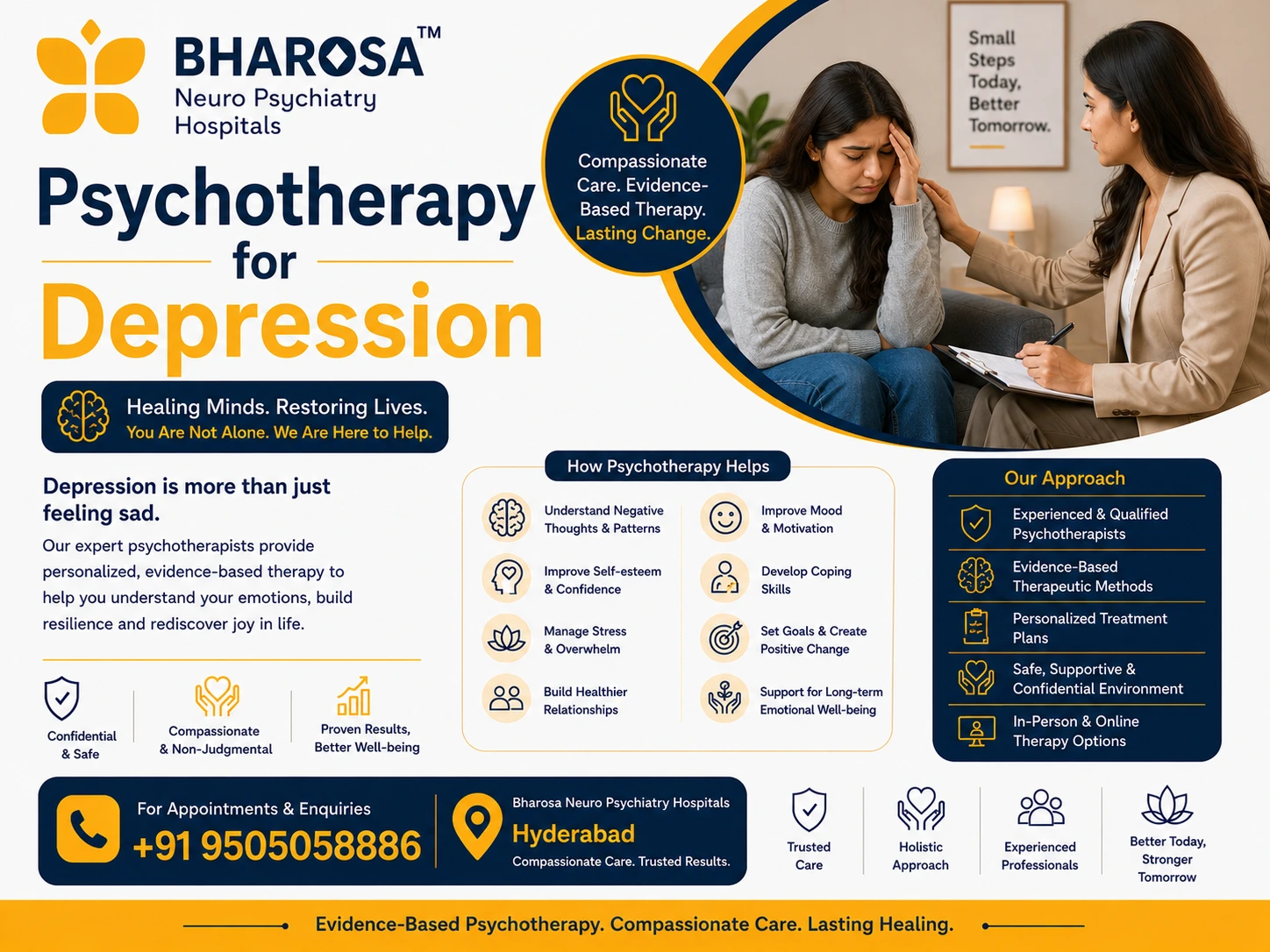
For millions of people living with depression, the idea of taking medication indefinitely — with its attendant side effects, dependencies, and social stigma — is one of the greatest barriers to seeking treatment. "Is there any way to treat my depression without medicines?" is one of the most common questions asked by patients and families at Bharosa Hospitals. The answer, increasingly, is yes. The combination of rTMS (Repetitive Transcranial Magnetic Stimulation) and expert Psychotherapy for Depression offers a powerful, evidence-based, medication-free path to genuine relief from depression for many patients — including those who have not responded to antidepressant medications.
Bharosa Neuro Psychiatry Hospital in LB Nagar, Hyderabad, is at the forefront of integrated, non-pharmacological depression treatment — combining rTMS brain stimulation technology with the full spectrum of evidence-based psychotherapeutic modalities to deliver lasting relief without the systemic effects of medication.
Clinical Evidence: rTMS combined with psychotherapy for depression produces response rates of 60–70% in treatment-resistant depression — significantly exceeding medication alone — without anaesthesia, hospitalisation, or systemic side effects. (American Psychiatric Association, 2024)
Why Do Some Patients Prefer Depression Treatment Without Medication?
The preference for non-pharmacological depression treatment is not simply about avoiding side effects — it reflects a range of legitimate clinical, personal, and practical considerations:
- Medication Side Effects: Weight gain, sexual dysfunction, emotional blunting, gastrointestinal disturbances, sleep disruption, and dry mouth are among the most commonly reported antidepressant side effects that lead patients to discontinue medication prematurely or avoid it altogether
- Medication Ineffectiveness: Approximately 30–40% of patients with major depressive disorder do not achieve adequate response to their first antidepressant trial, and up to 50% do not achieve remission after multiple medication trials — leaving a large population seeking effective alternatives
- Pregnancy and Breastfeeding: Concerns about medication exposure during pregnancy or breastfeeding make non-pharmacological treatment particularly important for women of reproductive age with depression
- Drug Interactions and Medical Conditions: Certain medical conditions and concurrent medications limit pharmacological options, making drug-free alternatives clinically necessary
- Personal Values and Preference: Some patients have a strong personal preference for non-medication approaches — a preference that deserves to be respected and accommodated with effective alternatives
- Long-Term Dependence Concerns: Concerns about long-term dependence on antidepressants — and difficulty discontinuing them after extended use — are a common and legitimate reason for seeking medication-free options
rTMS for Depression: How Magnetic Brain Stimulation Works Without Medication
Repetitive Transcranial Magnetic Stimulation (rTMS) is an FDA-cleared, non-invasive neuromodulation treatment that delivers focused magnetic pulses through a coil placed gently on the scalp — stimulating specific neural circuits in the brain that are underactive in depression without any drugs, anaesthesia, or surgery.
The primary target for depression rTMS is the left dorsolateral prefrontal cortex (DLPFC) — a region consistently found to be hypoactive in major depressive disorder. By delivering high-frequency magnetic pulses to this area, rTMS activates and 'normalises' these underperforming circuits, triggering the release of neurotransmitters including serotonin and dopamine and producing downstream changes throughout the depression-related neural network.
- No anaesthesia required — patients remain fully conscious and alert throughout each session
- No systemic medication — the magnetic stimulation acts directly on the targeted brain region without affecting any other organ system
- No hospitalisation — treatment is entirely outpatient; patients drive themselves home immediately after each session
- No cognitive side effects — rTMS does not impair memory, concentration, or cognitive function
- No withdrawal effects — rTMS can be stopped at any time without tapering or withdrawal symptoms
Psychotherapy for Depression: The Psychological Engine of Lasting Recovery
While rTMS addresses the neurobiological dimension of depression, expert Psychotherapy for Depression addresses the psychological, behavioural, and relational dimensions — creating the most comprehensive and durable approach to depression treatment available without medication. At Bharosa, psychotherapy for depression includes:
1. Cognitive Behavioural Therapy (CBT) for Depression — The Gold Standard
CBT is the most extensively researched and validated psychotherapy for depression, with decades of randomised controlled trial evidence demonstrating its effectiveness in producing both acute symptom relief and long-term relapse prevention. CBT for depression targets three interconnected dimensions:
- Cognitive Restructuring: Identifying and challenging the negative automatic thoughts, depressogenic beliefs ('I am worthless,' 'nothing will ever change'), and cognitive distortions (all-or-nothing thinking, catastrophising, personalisation) that maintain depressive mood
- Behavioural Activation: Systematically re-engaging with activities that provide pleasure, mastery, or social connection — counteracting the withdrawal and inactivity that both result from and perpetuate depression
- Metacognitive Techniques: Addressing the rumination processes (repetitive, unhelpful thinking about problems, causes, and consequences) that are among the most powerful maintaining factors of depressive episodes
2. Mindfulness-Based Cognitive Therapy (MBCT) for Depression Relapse Prevention
MBCT is specifically designed for patients with recurrent depression — those who have experienced three or more depressive episodes and for whom the risk of relapse is substantial. By combining mindfulness meditation practices with CBT principles, MBCT teaches patients to recognise early warning signs of a depressive episode and respond with mindful awareness rather than the automatic ruminative patterns that typically escalate a low mood into a full depressive episode.
Research demonstrates that MBCT reduces relapse risk by up to 43% in patients with recurrent depression — making it one of the most powerful tools in Psychotherapy for Depression for long-term protection.
3. Behavioural Activation Therapy (BAT)
A structured, evidence-based component of depression treatment that directly targets the withdrawal and avoidance cycle maintaining depression — using activity scheduling, pleasant events planning, and values-based engagement to rebuild the rewarding daily routine that depression erodes. Behavioural activation alone has demonstrated effectiveness comparable to full CBT in mild to moderate depression.
4. Interpersonal Therapy (IPT) for Depression
Depression frequently occurs in the context of interpersonal difficulties — grief and loss, role transitions (new parenthood, retirement, divorce), interpersonal conflict, or social isolation. IPT focuses specifically on improving communication, resolving interpersonal difficulties, and building social support networks — addressing the relational dimension of depression that purely cognitive approaches may not fully reach.
5. Acceptance and Commitment Therapy (ACT) for Depression
ACT helps patients develop psychological flexibility — accepting the presence of depressive thoughts and feelings without being controlled by them, and committing to values-guided action regardless of how they feel in the moment. ACT is particularly valuable for chronic or treatment-resistant depression where the struggle against depressive experience itself becomes an additional source of suffering.
The Power of Combining rTMS with Psychotherapy for Depression
The most compelling case for combining rTMS with Psychotherapy for Depression comes from both neuroscience and clinical research. rTMS produces a window of enhanced neuroplasticity — a period during which the brain's newly stimulated prefrontal circuits are more responsive to psychological learning and change. Psychotherapy delivered during and after an rTMS course capitalises on this neuroplastic window, producing more robust and durable antidepressant effects than either treatment alone.
What to Expect: The Combined rTMS and Psychotherapy Journey at Bharosa
- Week 1–2: Comprehensive psychiatric and psychological assessment; rTMS mapping session; commencement of weekly CBT or MBCT sessions
- Week 3–6: Daily rTMS sessions (Mon–Fri) running concurrently with twice-weekly psychotherapy — leveraging the neuroplastic window created by each rTMS session
- Week 7–10: Consolidation phase — rTMS maintenance sessions (if indicated) combined with continued psychotherapy focusing on skill consolidation and relapse prevention planning
- Month 3 and beyond: Aftercare psychotherapy sessions; relapse prevention plan implementation; regular psychiatric review; booster rTMS course if and when needed
Who Is This Combined Approach Ideal For?
- Patients with moderate to severe depression who prefer medication-free treatment
- Patients who have not responded adequately to one or more antidepressants (treatment-resistant depression)
- Patients who have stopped antidepressants due to intolerable side effects
- Women with depression during pregnancy or the post-partum period (rTMS suitability assessed individually)
- Patients with recurrent depression seeking the strongest possible relapse prevention strategy
- Individuals with mild to moderate depression motivated to engage with a structured psychotherapy program
Depression without medication is not just possible — for many patients, it produces better long-term outcomes than medication alone. The combination of rTMS brain stimulation and expert Psychotherapy for Depression at Bharosa Neuro Psychiatry Hospital represents the most advanced, comprehensive, medication-free depression treatment available in Hyderabad. If you are looking for a genuinely effective path out of depression without relying on antidepressants, call us today.
Call Now for a Consultation: +91 9505058886
Frequently Asked Questions (FAQs)
Q: Can depression really be treated effectively without any medication?
A: Yes — for many patients. For mild to moderate depression, evidence-based psychotherapy (particularly CBT and MBCT) produces outcomes equivalent to medication with more durable long-term results. For moderate to severe and treatment-resistant depression, combining rTMS with psychotherapy provides a powerful medication-free option. Bharosa assesses each patient individually to determine the most appropriate approach.
Q: How many rTMS sessions are needed for depression treatment without medication?
A: A standard rTMS course for depression consists of 20–30 sessions delivered five days per week over 4–6 weeks. When combined with concurrent psychotherapy, this course produces effects that can be sustained for 6–12 months or longer. Maintenance rTMS sessions (monthly or as needed) and continued psychotherapy booster sessions help protect long-term recovery.
Q: Is Psychotherapy for Depression at Bharosa suitable for severe depression?
A: For severe depression, particularly with psychotic features, suicidal crisis, or inability to engage cognitively with therapy, pharmacological or biological treatment (medication or ECT) may be necessary as an initial stabilisation measure before psychotherapy can be effectively engaged. Our psychiatrists assess severity at the initial consultation and design the most appropriate treatment plan. Psychotherapy is available for mild, moderate, and stable severe depression.
Q: What is the difference between CBT and MBCT for depression?
A: CBT (Cognitive Behavioural Therapy) is primarily used for active, acute depressive episodes — targeting and restructuring the negative thoughts and avoidance behaviours maintaining depression. MBCT (Mindfulness-Based Cognitive Therapy) is primarily designed for patients in remission from recurrent depression — building mindfulness skills that protect against future relapse. At Bharosa, both are available and the most appropriate is recommended based on the patient's current presentation.
Q: Can I switch from medication to the rTMS and psychotherapy approach?
A: In many cases, yes — but this transition should always be managed carefully by a qualified psychiatrist rather than abruptly stopping medication independently. Bharosa's psychiatrists can guide a carefully managed transition from antidepressant medication to rTMS and psychotherapy, including appropriate tapering schedules and monitoring during the transition period.
Q: How do I access rTMS and Psychotherapy for Depression at Bharosa Hospitals?
A: Call or WhatsApp +91 9505058886 at any time, or visit our hospital at Plot No. 114, Mythripuram, Karmanghat, Opposite TKR College Comman, LB Nagar, Hyderabad – 500079. Our team will arrange a comprehensive psychiatric assessment to determine your suitability for rTMS, psychotherapy, or the combined approach, and guide your treatment journey from day one.
Hospital Address & Contact
Bharosa Neuro Psychiatry Hospital & Rehabilitation Center
Plot No. 114, Mythripuram, Karmanghat, Opposite TKR College Comman (TKR Kamaan),Main Road, LB Nagar / Karmanghat, Hyderabad – 500079, Telangana, India
Phone: +91 9505058886