
RTMS Treatment in Hyderabad: A Non-Invasive Solution for Depression and Anxiety | Bharosa Hospitals
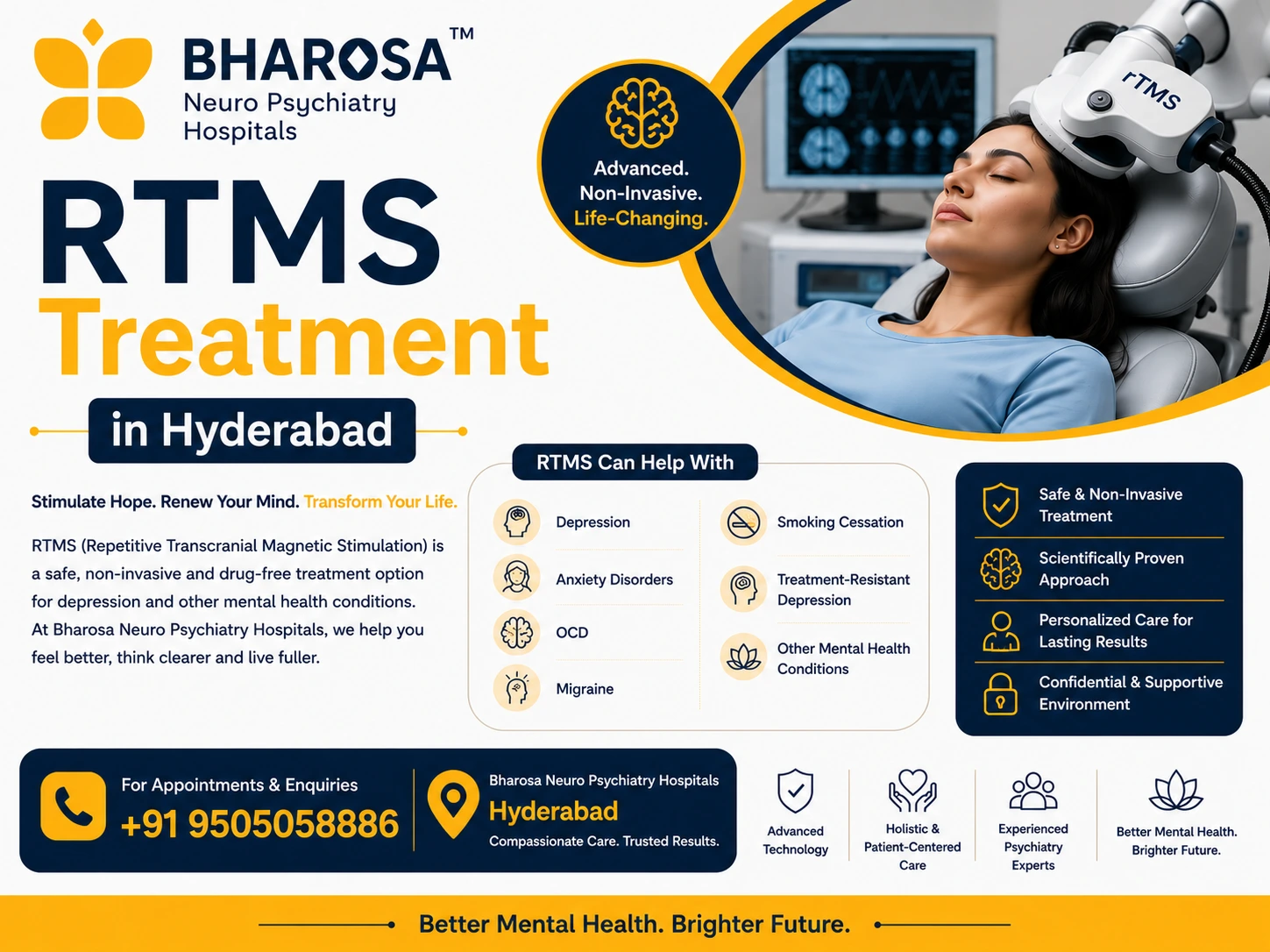
Imagine a treatment for depression and anxiety that requires no anaesthesia, no hospitalisation, no medications, and no downtime — one where you could sit comfortably in a chair for 30–40 minutes, receive treatment, and then drive yourself home and return to work. This is not a distant promise — this is the reality of Repetitive Transcranial Magnetic Stimulation (rTMS). As a leading provider of RTMS Treatment in Hyderabad, Bharosa Neuro Psychiatry Hospital offers this advanced, FDA-cleared neuromodulation therapy for patients with depression, anxiety, OCD, and other psychiatric conditions who have not achieved sufficient relief from medications alone.
rTMS represents a fundamental shift in psychiatric treatment — from systemic medications that affect the entire body to precisely targeted brain stimulation that directly activates the specific neural circuits that are underactive in depression and anxiety. It is one of the most significant advances in psychiatry in recent decades, and it is now available in Hyderabad at Bharosa Hospitals.
Medical Fact: rTMS is cleared by the US FDA and approved by major international psychiatric bodies including the American Psychiatric Association for the treatment of major depressive disorder unresponsive to antidepressant medication.
What Is rTMS? The Science of Magnetic Brain Stimulation
Repetitive Transcranial Magnetic Stimulation (RTMS Treatment in Hyderabad) is a non-invasive neuromodulation procedure that uses precisely calibrated, repetitive magnetic pulses — delivered through a specialised coil placed gently against the scalp — to stimulate or inhibit specific regions of the brain without surgery, anaesthesia, or any physical contact with brain tissue.
The physics of rTMS are elegant: a rapidly alternating magnetic field passes effortlessly through the skull and induces small electrical currents in the targeted cortical neurons, causing them to fire and producing downstream changes in neural circuit activity, neurotransmitter release, and synaptic connectivity.
How rTMS Works for Depression
The most established rTMS protocol for depression targets the left dorsolateral prefrontal cortex (DLPFC) — a region of the brain that is demonstrably underactive in major depressive disorder. High-frequency rTMS (10 Hz or 20 Hz) is applied to this area to activate and 'wake up' these hypoactive neural circuits, normalising the prefrontal activity that governs mood regulation, motivation, cognitive function, and emotional processing.
After a course of rTMS treatment, neuroimaging studies show measurable, lasting changes in DLPFC activity and connectivity — providing the neurobiological foundation for the clinical antidepressant effect that patients experience.
How rTMS Works for Anxiety and OCD
For anxiety disorders and OCD, rTMS protocols target different brain regions. Low-frequency (1 Hz) rTMS applied to the right DLPFC inhibits hyperactive anxiety circuits. For OCD, rTMS targeting the supplementary motor area (SMA) and the orbitofrontal cortex — regions implicated in the obsessive-compulsive neural loop — has demonstrated significant OCD symptom reduction in clinical trials.
Conditions Treated with RTMS Treatment in Hyderabad at Bharosa
Bharosa's RTMS Treatment in Hyderabad program offers evidence-based rTMS protocols for the following conditions:
1. Major Depressive Disorder (MDD) — Primary Indication
rTMS is specifically indicated for patients with MDD who have not responded adequately to one or more antidepressant medications — so-called treatment-resistant depression (TRD). Meta-analyses of randomised controlled trials consistently show response rates of 50–60% and remission rates of 30–35% in TRD — significantly exceeding the next medication trial in the same population.
rTMS is also valuable for patients who cannot tolerate antidepressant side effects, patients who cannot take medications due to medical conditions or pregnancy, and patients who wish to avoid systemic medication altogether.
2. Anxiety Disorders
Clinical evidence supports rTMS for generalised anxiety disorder (GAD), social anxiety disorder, and PTSD — with right-sided low-frequency protocols inhibiting the hyperactive right prefrontal anxiety circuits and producing clinically meaningful reductions in anxiety symptoms.
3. Obsessive-Compulsive Disorder (OCD)
Deep TMS targeting the medial prefrontal cortex and anterior cingulate cortex has received FDA clearance specifically for OCD, with clinical trials showing significant reduction in OCD symptom severity. At Bharosa, rTMS for OCD is offered in combination with ERP therapy for optimised outcomes.
4. Post-Traumatic Stress Disorder (PTSD)
rTMS protocols targeting both the DLPFC and other prefrontal-limbic circuits have demonstrated effectiveness for PTSD symptoms — reducing hyperarousal, intrusive symptoms, and emotional reactivity — and are offered at Bharosa as part of a comprehensive PTSD treatment program.
5. Bipolar Depression
rTMS offers a medication-free option for the depressive phase of bipolar disorder — particularly valuable for patients who are sensitive to antidepressant-induced mood switching or whose bipolar depression has not responded to mood stabiliser-based treatment.
6. Smoking Cessation
Emerging evidence and regulatory approvals in several countries support rTMS targeting specific prefrontal circuits for reducing nicotine cravings and supporting smoking cessation — representing an exciting expanding application of this technology.
The rTMS Treatment Process at Bharosa: What to Expect
A course of RTMS Treatment in Hyderabad at Bharosa is a straightforward, outpatient experience:
Session 1: Initial Mapping and Motor Threshold Determination
The first session involves 'mapping' — the clinician systematically places the rTMS coil over the motor cortex of the brain and delivers single pulses to identify the 'motor threshold' — the minimum magnetic intensity required to produce a visible finger twitch. This individual motor threshold is then used to precisely calibrate the stimulation intensity for all subsequent sessions, ensuring both safety and effectiveness.
Standard Treatment Sessions (Sessions 2 Onwards)
- The patient sits comfortably in a reclining chair — no anaesthesia, no sedation, fully awake throughout
- The rTMS coil is positioned precisely over the target brain region based on the initial mapping
- Repetitive magnetic pulses are delivered in trains — the patient may feel a gentle tapping or knocking sensation on the scalp during each pulse train
- Each session lasts approximately 20–40 minutes depending on the protocol (standard, accelerated, or deep TMS)
- No recovery time is needed — patients can drive immediately after the session and return to all normal activities
Course Duration
A standard rTMS course consists of 20–30 sessions delivered 5 days per week over 4–6 weeks. Accelerated protocols (multiple sessions per day) can compress treatment into shorter timeframes for patients who require more rapid response. Clinical response is typically first noticed between sessions 10–15, with the full therapeutic effect accumulating over the complete course.
Safety Profile of RTMS Treatment in Hyderabad
One of the most compelling attributes of RTMS Treatment in Hyderabad is its outstanding safety profile — making it accessible to patients for whom medications or ECT may not be appropriate:
- No anaesthesia required — accessible to patients with anaesthetic risk
- No systemic medication side effects — no weight gain, sexual dysfunction, gastrointestinal effects, or metabolic changes
- No cognitive or memory side effects — rTMS does not impair memory or cognitive function
- No seizure risk in standard protocols — safe for patients with seizure concerns (with appropriate screening)
- Safe in pregnancy — rTMS is being studied as a treatment option for perinatal depression where medication exposure is a concern
- Mild, temporary side effects limited to: mild scalp discomfort or headache during/immediately after sessions (resolves within minutes to hours), and occasional mild facial muscle twitching during pulse delivery
Combining rTMS with Psychotherapy: The Optimal Approach
The most powerful outcomes in rTMS treatment occur when magnetic brain stimulation is combined with concurrent psychotherapy — particularly CBT. The neurobiological changes induced by rTMS create a 'window of enhanced neuroplasticity' during which the brain is more responsive to psychological learning and therapeutic change. At Bharosa, rTMS is integrated with CBT, DBT, or other appropriate therapies as part of a comprehensive, personalised treatment plan.
rTMS represents a paradigm shift in psychiatric treatment — bringing precise, safe, non-invasive, and highly effective brain stimulation to patients who deserve more than the next medication trial. RTMS Treatment in Hyderabad at Bharosa Hospitals offers patients access to this revolutionary therapy within a comprehensive, expert psychiatric care framework. If depression, anxiety, OCD, or PTSD is limiting your life and standard treatments have not delivered the relief you deserve, rTMS may be the answer you have been searching for.
Call Now for an rTMS Consultation: +91 9505058886
Frequently Asked Questions (FAQs)
Q: Is RTMS Treatment in Hyderabad painful or uncomfortable?
A: rTMS is generally well-tolerated. During each magnetic pulse train, patients feel a gentle tapping or knocking sensation on the scalp — similar to someone lightly tapping the head with a finger. Some patients experience mild scalp sensitivity or a headache during or immediately after sessions, particularly in the first few sessions as they acclimatise. These sensations diminish significantly as treatment progresses. The vast majority of patients tolerate the full treatment course without significant discomfort.
Q: How quickly will I feel the effects of rTMS treatment?
A: Most patients begin to notice improvement in mood, energy, motivation, or anxiety levels between sessions 10–15 (typically after 2–3 weeks of daily treatment). The full therapeutic effect accumulates over the complete treatment course of 20–30 sessions. Some patients notice earlier improvement; others respond more gradually. Our clinical team monitors response throughout the course and adjusts protocols as needed.
Q: Can rTMS be combined with antidepressant medications?
A: Yes. rTMS can be safely combined with most antidepressant medications and mood stabilisers. In many cases, combining rTMS with medication produces superior outcomes compared to either treatment alone — as the two approaches complement each other through different mechanisms of action. Our psychiatrists will review your current medications and optimise the combined treatment approach.
Q: Who is NOT suitable for rTMS treatment?
A: rTMS is contraindicated for patients with metallic implants in or near the head (cochlear implants, deep brain stimulators, aneurysm clips, metal plates), as the magnetic field could displace these. Patients with a history of epilepsy require careful evaluation before rTMS. Our team conducts a thorough safety screening before beginning any rTMS course. For patients who are not suitable for rTMS, alternative treatments including ECT are available.
Q: How long do the benefits of rTMS last after completing the treatment course?
A: Clinical studies show that the antidepressant effects of rTMS are durable — with many patients maintaining response for 6–12 months or longer after a successful treatment course. When symptoms begin to return, a booster course of rTMS sessions (typically shorter than the initial course) can effectively restore remission. Maintenance rTMS is an established strategy for preventing relapse in treatment-resistant conditions.
Q: How do I book an rTMS assessment at Bharosa Hospitals?
A: Call or WhatsApp +91 9505058886 at any time, or visit our hospital at LB Nagar, Hyderabad. Our psychiatrists will conduct a comprehensive assessment to determine whether rTMS is appropriate for your specific situation — reviewing diagnosis, previous treatment history, and suitability. No referral is required.
Hospital Address & Contact
Bharosa Neuro Psychiatry Hospital & Rehabilitation Center
Plot No. 114, Mythripuram, Karmanghat, Opposite TKR College Comman (TKR Kamaan),Main Road, LB Nagar / Karmanghat, Hyderabad – 500079, Telangana, India
Phone: +91 9505058886