
How OCD Treatment Hyderabad Helps Patients Regain Control
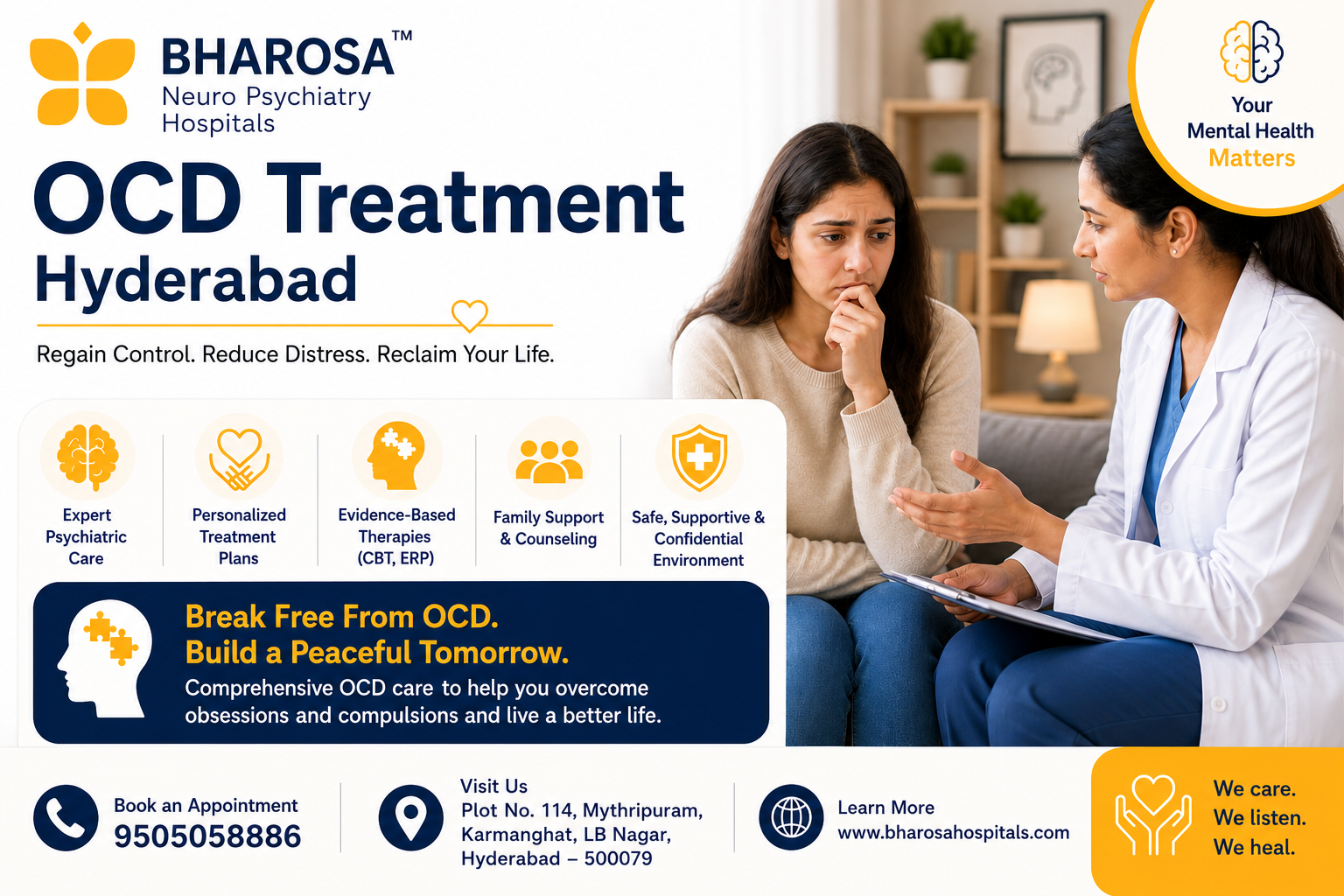
Obsessive-Compulsive Disorder (OCD) is far more than a preference for neatness or a quirky habit. It is a serious, often debilitating anxiety-related condition that traps individuals in relentless cycles of intrusive thoughts (obsessions) and repetitive behaviours (compulsions). At Bharosa Hospitals, our dedicated OCD Treatment Hyderabad programme is designed to help patients break free from these cycles and reclaim full, functional lives.
Understanding OCD: Obsessions and Compulsions
OCD is characterised by two core features:
- Obsessions: Unwanted, intrusive, and distressing thoughts, images, or urges. Common themes include contamination fears, fears of harming others, symmetry/order needs, and religious or sexual intrusive thoughts
- Compulsions: Repetitive behaviours or mental acts performed to neutralise the anxiety caused by obsessions — such as excessive handwashing, checking locks, counting, or repeating prayers
The cycle is self-perpetuating: the compulsion provides brief relief, which reinforces the behaviour, which strengthens the obsession. Without professional treatment, OCD typically worsens over time.
How Severe Can OCD Become?
OCD exists on a spectrum. Mild OCD may consume 1–2 hours per day. Severe OCD can be completely disabling — with patients unable to leave the house, complete basic tasks, or maintain relationships. OCD commonly co-exists with depression and anxiety, compounding the overall burden. Timely, specialised OCD Treatment Hyderabad is therefore essential.
The Gold-Standard Treatment: ERP Therapy
The most effective psychological treatment for OCD is Exposure and Response Prevention (ERP) therapy, a specialised form of CBT. ERP works by:
- Exposure: Gradually and systematically confronting feared situations or obsessive triggers — starting from less anxiety-provoking to more challenging ones
- Response Prevention: Resisting the compulsive behaviour in response to the obsession, allowing the anxiety to naturally decrease without performing the ritual
Over time, ERP rewires the brain's threat-response, reducing the power of obsessions and breaking the compulsion cycle. Multiple clinical trials confirm ERP as the most effective psychological treatment for OCD.
OCD Treatment at Bharosa Hospitals: A Comprehensive Approach
Bharosa Hospitals offers the most comprehensive OCD Treatment Hyderabad available, delivered by psychiatrists and clinical psychologists trained in evidence-based OCD interventions:
1. Thorough Diagnosis
A detailed psychiatric and psychological assessment determines OCD severity, subtypes (contamination, harm, symmetry, religious, etc.), and the presence of co-occurring conditions.
2. Exposure and Response Prevention (ERP)
Structured ERP therapy conducted by trained therapists forms the core of OCD treatment. The programme is personalised, progressing at a pace the patient can manage.
3. Cognitive Restructuring
Cognitive therapy addresses the distorted beliefs that fuel OCD — such as inflated responsibility, magical thinking, and overestimation of threat. Patients learn to appraise their obsessive thoughts more realistically.
4. Medication Management
SSRIs (selective serotonin reuptake inhibitors) such as fluvoxamine, sertraline, and fluoxetine are first-line medications for OCD. They reduce obsessive thought frequency and intensity, making ERP more effective. Clomipramine is used in treatment-resistant cases.
5. Family Education and Involvement
Family members often inadvertently enable OCD by providing reassurance or participating in rituals. Bharosa's family therapy component educates families on how to support recovery without accommodation.
6. Mindfulness-Based Approaches
Mindfulness helps patients observe obsessive thoughts without reacting to them, reducing their power and emotional grip over time.
Real Results: What Patients Experience
With consistent ERP and medication at Bharosa Hospitals, patients typically experience:
- Significant reduction in obsessive thoughts within 8–12 weeks
- Progressive ability to resist compulsions without severe anxiety
- Improved daily functioning, relationships, and self-esteem
- Restored sense of personal control and freedom
OCD is not a character weakness or something to simply "snap out of." It is a neurobiological condition that responds remarkably well to specialist care. The OCD Treatment Hyderabad team at Bharosa Hospitals combines ERP therapy, CBT, medication management, and family support in a personalised, compassionate programme. If OCD is controlling your life or a loved one's, it is time to take back control. Call +91 95050 58886 or visit bharosahospitals.com to begin your journey.
FAQs
Q: What makes OCD Treatment Hyderabad at Bharosa different from general therapy?
A: Bharosa's OCD programme is specifically designed around ERP therapy — the gold-standard treatment for OCD — delivered by specialists trained in OCD psychology. This differs from general counselling, which may not use the most effective OCD-specific techniques.
Q: How long does OCD treatment typically take?
A: Most patients undergoing ERP and medication see meaningful improvement within 12–20 therapy sessions over 3–5 months. More severe or chronic OCD may require longer treatment, which Bharosa's team will personalise.
Q: Is OCD a lifelong condition?
A: OCD can be a chronic condition, but with the right treatment, many patients achieve full remission or very significant symptom reduction. Maintenance strategies and occasional booster sessions can prevent relapse.
Q: Can children and adolescents receive OCD treatment at Bharosa?
A: Yes. Bharosa Hospitals has a Child Psychiatry department with experience treating OCD in younger patients using age-appropriate ERP techniques and family involvement.
Q: Does reassurance-seeking make OCD worse?
A: Yes. Seeking reassurance is a compulsion that temporarily reduces anxiety but reinforces the OCD cycle. A key part of ERP therapy involves reducing reassurance-seeking behaviour.
Q: Can OCD co-exist with other mental health conditions?
A: Yes. OCD frequently co-occurs with depression, generalised anxiety disorder, and body dysmorphic disorder. Bharosa's comprehensive psychiatric assessment identifies and treats all co-existing conditions simultaneously for better outcomes.