
Schizophrenia Hospital Hyderabad: What Families Should Know
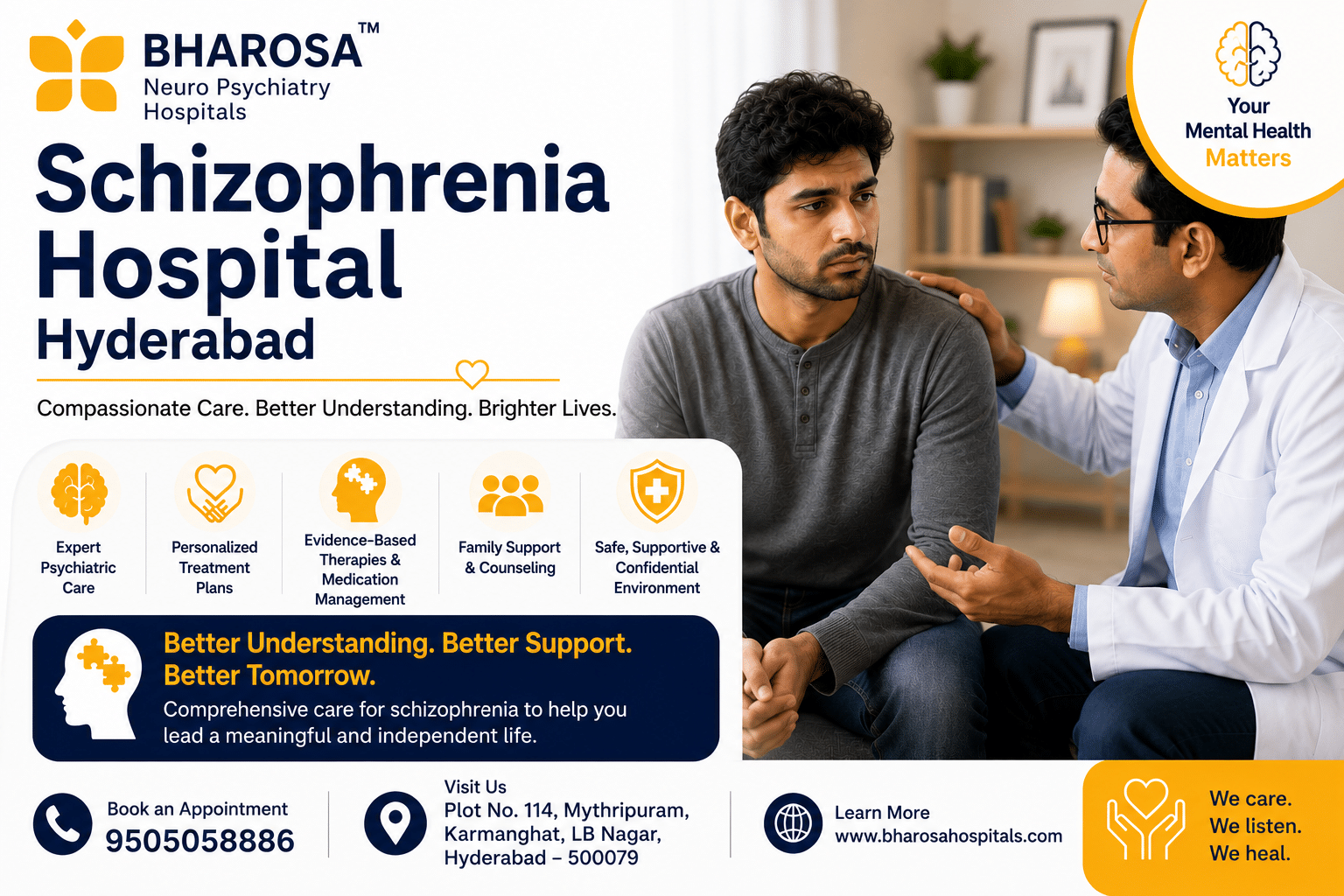
en a family member receives a diagnosis of schizophrenia, the family often experiences a profound disruption — a mixture of grief, fear, confusion, guilt, and desperate uncertainty about what to do. This blog is written specifically for those families — the parents, spouses, siblings, and children who are trying to understand what schizophrenia means, what treatment involves, and how they can best support their loved one through what lies ahead. At Bharosa Neuro Psychiatry Hospital, the leading Schizophrenia Hospital Hyderabad, we believe that informed, supported families are one of the most powerful determinants of recovery from schizophrenia. This guide addresses the questions that families most frequently bring to us — honestly, compassionately, and with the clinical depth that families deserve.
What Is Schizophrenia, and What Causes It?
Schizophrenia is a complex neuropsychiatric disorder characterised by a combination of positive symptoms (hallucinations, delusions, disorganised thinking), negative symptoms (flat affect, avolition, social withdrawal, alogia), and cognitive symptoms (impaired attention, memory, and executive function). It typically emerges in late adolescence or early adulthood and requires long-term treatment and support from a specialist Schizophrenia Hospital Hyderabad.
Schizophrenia arises from a complex interaction of genetic vulnerability, neurodevelopmental factors, and environmental stressors. No single gene causes it, and no single environmental factor determines its onset. Crucially, it is not caused by family dysfunction, poor parenting, or any failure on the part of the patient or family. Families who feel guilt for their loved one's schizophrenia are carrying a burden they do not deserve.
What Families Should Understand About Insight and Anosognosia
One of the most challenging aspects of supporting a loved one with schizophrenia — and one of the most important things that families learn from the Schizophrenia Hospital Hyderabad psychoeducation programme — is the concept of anosognosia. Anosognosia is a neurological condition — not stubbornness or denial — in which the illness itself impairs the person's ability to recognise that they are unwell. When a family member with schizophrenia insists that nothing is wrong with them and refuses to accept treatment, this is frequently a symptom of the condition itself, not a deliberate choice.
Understanding anosognosia transforms how families approach the conversation about treatment — replacing frustrated confrontation with the compassionate, non-argumentative persistence that is most effective in encouraging eventual engagement with care.
What Families Should Know About Treatment
Treatment at Bharosa Schizophrenia Hospital Hyderabad is comprehensive — addressing the biological, psychological, social, and functional dimensions of schizophrenia. Families should understand the following about the treatment their loved one will receive:
Antipsychotic Medication: The Non-Negotiable Core
Antipsychotic medication is the foundation of schizophrenia treatment — without it, positive symptoms (hallucinations, delusions) cannot be reliably controlled. Medication refusal is one of the primary drivers of relapse, and families play a critical role in supporting consistent adherence. Long-acting injectable (LAI) antipsychotics — administered every 2 to 4 weeks rather than daily — are available for patients who struggle with oral medication consistency, dramatically reducing the adherence challenge.
Cognitive Remediation: Rebuilding Thinking Skills
The cognitive impairments of schizophrenia — memory, attention, processing speed — are a major driver of functional disability. Cognitive remediation therapy at Bharosa Hospitals systematically strengthens these domains, improving the patient's ability to manage daily life, maintain employment, and sustain relationships. Families often notice this improvement as the patient becoming more organised, reliable, and engaged.
Family Psychoeducation: Where Families Become Part of Treatment
Family psychoeducation at Bharosa Schizophrenia Hospital Hyderabad is a structured, multi-session programme that equips families with the knowledge and skills to support recovery effectively. Topics covered include the neuroscience of schizophrenia, the importance of medication adherence, communication strategies that reduce stress and tension in the home, early warning sign identification, and how to access rapid support when warning signs appear.
How Families Can Best Support Recovery
Research on schizophrenia recovery consistently identifies the following family behaviours as most supportive of long-term stability — and these are the behaviours that Bharosa Schizophrenia Hospital Hyderabad coaches families to develop:
- Low expressed emotion — reducing criticism, hostility, and emotional overinvolvement in the home environment
- Consistent, calm support for medication adherence without confrontation
- Learning and monitoring the patient's personal early warning signs
- Maintaining a structured, predictable home routine that supports mood and sleep stability
- Engaging with family therapy and psychoeducation — not as a luxury but as a clinical necessity
- Seeking support for themselves — family carers of people with schizophrenia face significant stress, and their own wellbeing matters
What Families Should Know About the Long Term
Recovery from schizophrenia is a long-term journey — and families need to approach it with long-term expectations. Bharosa Schizophrenia Hospital Hyderabad provides the sustained, continuous care that this journey requires: regular outpatient monitoring, rapid access for early warning signs, medication optimisation over time, and ongoing family support. Many patients with schizophrenia, with appropriate long-term support, achieve sustained functional recovery — maintaining employment, relationships, and independent living. This is the goal that Bharosa Hospitals works toward with every patient and every family.
Frequently Asked Questions
Q: What do I do if my family member with schizophrenia refuses all treatment?
A: Contact Bharosa schizophrenia hospital Hyderabad at +91 95050 58887. Our team can advise on communication strategies, the use of motivational approaches that may increase the person's willingness to engage, and in situations where safety is at immediate risk, the legal provisions that may apply. We also provide family consultation appointments to support you through this challenging situation.
Q: Is schizophrenia hereditary, and should other family members be monitored?
A: Schizophrenia has a significant genetic component — first-degree relatives have an elevated risk compared to the general population. However, genetic risk is not destiny. Bharosa Hospitals can advise on monitoring and early intervention for at-risk family members, particularly adolescents showing subtle changes in functioning, thinking, or social behaviour.
Q: Can a person with schizophrenia live independently?
A: Yes. Many patients with schizophrenia, with appropriate treatment, cognitive remediation, and vocational rehabilitation, achieve independent living. The timeline and extent of independence depend on the severity of the condition, the quality of treatment, and the level of family and social support available. Bharosa Hospitals' rehabilitation programme specifically targets independent living skills.
Q: How do I talk to other family members and children about a loved one's schizophrenia diagnosis?
A: Bharosa Hospitals' family psychoeducation programme includes guidance on communicating a schizophrenia diagnosis to other family members, including age-appropriate ways of explaining the condition to children. Contact +91 95050 58887 to discuss your specific family situation with our team.
Q: Is residential inpatient treatment at Bharosa schizophrenia hospital always necessary?
A: Not always. Patients with mild or stable schizophrenia can often be managed effectively in an outpatient setting. Inpatient residential treatment is recommended for acute psychotic episodes, when safety is a concern, when medication initiation requires close monitoring, or when the home environment cannot adequately support recovery. The appropriate level of care is determined through the initial clinical assessment.