
Why Long-Term Recovery Needs a Structured 100 Days Rehab Program Hyderabad
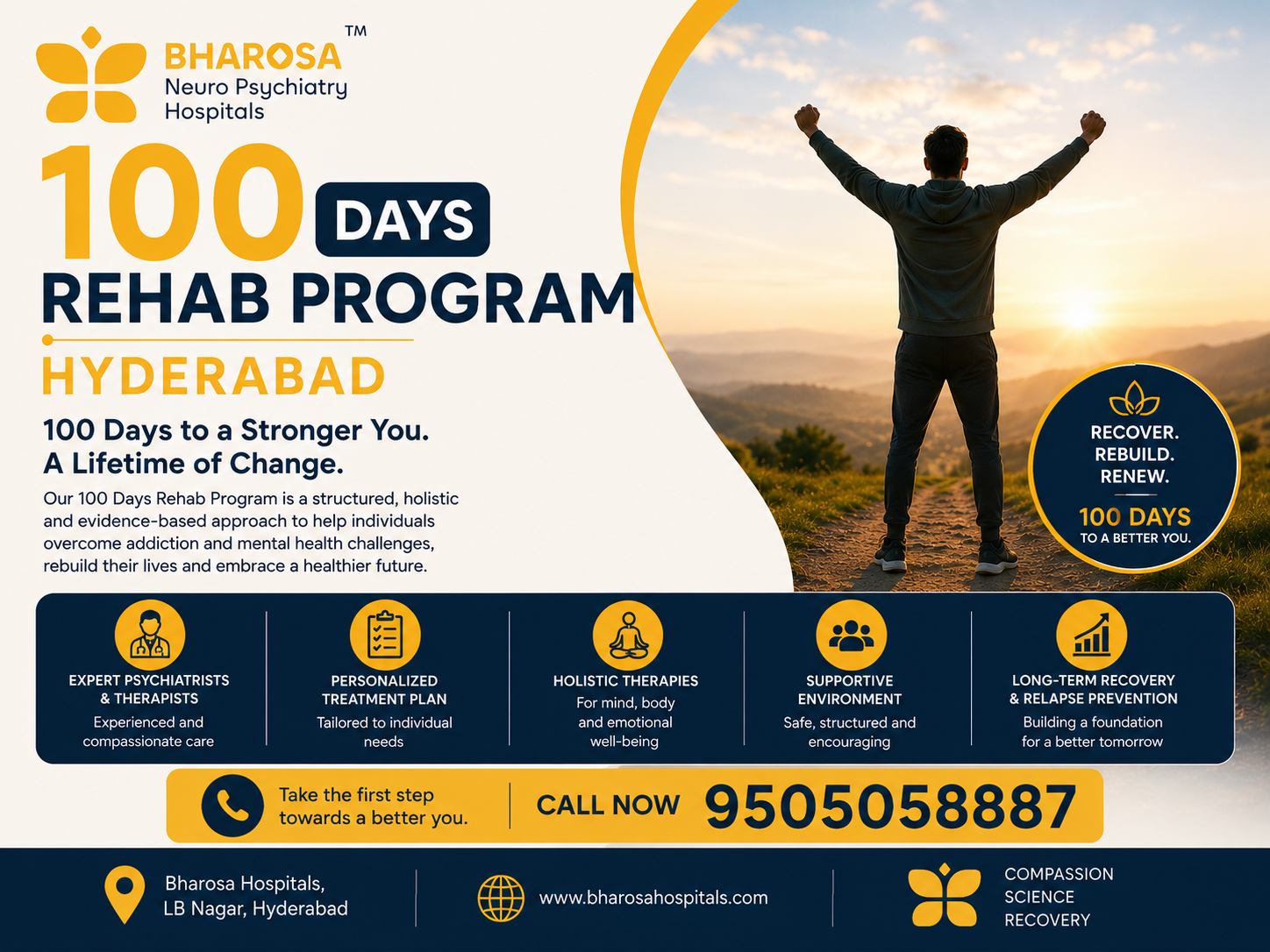
Recovery from addiction is not an event — it is a process. A complex, neurological, psychological, and social process that cannot be compressed into a week of detox or a month of supervised abstinence without sacrificing the depth and durability that genuine, lasting recovery requires. This is the core argument behind the 100 days Rehab Program Hyderabad at Bharosa Neuro Psychiatry Hospital — a structured, evidence-based, medically supervised programme designed not to stop addiction temporarily, but to create the conditions for it to end permanently.
In this blog, we examine why long-term recovery is neurologically incompatible with short programmes, what structure provides that willpower alone cannot, and how Bharosa Hospitals' 100-day model has become the most trusted rehabilitation pathway in Hyderabad.
The Neuroscience of Why Short Programmes Fail
To understand why a 100 days Rehab Program Hyderabad is necessary rather than optional, it is essential to understand what addiction does to the brain. Sustained substance use physically restructures key neural circuits: the reward system becomes calibrated to expect the substance for any sense of pleasure; the prefrontal cortex — responsible for decision-making, impulse control, and future planning — becomes progressively impaired; and the brain's stress response system becomes dysregulated, making ordinary challenges feel unbearable without chemical relief.
These changes do not reverse in 14 or 28 days. Neuroimaging studies confirm that the brain requires a minimum of 90 days of sustained abstinence and therapeutic engagement for measurable recovery in the circuits most damaged by addiction. A programme that discharges patients at 28 days is discharging them precisely when their brain is at its most neurologically vulnerable — with impaired decision-making, heightened craving reactivity, and minimal protective habit formation.
What 'Structure' Actually Means in Recovery
One of the most misunderstood elements of the 100 days Rehab Program Hyderabad is the word 'structured'. Many people assume this means rigid, institutional, or restrictive. In a therapeutic context, structure means something profoundly different: it means a deliberate, sequenced, medically supervised environment in which every element of the day — therapeutic, social, physical, and restorative — is designed to support the neurological and psychological healing process.
Structure in recovery provides what addiction has systematically destroyed: predictability, routine, purpose, and accountability. When a person's neural circuitry has been rewired around the unpredictability and euphoria of substance use, the regularity of a structured programme creates new neurological pathways — demonstrating through daily lived experience that life without substances can be meaningful, manageable, and even enjoyable.
Why Duration Matters: The Three Healing Timelines
Bharosa Hospitals' 100 day rehab program Hyderabad is calibrated to three distinct healing timelines that must all complete before lasting recovery is achievable:
Timeline 1: Neurochemical Rebalancing (Weeks 1–8)
During the first eight weeks of abstinence, the brain's dopamine and serotonin systems begin the slow process of restoring normal baseline function. Cravings remain intense and neurological reward sensitivity to natural pleasures remains blunted. This period requires the most intensive medical and psychological support — and it is precisely the period during which most short programmes discharge their patients.
Timeline 2: Pharmacological Optimisation (Weeks 4–12)
Psychiatric medications initiated or adjusted at admission — antidepressants, mood stabilisers, anti-craving agents — require 8 to 12 weeks of consistent administration to reach full therapeutic effectiveness. Discharging a patient before medications have reached their optimal level means they re-enter daily life with a brain that has not yet received the full protection the treatment plan intended.
Timeline 3: Habit and Identity Formation (Weeks 8–14)
New coping behaviours, emotional regulation skills, and sober social patterns require sustained daily practice before they become genuinely reliable neurological habits. Research on habit formation consistently indicates that complex behavioural changes require a minimum of 90 days of consistent practice to become stable. The final phase of the 100-day programme is where these habits are formed, tested, and embedded.
The Role of Professional Supervision Throughout
A critical distinction between the 100 days Rehab Program Hyderabad at Bharosa Hospitals and self-managed extended abstinence is the continuous presence of professional clinical oversight. Our multidisciplinary team — psychiatrists, psychologists, addiction counsellors, nurses, and holistic therapists — monitors each patient's progress weekly, adjusting treatment as needed. Setbacks are identified and addressed clinically rather than becoming triggers for relapse. Medication is optimised based on observed response. Therapeutic approaches are adapted when one modality is not producing the expected progress.
This responsiveness — the ability to adjust in real time based on clinical observation — is what professional supervision provides that no self-directed programme can replicate. Recovery is not linear, and the 100-day programme is designed to accommodate and therapeutically address the inevitable peaks and troughs of the healing process.
Dual Diagnosis: Treating What Was Driving the Addiction
One of the most important structural features of Bharosa's 100 day rehab program Hyderabad is its mandatory dual diagnosis approach. Research consistently demonstrates that 50 to 60% of patients with substance use disorders have an underlying psychiatric condition — most commonly depression, anxiety disorder, PTSD, or bipolar disorder — that was driving or sustaining the substance use. Treating addiction without treating this underlying condition does not address the root cause; it leaves the most powerful trigger for relapse completely unmanaged.
The 100-day programme provides sufficient time to accurately diagnose co-occurring psychiatric conditions, initiate and optimise appropriate psychiatric treatment, and ensure that both the addiction and its psychological foundation are addressed before the patient re-enters everyday life.
Family Involvement: Healing the Whole System
Long-term recovery does not happen in isolation — it happens within families, relationships, and communities. The 100 day rehab program Hyderabad formally integrates families through structured psychoeducation, family therapy sessions, and guided communication workshops that help loved ones understand the nature of addiction, identify and change enabling patterns, and rebuild the relational trust that addiction has damaged. Families who complete this process alongside their loved one's treatment become the most powerful protective factor against relapse in the months that follow.
Aftercare: The Programme Continues Beyond Discharge
Completing the 100 days Rehab Program Hyderabad at Bharosa Hospitals does not mark the end of support — it marks the beginning of the aftercare phase. Every patient leaves with a personalised aftercare plan covering scheduled outpatient follow-up appointments, continued individual or group therapy, a personalised relapse prevention plan identifying specific triggers and corresponding responses, vocational reintegration support where needed, and direct access to the clinical team for support during challenging moments in the post-discharge period.
Frequently Asked Questions
Q: Is a 100-day programme suitable for someone who has work or family responsibilities?
A: Yes. The 100-day programme is delivered in a residential format that provides comprehensive care within the hospital campus. For patients with significant work or family responsibilities, Bharosa Hospitals can discuss phased treatment approaches, including intensive outpatient options, during the initial assessment. In most cases, the investment of 100 days produces outcomes that make sustained professional and family functioning more — not less — achievable after treatment.
Q: What happens if a patient wants to leave the 100-day programme early?
A: Bharosa Hospitals works with patients and families to address any concerns that arise during treatment and to strongly encourage programme completion. In situations where early departure is unavoidable, a comprehensive stepped-down care plan is developed to minimise relapse risk and maintain therapeutic continuity. However, completing the full programme remains the strongest predictor of long-term recovery.
Q: How does the 100-day programme differ from standard rehabilitation programmes?
A: Standard programmes typically provide 7 to 28 days of care — primarily focused on detoxification and initial stabilisation. Bharosa's 100-day programme extends through neurochemical rebalancing, full medication optimisation, intensive psychotherapy, family therapy, habit formation, and structured reintegration preparation — addressing every dimension of recovery that shorter programmes cannot reach.
Q: Is the 100-day programme available for alcohol addiction specifically?
A: Yes. The 100-day programme is highly effective for alcohol dependence — addressing medically supervised detox, anti-craving medication management, psychological therapy, family involvement, and relapse prevention in a single integrated programme. Contact Bharosa Hospitals at +91 95050 58887 for a detailed alcohol-specific programme overview.
Q: Can the programme be started immediately, or is there a waiting period?
A: Bharosa Hospitals endeavours to offer admission as rapidly as clinically appropriate. Contact +91 95050 58887 or visit www.bharosahospitals.com to arrange a pre-admission assessment, which will determine the most appropriate admission timeline based on your specific clinical situation.