
Depression Treatment in Hyderabad
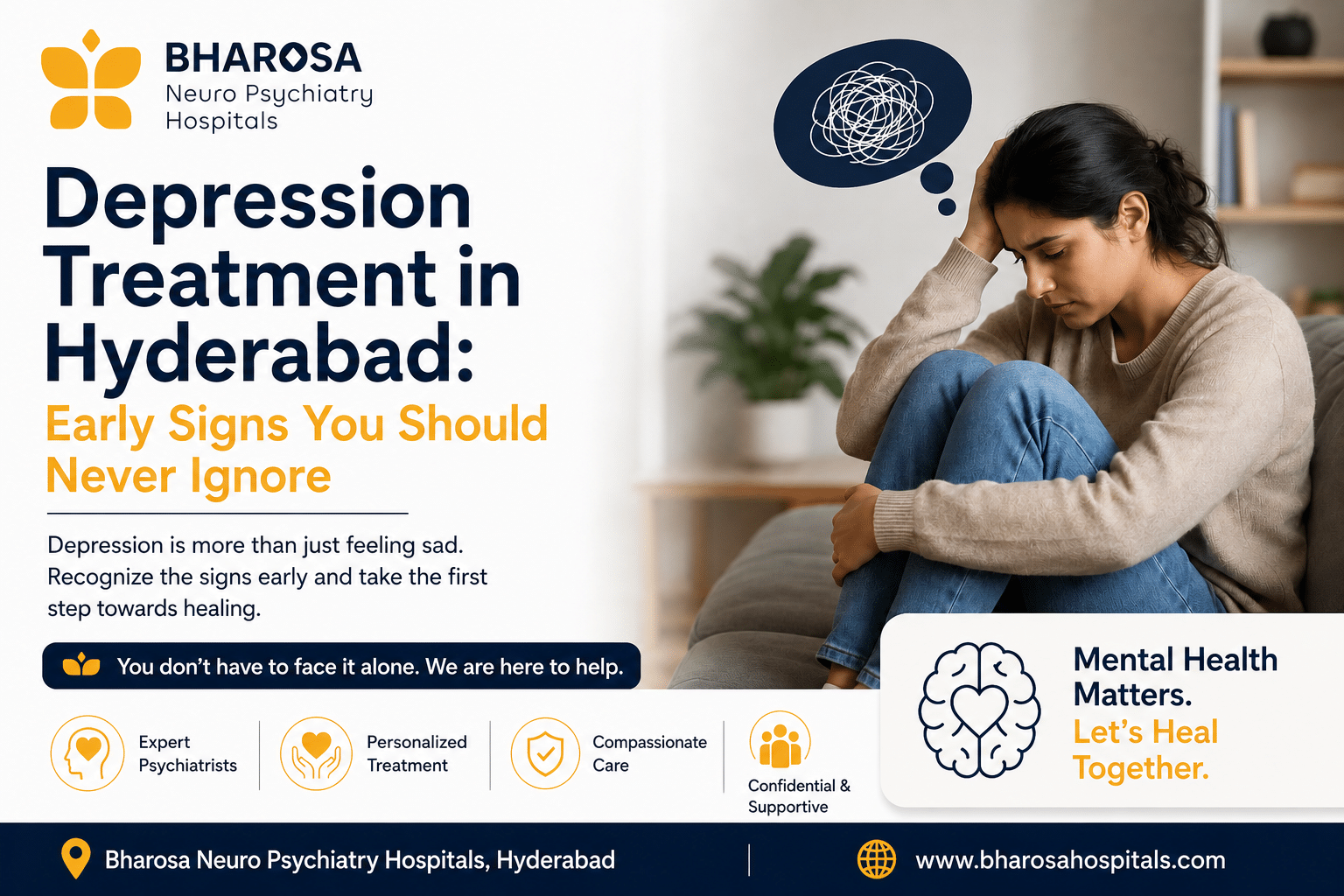
The point of using dummy text for your paragraph is that it has a more-oDepression is rarely dramatic in its early stages. It does not arrive with a sudden declaration — it creeps in quietly, disguising itself as tiredness, loss of enthusiasm, a phase of low energy, or simply 'not being yourself'. This gradual onset is one of the most dangerous features of depression, because it allows the condition to become deeply entrenched before most people recognise it as a medical issue requiring professional care.
At Bharosa Neuro Psychiatry Hospital, we specialise in evidence-based Depression Treatment in Hyderabad for patients at every stage of the illness — from the first subtle signs through to severe, treatment-resistant depression. This blog is designed to help you recognise the earliest indicators that professional support is needed — before depression deepens and becomes significantly harder to treat.
Why Early Recognition Matters
The relationship between depression and time is not neutral — it is adversarial. Untreated depression undergoes neurobiological progression: repeated depressive episodes cause measurable structural changes in the hippocampus, reduce neuroplasticity, and increase vulnerability to future episodes. Early Depression Treatment in Hyderabad — initiated within the first months of symptom onset — is significantly more effective, requires less intensive intervention, and has a substantially higher rate of full remission than treatment initiated after years of untreated illness. Early action is not just kinder — it is clinically superior.
Early Sign 1: Persistent Low Mood That Doesn't Lift
A key distinction between ordinary sadness and early depression is duration and responsiveness. Sadness is contextual — it responds to good news, a pleasant interaction, or a change of environment. Early depression produces a low mood that persists across days regardless of external circumstances — not dramatically low, but consistently grey, flat, and unresponsive. Many patients describe early depression as 'feeling nothing' rather than 'feeling sad' — an emotional blunting that strips ordinary experiences of colour and meaning.
Early Sign 2: Losing Interest in Things You Used to Enjoy
Anhedonia — the reduced capacity to experience pleasure from previously enjoyable activities — is one of the hallmark early signs of depression and a strong indicator that Depression Treatment in Hyderabad should be sought. The hobbies, social activities, creative pursuits, or physical activities that once provided genuine pleasure become effortful, pointless, or simply unappealing. This is not laziness or boredom — it is a neurobiological change in the brain's reward circuitry that cannot be resolved through motivation or discipline.
Early Sign 3: Sleep Changes That Won't Resolve
Sleep disturbance is one of the earliest and most reliable biological markers of depression. This may present as difficulty falling asleep despite exhaustion, frequent waking during the night, early morning waking (typically 2 to 4 hours before the intended time) with an inability to return to sleep, or — particularly in younger patients and those with atypical depression — sleeping significantly more than usual without feeling rested. Any persistent, unexplained change in sleep architecture warrants professional evaluation.
Early Sign 4: Unexplained Fatigue and Physical Heaviness
Early depression frequently manifests physically — a persistent, profound fatigue that is not relieved by sleep or rest, a heaviness in the limbs, and a general slowing of movement and thought. Patients describe feeling as though they are moving through water, or as though a weight is pressing them down. This is not laziness — it reflects the neurobiological reality of depression's impact on the body's energy regulation systems. When fatigue is disproportionate to activity level and does not resolve with rest, depression should be considered.
Early Sign 5: Difficulty Concentrating or Making Decisions
Cognitive slowing is a frequently overlooked early sign of depression — particularly in professional or academic contexts where its impact is felt keenly but attributed to other causes. Difficulty concentrating on tasks that previously required little effort, forgetting things that would normally be remembered easily, struggling to make decisions that should be straightforward, and a general sense of mental fog are all early cognitive markers of depression. If you have noticed unexplained cognitive changes alongside other signs on this list, early Depression Treatment in Hyderabad is strongly indicated.
Early Sign 6: Increased Irritability or Emotional Sensitivity
Depression does not always present as visible sadness — particularly in men, adolescents, and individuals in high-pressure environments. Increased irritability, a shortened fuse, emotional reactivity disproportionate to situations, and a sense of being overwhelmed by ordinary frustrations are common early presentations of depression that are frequently misattributed to stress, personality, or relationship problems. When irritability is accompanied by other signs on this list, depression is a probable underlying cause.
Early Sign 7: Withdrawing from Social Connection
Social withdrawal in early depression is a self-reinforcing cycle: depression makes social connection feel effortful or pointless, withdrawal removes the social support that buffers depression, and isolation deepens the depressive state. If you or someone you know has been gradually pulling back from friendships, family gatherings, social obligations, or even casual social interactions — particularly with no clear external reason — this is an early warning sign that Depression Treatment in Hyderabad should be sought before the withdrawal becomes more entrenched.
Early Sign 8: Negative Self-Talk and Disproportionate Self-Criticism
Early depression often announces itself in the quality of internal dialogue — a persistent inner critic that finds fault in everything the person does, catastrophises minor mistakes, attributes positive outcomes to luck rather than ability, and generally maintains a relentlessly negative narrative about the self, the world, and the future. These three negative themes — negative self, negative world, negative future — are what clinicians call the cognitive triad of depression, and they are present in some form even in the earliest stages of the condition.
When to Take Action
If three or more of these early signs have been present for more than two weeks, it is time to seek professional Depression Treatment in Hyderabad. You do not need to be at a crisis point to ask for help — in fact, seeking help before reaching crisis is precisely what leads to the best outcomes. Bharosa Neuro Psychiatry Hospital offers confidential, compassionate, evidence-based depression assessment and treatment for patients at every stage of the illness.
Frequently Asked Questions
Q: How is depression clinically different from going through a difficult life period?
A: A difficult life period produces sadness and struggle that is contextually linked and gradually resolves as circumstances improve or time passes. Clinical depression produces symptoms that persist regardless of circumstances, last more than two weeks, affect multiple areas of functioning, and do not respond to ordinary self-care or support. If your low mood meets these criteria, seek a clinical assessment.
Q: Can depression improve on its own without treatment?
A: Mild depression sometimes resolves with lifestyle changes, social support, and time. However, moderate to severe depression rarely resolves spontaneously and tends to worsen without treatment. Each untreated episode also increases vulnerability to future episodes. Early professional intervention at Bharosa Hospitals is always the safer, more effective choice.
Q: What does depression treatment at Bharosa Hospitals involve?
A: Depression treatment in Hyderabad at Bharosa involves a comprehensive psychiatric assessment followed by a personalised combination of evidence-based psychotherapy (CBT, MBCT, IPT), medication management where indicated, holistic therapies, lifestyle intervention, and family support — tailored to the specific type, severity, and context of your depression.
Q: Is depression treatment in Hyderabad at Bharosa Hospitals confidential?
A: Yes, absolutely. Every aspect of your assessment, diagnosis, and treatment at Bharosa Hospitals is protected by complete medical confidentiality. Your information will not be shared with employers, family members without consent, or any external party.
Q: Does Bharosa treat depression in young people and teenagers?
A: Yes. Bharosa Hospitals has a dedicated Department of Child and Adolescent Psychiatry providing age-appropriate depression assessment and treatment — including school-sensitive scheduling for outpatient therapy and family-inclusive treatment planning.
r-less normal distribution of letters. making it look like readable English.